Chinese expert warns of Tokyo's attempt to advance right-wing agenda, break through postwar constraints as Takaichi shows intention on constitution revision to enshrine SDF
By Published: Feb 03, 2026 02:44 PM

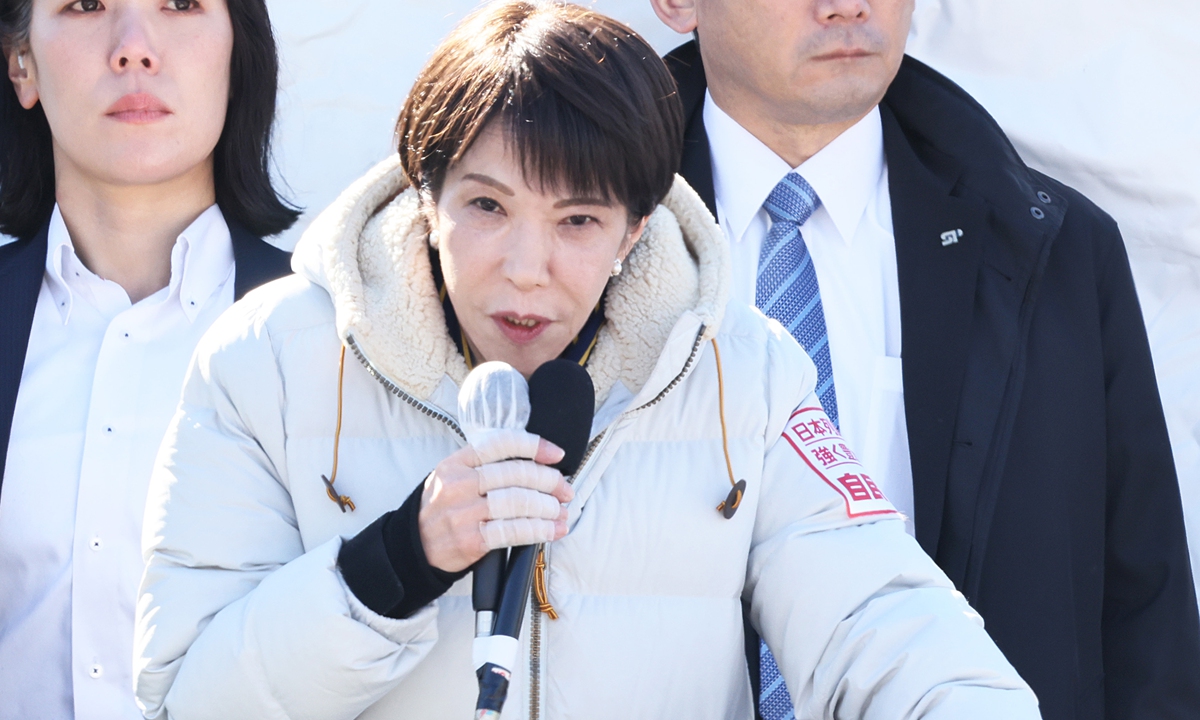
Japanese Prime Minister Sanae Takaichi, President of the Liberal Democratic Party (LDP), appeals for support during a street speech of the House of Representatives Election Campaign in Kofu City, Japan, on February 2, 2026. Photo: VCG
Japanese Prime Minister Sanae Takaichi once again voiced her dangerous intention to pursue constitutional revision that explicitly enshrines the Self-Defense Forces (SDF) during the ongoing House of Representatives election campaign on Monday, a move a Chinese expert says is aimed at consolidating personal power and at the same time paving the way for the long-term political agenda of the Japanese right wing. Expert also alerted that China and other Asian countries must remain vigilant against the risk that Japan's right-wing forces, driven by a distorted view of history, may exploit the amendment process to break through postwar international constraints, encroach upon military security boundaries, and undermine regional peace and stability.
The heated confrontations between Japan's ruling and opposition parties during their House of Representatives election campaign have become more pronounced, as Takaichi once again voiced on Monday her dangerous intention to pursue constitutional revision that explicitly enshrines the SDF - while Yoshihiko Noda, co-leader of the largest opposition party the Centrist Reform Alliance, reaffirmed the group's resolve to "build a country that never wages war again and is not drawn into conflict," according to media reports on Monday.
The Japanese prime minister further claimed that the constitutional revision process has completely stalled as the chair of the Diet's constitutional review committee is held by an opposition party member, Kyodo News reported. "We must break this deadlock," Takaichi claimed, according to Kyodo News. This, Nikkei Shimbun reported, indicates her view that the ruling coalition must increase its seats to secure the committee chairmanship and advance constitutional revision discussions.
Article 9 of the Japanese Constitution, which took effect in 1947 following Japan's defeat in the World War II, is a landmark "renunciation of war" clause. According to the clause, "the Japanese people forever renounce war as a sovereign right of the nation and the threat or use of force as means of settling international disputes. In order to accomplish the aim of the preceding paragraph, land, sea, and air forces, as well as other war potential, will never be maintained. The right of belligerency of the state will not be recognized." According to the official website of the Prime Minister of Japan, the country's current constitution does not mention the SDF.
Japanese Defense Ministry claimed on its website that "Under the framework of the Constitution, our country has consistently taken exclusive defense as the basic policy of national defense, maintained the Self-Defense Forces (SDF) as a combat-capable armed force, and continued to advance its development and conduct its relevant operations."
According to Nikkei Shimbun, initiating a constitutional amendment proposal requires approval by at least two-thirds of all members in both houses of the Diet. In the 2024 House of Representatives election, the Japanese ruling Liberal Democratic Party (LDP) suffered a major defeat, and even with the combined seats of "pro-amendment forces"—including the Japan Innovation Party and the Democratic Party for the People—they failed to secure a two-thirds majority.
Xiang Haoyu, a distinguished research fellow at the China Institute of International Studies, told the Global Times on Tuesday that constitutional revision has long been a fundamental policy goal of Japan's conservative forces, serving their pursuit of so-called "normal state" status for Japan.
By reiterating this during the election campaign, Takaichi aims to consolidate her personal power, seek a breakthrough for her political agenda—a continuation of the LDP's consistent stance over its 70-year history, Xiang said. While the amendment process currently faces some resistance, it already enjoys considerable political consensus within Japan, the expert added.
Nikkei Shimbun reported Monday that former Japanese Prime Minister Shinzo Abe, whom Takaichi regards as her "political mentor," also pursued constitutional revision during his second administration, proposing measures such as explicitly referencing the Self-Defense Forces in Article 9.
According to the report, in its campaign platform for the House of Representatives election this time, the LDP included a pledge to "carefully explain to the public four proposed constitutional amendments, including the explicit reference to the Self-Defense Forces."
"Although constitutional revision falls within Japan's domestic affairs, its spillover effects warrant attention. We must remain vigilant against the risk that Japan's right-wing forces, driven by a distorted view of history, may exploit the amendment process to break through postwar international constraints, encroach upon military security boundaries, and undermine regional peace and stability," Xiang said.
On January 27, campaigning began for the Japanese lower house election, set to take place on February 8, after Takaichi dissolved the lower house on January 23.
Takaichi's initiation of a snap election campaign for the House of Representatives on Tuesday — described by Japanese media as "an unusually early election at an unusual time" — has drawn domestic criticism.
In an exclusive interview with the Global Times on January 29, Takakage Fujita, secretary-general of the Association for Inheriting and Propagating the Murayama Statement, described the dissolution of the lower house and the election as "against public opinion." He believes that the move aims to consolidate the ruling foundation of the "anti-China, ultra-right " Takaichi administration and advance its path toward becoming a military power.
"The Takaichi administration is pushing forward ultra-reactionary politics that suppresses public opinion and democracy on all issues, with the ulterior motive of revising the pacifist Constitution," Fujita criticized.
RELATED ARTICLES