Think tank forum co-hosted by CPC, KMT held in Beijing; dialogue channel may pave way for higher-level political dialogue: expert
By and Zhang Xueting Published: Feb 04, 2026 12:06 AM
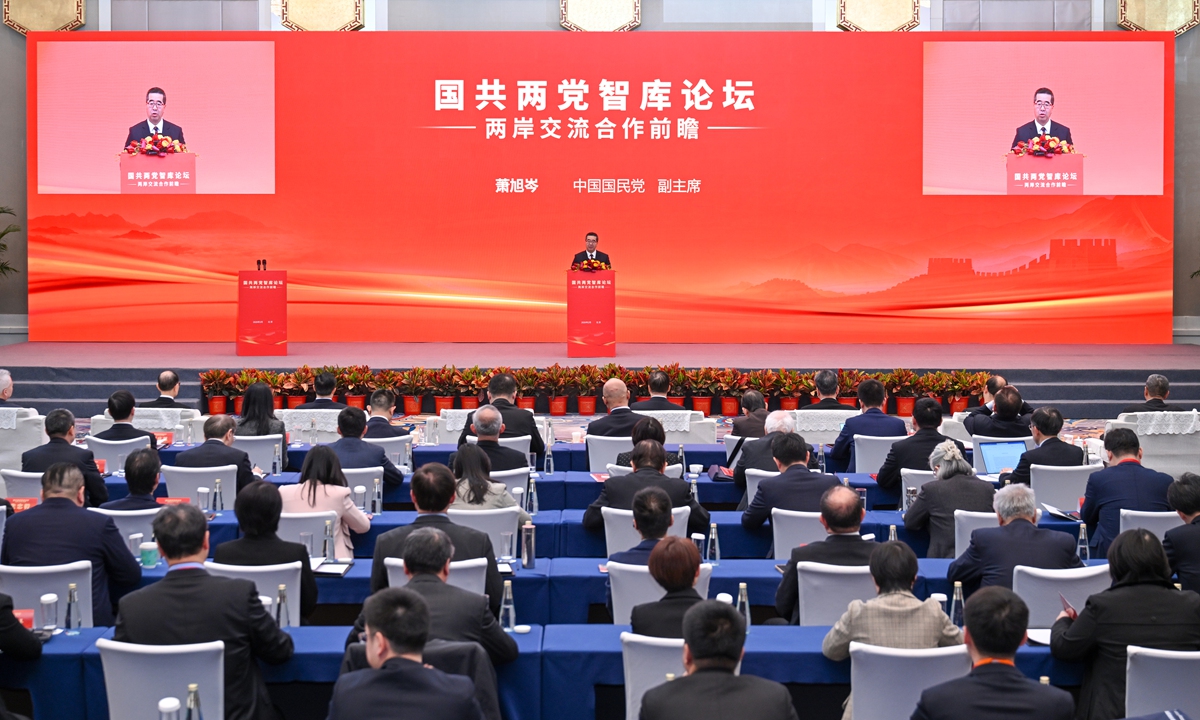
Hsiao Hsu-tsen, vice chairman of the Chinese Kuomintang Party (KMT), delivers a speech at the think tank forum co-hosted by research institutes affiliated with the Communist Party of China (CPC) and the KMT in Beijing on February 3, 2026. Photo: CNS
A think tank forum co-hosted by research institutes affiliated with the Communist Party of China (CPC) and the Chinese Kuomintang Party (KMT) kicked off in Beijing on Tuesday, marking the revival of the forum mechanism after a nine-year hiatus amid prolonged cross-Straits tensions since the secessionist Democratic Progressive Party (DPP) took office.The forum, themed "prospects for cross-Straits exchange and cooperation," was attended by over 100 participants from both sides of the Taiwan Straits, including think tank members of the CPC and the KMT, as well as representatives and experts from various fields such as tourism, industry, science and technology, healthcare, and environmental protection, the Xinhua News Agency reported.
Participants held in-depth discussions on three themes: cross-Straits tourism exchanges and cooperation, industrial exchanges and cooperation, and exchanges and cooperation on environmental and sustainable development, and put forward 15 consensual opinions in five key areas, according to Xinhua.
In addition to both sides emphasizing the advancement of cross-Straits exchanges and cooperation, mainland officials and senior KMT figures reiterated stance of opposing Taiwan secession.
In his speech at the opening of the Tuesday forum, Song Tao, head of the Taiwan Work Office of the CPC Central Committee, said the two parties should remain unwavering in upholding the common political foundation of the 1992 Consensus and opposing "Taiwan independence," and jointly guide cross-Straits relations toward the correct direction of development, according to a release by Xinhua.
He added that firm actions will be taken against diehard "Taiwan independence" separatists and their accomplices, and that attempts by external forces to "use Taiwan to contain China" will not be tolerated.
In his speech on Tuesday, vice chairman of the KMT Hsiao Hsu-tsen said that people across the Taiwan Straits both belong to the Chinese nation and should work together for its rejuvenation. He expressed hope that, on the common political foundation of upholding the 1992 Consensus and opposing "Taiwan independence," the two sides will pursue mutual benefit, promote shared prosperity and advance peaceful development, Xinhua reported.
The Global Times reporter observed that the on-site atmosphere was exceptionally lively, with applause from the floor accompanying nearly every speech by participants from both sides of the Straits. Some attendees from the Taiwan region told the reporter that participating in the forum was a rare opportunity, and that they even made use of tea breaks and lunch hours to hold direct, in-depth conversations with their mainland counterparts about the latest cross-Straits situation and hot-spot issues.
Zhu Songling, a professor at the Institute of Taiwan Studies of Beijing Union University, told the Global Times that resumption of the KMT-CPC think tank forum reaffirms that the 1992 Consensus remains the "anchor" stabilizing cross-Straits relations. No matter how the political landscape in Taiwan may change, the direction and initiative of cross-Straits relations will never be dictated by secessionists.
Zhu believes that re-establishing a stable communication channel between the two parties at a time when the cross-Straits situation remains complex and severe helps to "cool tensions and prevent conflict."
"The forum also sends a clear signal to Taiwan society: as long as the 1992 Consensus is upheld and 'Taiwan independence' is opposed, cross-Straits dialogue and cooperation are not only possible but can deliver tangible dividends to Taiwan people," Zhu said. "This offers Taiwan people an alternative peaceful vision beyond confrontation incited by the DPP authorities."
Taiwan-based media have paid close attention to the cross-Straits engagement. The udn.com remarked that the think tank forum marks the first high-level and large-scale exchange between the two parties in nearly a decade, holding significant importance amid the current cross-Straits strains.
The udn.com added that the latest interactions are bound to serve as a "key indicator" for observing mainland's Taiwan policy this year.
DPP authorities' leader Lai Ching-te attacked the KMT at a Tuesday press conference, claiming that stalling defense budget reviews while advancing the KMT-CPC cooperation is "dangerous for Taiwan," Taiwan-based media outlets reported.
A commentary published by Taiwan-based China Times on Monday noted that as Western countries are "waking up" to reality and have made a series of visits to China recently, only the DPP authorities have aligned themselves entirely with the US, being taken full advantage of by the latter.
It called the reactivation of cross-Straits exchange channel this time as a "heaven-sent sweet rain," which aligns with the global trend but also ushers in new hope for cross-Straits peace.
The renewed cross-Straits interactions unfolded on the eve of Lichun, the "Beginning of Spring" and the opening solar term of the Chinese lunar calendar, just under two weeks before the 2026 Spring Festival, a unifying celebration for Chinese compatriots on both sides of the Taiwan Straits.
Song, according to the China Times, said that the exchanges and discussions this time mark a promising and sound start, adding that cross-Straits relations will ultimately see winter give way to spring, noting that a bright future lies ahead.
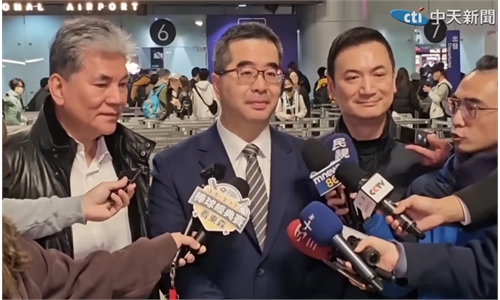
Upon arriving in Beijing on Monday, Hsiao told Taiwan media that even though it's winter in Beijing, the sunshine brings the comforting warmth, reminiscent of the thawing cross-Straits relations.
He said that despite challenges, under the efforts of KMT and CPC the warmth is already becoming evident.
If the think tank forum achieves positive results, it will in effect pave the way for higher-level political dialogue in the future, Zhu said. By starting with think tanks and professional exchanges, both sides of the Straits are gradually rediscovering a "common language" for resolving issues, he added.
RELATED ARTICLES