China’s No.1 central document in starting year of 15th Five-Year Plan sets agricultural modernization roadmap, turning rural potential into growth momentum
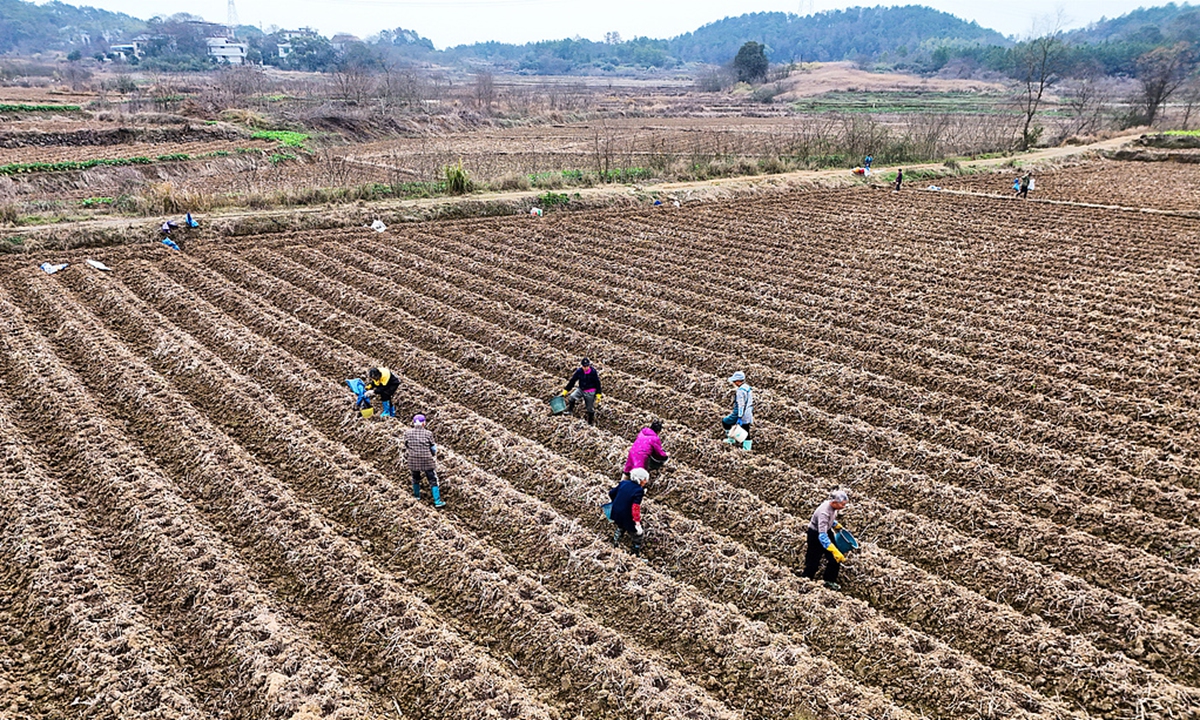
Farmers spread base fertilizer in the fields at a village in Qidong County, Hengyang, Central China's Hunan Province on February 2, 2026. Photo: VCG
China unveiled its "No.1 central document" for 2026 on Tuesday, outlining plans to advance agricultural and rural modernization and to promote all-around rural revitalization, according to the Xinhua News Agency.
As the first major policy document on agriculture and rural affairs issued at the start of the 15th Five-Year Plan period (2026-30), analysts said the document is expected to help translate the vast potential of agriculture and rural areas into concrete drivers of economic growth and high-quality development.
This marks the 14th No.1 central document focusing on agriculture and rural work since the 18th National Congress of the Communist Party of China in 2012. As the first policy statement released by central authorities each year, the document is widely seen as a barometer of policy priorities.
According to Xinhua, the document consists of six sections covering efforts to enhance agricultural production capacity and efficiency, implement normalized and targeted assistance, promote steady income growth for farmers, advance livable and business-friendly rural development, enhance institutional innovation, and strengthen the Party's leadership over agriculture, rural areas and farmers.
The document notes that the 15th Five-Year Plan period is a critical stage for laying the foundation for basically realizing socialist modernization, calling for efforts to shore up weak links in agriculture and rural areas, and secure faster progress in building up China's strength in agriculture.
Among the key highlights, the document places particular emphasis on boosting comprehensive agricultural production capacity and quality efficiency, and for the first time makes systematic arrangements for implementing normalized and targeted assistance,
Chinese economists said the document sets higher development benchmarks while strengthening baseline safeguards through a system-wide modernization approach, helping lay a solid foundation for accelerating agricultural and rural modernization during the 15th Five-Year Plan period and supporting high-quality growth and domestic demand.
Boosting food security through technology
The document calls for improving the effectiveness of policies that strengthen agriculture, benefit farmers and promote rural prosperity, while firmly safeguarding national food security and upgrading rural industries. It also stresses efforts to build agriculture into a modernized major industry and improve farmers' livelihoods, providing support for Chinese modernization, according to Xinhua.
By anchoring agricultural development firmly in modernization, the document sets a high bar even by international standards and reflects policymakers' determination to advance agricultural and rural modernization through systemic reform, said Hu Qimu, deputy secretary-general of the Forum 50 for Digital-Real Economies Integration.
"The goal goes beyond agricultural output, aiming to build a coordinated framework linking population mobility, rural development and industrial growth," Hu told the Global Times on Tuesday.
Food security remains the top priority and a firm red line, according to the document. It sets a target of keeping grain output at around 1.4 trillion jin (700 million tons), providing a clear benchmark for the first year of the 15th Five-Year Plan period and underscoring China's resolve to keep its food supply firmly in its own hands.
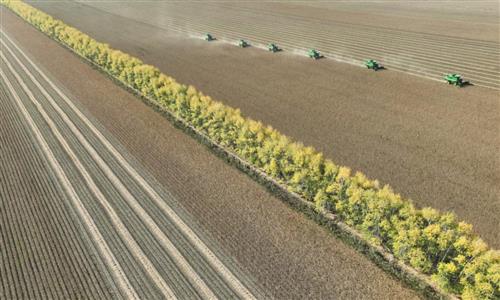
The document sets out new measures to stabilize grain and edible oil production, including stepping up a new round of the 50-million-ton grain capacity enhancement program and promoting integrated use of farmland, seeds, machinery and farming techniques to raise yields at scale.
Zhao Changbao, director of the Rural Economy Research Center at the Ministry of Agriculture and Rural Affairs, said boosting per-unit yields of major grain and oil crops is key to strengthening food security, improving the match between supply and demand, and supporting farmers' income growth, CCTV reported on Tuesday.
Wang Gangyi, a professor at Northeast Agricultural University, told the Global Times that technology - including bio-breeding, AI and digital technologies - has become the key variable and the critical breakthrough for raising grain output under resource constraints in China.
These priorities are translated into concrete measures in the document, which calls for accelerating the breeding and promotion of breakthrough crop varieties, expanding applications of drones, the Internet of Things and robotics, and ensuring agricultural technologies reach villages.
Official data show that China's contribution rate of agricultural science and technology progress exceeds 64 percent, and independently bred crop varieties account for more than 95 percent of planted areas.
Normalized targeted assistance
Another major highlight is the call to implement normalized and targeted assistance, marking the first time the No.1 central document has made systematic arrangements for this policy.
The move reflects the evolving policy needs. Although China achieved decisive success in poverty alleviation in 2020 and consolidated the results through a five-year transition period, risks of falling back into poverty remain, making it necessary to shift support measures from temporary arrangements to a normalized and institutionalized framework, members of the document's drafting group said, according to a Xinhua report.
The document outlines measures to improve the policy system for normalized assistance, enhance monitoring precision and timeliness, strengthen industrial and employment-based support, and provide differentiated assistance to underdeveloped regions. It also incorporates normalized assistance into the overall rural revitalization strategy, while maintaining policy stability in fiscal input, financial support and resource allocation.
Hu said the policy shift reflects a move toward more focused and efficient support as rural industrial foundations and farmers' income-generating capacity improve, providing stronger institutional safeguards for consolidating poverty alleviation gains.
In addition to these key measures, the document also stresses promoting steady income growth for farmers through coordinated policies on prices, subsidies and insurance, fostering county-level industries and stabilizing employment for migrant workers.
As the first major sector-specific policy released in the 15th Five-Year Plan period (2026-30), the document aims to systematically turn rural potential into tangible growth momentum, income gains and jobs, Hu added.
More broadly, experts noted that while the document focuses on agriculture and rural affairs, it carries wider economic implications. With China's urbanization rate at 67.89 percent, boosting rural incomes and development capacity is key to expanding domestic demand and supporting the unified national market.
RELATED ARTICLES