Xi holds virtual meeting with Putin, phone talks with Trump
Head-of-state communications chart course for major-country relations amid global turbulence: expert
By , Zhang Han and Li Yawei Published: Feb 05, 2026 01:43 AM

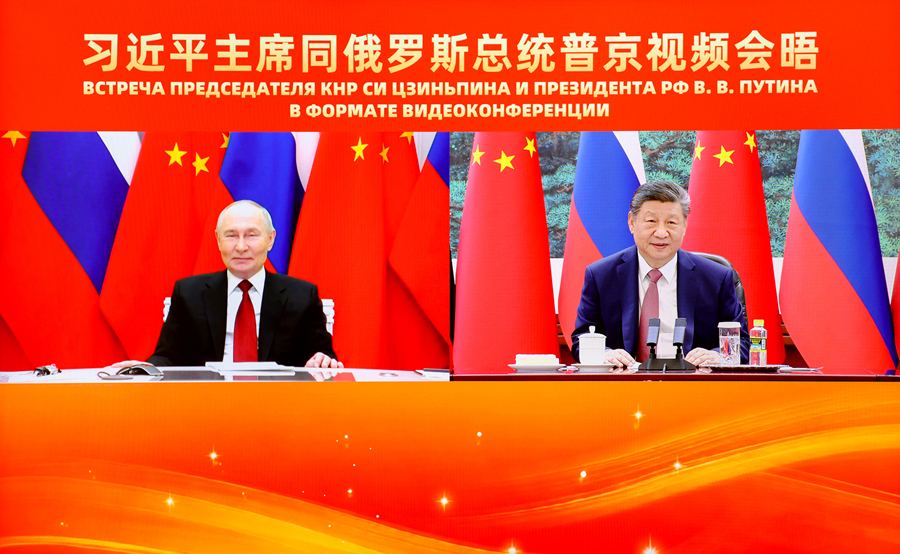
Chinese President Xi Jinping holds a virtual meeting with Russian President Vladimir Putin at the Great Hall of the People in Beijing on February 4, 2026. Photo: Xinhua
Chinese President Xi Jinping on Wednesday held a virtual meeting with Russian President Vladimir Putin. Later the same day, Xi talked with US President Donald Trump over phone, according to Xinhua News Agency.
In the virtual meeting with Putin, Xi said China and Russia should work together to maintain global strategic stability as the international situation has become increasingly turbulent since the beginning of the year, Xinhua News Agency reported.
As responsible major countries and permanent members of the United Nations Security Council, China and Russia have the obligation to encourage the international community to uphold fairness and justice, firmly safeguard the victorious outcomes of World War II, resolutely defend the UN-centered international system and the basic norms of international law, Xi said.
According to the Chinese calendar, today is Lichun, which signifies the beginning of spring. This is when cold weather starts receding, and nature enters the renewal and awakening phase. But in terms of the Russia-China relations, spring continues throughout the year, no matter the season, said Putin, according to a readout released by the Kremlin.
During his talks with Trump over phone, Xi noted that he attaches great importance to China-US relations, saying that over the past year, he and Trump have enjoyed sound communication, and had a successful meeting in Busan, charting the direction and course for China-US relations, according to Xinhua. Xi emphasized that the Taiwan question is the most important issue in China-US relations. Taiwan is China's territory, and China must safeguard its own sovereignty and territorial integrity, and will never allow Taiwan to be separated, he said. The US must handle the issue of arms sales to Taiwan with prudence, Xi said.
According to a readout from Chinese Foreign Ministry, Trump said that both the US and China are great countries, and the US-China relationship is by far the most important in the world. Under our leadership, the US and China are doing well in economy and trade. I want to see China succeed. The US would like to work with China and make more progress in bilateral ties. I understand how China feels about the Taiwan question. I would like the two sides to continue talking to each other and keep the relationship in good shape during my presidency.
Frequent exchanges
The interactions between the Chinese and Russian leaders at the start of the year have become an important mechanism for consolidating bilateral relations. In the new year, a range of key tasks and major strategic issues will require coordination through high-level communication to clarify priorities and build consensus, Wang Xiaoquan, a research fellow at the Institute of Russian, East European and Central Asian Studies, Chinese Academy of Social Sciences, told the Global Times.
"As you know, to advance the comprehensive strategic partnership of coordination for a new era with China is a major priority of Russia's foreign policy. It is developing in a systematic, wide-ranging, productive and successful manner. And we see political will on both sides to continue advancing this cooperation," Russian presidential press secretary Dmitry Peskov told journalists on Wednesday, RIA Novosti reported.
Zhang Hong, a research fellow at the Institute of Russian, Eastern European and Central Asian Studies at the Chinese Academy of Social Sciences, said China and Russia share the position and long-term commitment to safeguarding the international order.
Meanwhile, China pursues stable, healthy, sustainable relations with the US based on mutual respect, peaceful coexistence, and win-win cooperation, analysts said. Despite competition that sometimes becomes fierce, China has maintained regular high-level communication with the US to set direction, prevent miscalculations, and stabilize ties, Li Haidong, a professor at the China Foreign Affairs University, told the Global Times.
From the head-of-state communications between China and major powers such as Russia and the US, to the intensive visits to China by Western countries and Global South nations since the beginning of this year, the international community has reached broad recognition of China's core role and standing in international affairs, Chinese observers said.
Countries are not only willing to conduct all‑round exchanges with China, but also expect China to play a stronger leading role in the transforming international landscape and order. This also signals that 2026 will be a highly active year for China's diplomacy and China's positioning as an anchor for world peace, stability, prosperity, confidence and hope is being continuously validated, they said.
Strategic stability
Xi's virtual meeting with Putin and phone talks with Trump came before the New Strategic Arms Reduction Treaty (New START) Treaty is set to expire on February 5, as the last remaining US-Russia nuclear arms control deal faces the risk of collapse.
China pursues a strategic, independent, and balanced great-power diplomacy that prioritizes national core interests, while emphasizing global stability, and true multilateralism, analysts said.
Li noted that China, Russia and the US are all permanent members of the UN Security Council. Such communication facilitates major powers' cooperation to address joint challenges faced by the international community and is conducive to global peace and stability.
The world today is undergoing multiple turbulences, and China sets an example of coping with such challenges and maintaining security and stability in region, therefore winning growing understanding, recognition and support from countries around the globe, Li said.
What is more noteworthy is that, in the face of global disputes including European issues, divergences in US European relations, the Ukraine crisis, and various problems in Latin America, all parties including the US and Russia have realized that the constructive settlement of these issues is inseparable from China's participation and must involve full communication, exchanges and dialogue with China. This has made China a core and critical connecting point in current international relations, and an important pillar for countries to strengthen their own development and resolve practical challenges, Li said.
Zhang noted when the world is facing multiple turmoil and geopolitical risks, China, in its communication with the other two major powers, conveyed a clear message to the international community: while global affairs demand the broad participation of many nations, China is fulfilling its distinct responsibilities and influence.
RELATED ARTICLES