Virtual meeting, important phone talks on Beginning of Spring inject certainty into the world, time for Taiwan to wake up: Bei Pingfeng
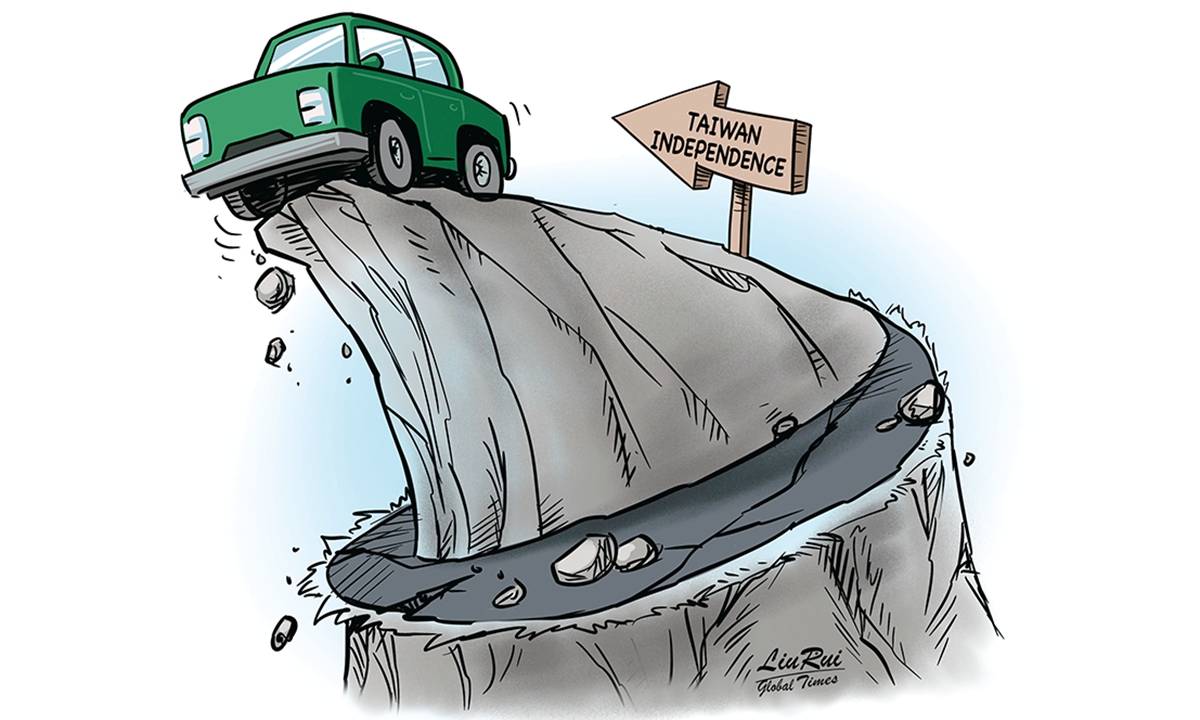
Illustration: Liu Rui/GT
Wednesday, February 4, is the day of Lichun, the "Beginning of Spring." It is the first of the 24 solar terms on the Chinese lunar calendar, symbolizing the thawing of ice and the revival of all things. On this very day, Chinese President Xi Jinping had a virtual meeting with Russian President Vladimir Putin and talked with US President Donald Trump over the phone, attracting global attention and injecting certainty into a turbulent world. It is believed this also prompted the island of Taiwan to reassess the world and itself.Amid wars waging in the world, unresolved trade frictions and intensifying bloc confrontations, the Chinese leader chose to engage in in-depth communication with the leaders of two globally influential major powers on the same day. The signal is powerful and weighty - if various sectors on the island of Taiwan still fail to understand it, they are only deceiving themselves.
The Taiwan question is the most important issue in China-US relations. During his phone talks with President Trump, President Xi emphasized: "Taiwan is China's territory, and China must safeguard its own sovereignty and territorial integrity, and will never allow Taiwan to be separated. The US must handle the issue of arms sales to Taiwan with prudence."
Every word carries immense weight, heavy as a mountain. Although President Trump did not publicly commit to ceasing arms sales to the island of Taiwan, he explicitly said that he understands how China feels about the Taiwan question and he would like the two sides to continue talking to each other and keep the relationship in good shape during his presidency.
The remarks pulled the rug out from under those on Taiwan island who still fantasize about "relying on the US to pursue independence." While Taiwan society continues to speculate whether the US would send troops to support the island or bear the costs for it, the US has already done the math. TSMC factories can be relocated, supply chains can be restructured, but the US will never risk full-scale confrontation with a China that possesses nuclear weapons, a market in the trillions, the world's most complete industrial system and the resolute will of more than 1.4 billion people supporting reunification - all over a "pen tip" on a "round table."
The more chaotic the world becomes, the more it needs China. At the start of 2026, Canadian Prime Minister Mark Carney, Finnish Prime Minister Petteri Orpo and British Prime Minister Keir Starmer visited China one after another - not out of a sudden urge of "looking toward the East," but a rationality of "looking toward reality."
European countries no longer blindly cling to the US' "values-based alliance." What they value highly is China's massive market scale, complete industrial chains, infrastructure efficiency and energy transition solutions. While the US imposes steel and aluminum tariffs on allies, threatens to withdraw from NATO and unilaterally tears up climate agreement, China has consistently kept its doors open to the world - with goods trade with Belt and Road partner countries reaching 23.6 trillion yuan ($3.4 trillion), China-Europe freight trains exceeding 120,000 trips and the draft of the 15th Five-Year Plan clearly calling for expanded high-level opening-up to create a new era of win-win cooperation.
In contrast, "Taiwan independence" separatist forces persist in moving backward. While Taiwan regional leader Lai Ching-te claimed that the lower Taiwan's investment link to the mainland, the better the island's economy, he cannot deny the resilience of cross-Straits economic cooperation shown by an 11.2 percent increase in the Chinese mainland's exports to Taiwan and a 6 percent rise in Chinese mainland imports from the island last year.
He loudly proclaims a "democratic alliance," yet dares not respond to US Commerce Secretary Howard Lutnick's public demand for TSMC to relocate factories. He fantasizes about "going global," yet continually funnels Taiwan island's fiscal surpluses, foreign exchange reserves and tech talent into the US' military-industrial complex and chip factories.
This is not "autonomy" - it is "self-immolation"; not a "diplomatic breakthrough," but "economic suicide." Taiwan island faces soaring housing prices, skyrocketing living costs and surging energy prices, while "pro-independence" politicians spout increasingly radical slogans - they are not safeguarding Taiwan's future but squandering its prospects and selling it out for personal political gain.
China has never been better positioned as it is today to achieve complete national reunification. Economically, the Chinese mainland's GDP maintains a long-term advantage of more than 20 times that of Taiwan island, with the gap continuing to widen. Militarily, weapons systems such as the DongFeng-5C missiles, J-35 fighter jet, Type 055 destroyer and long-range rocket artillery have established overwhelming superiority over Taiwan island. In terms of public sentiment, the younger generation on the mainland is forming a sense of "historical responsibility" toward national reunification, while Taiwan's youth increasingly recognize the inevitability of reunification - public support for reunification is becoming mainstream in Taiwan society.
Among the five permanent members of the UN Security Council, only China has yet to achieve reunification - this must be fully resolved. In 1949, we stood up through "millet plus rifles"; in 1978, we started to grow prosperous through reform and opening-up; now, through strategic resolve and comprehensive national strength, we are marching toward becoming strong. And a key hallmark of this strength is the complete reunification of the motherland.
Lichun has arrived, and spring thunder will soon follow. If the Taiwan authorities remain addicted to the illusion of the "US protective umbrella," still fantasize that external forces will back "Taiwan independence" and believe that "delaying reunification can buy temporary safety," what awaits them is nothing but the verdict of history. China does not initiate conflict, but it will never tolerate secession. Reunification is a matter of time, not a question of whether it will happen. Taiwan island, it is time to wake up.
The author is a commentator on international affairs. opinion@globaltimes.com.cn
RELATED ARTICLES