San Siro lights up for Milan-Cortina Winter Games as Olympics seek unity in divided world
China’s delegation to showcase sportsmanship beyond medals: expert
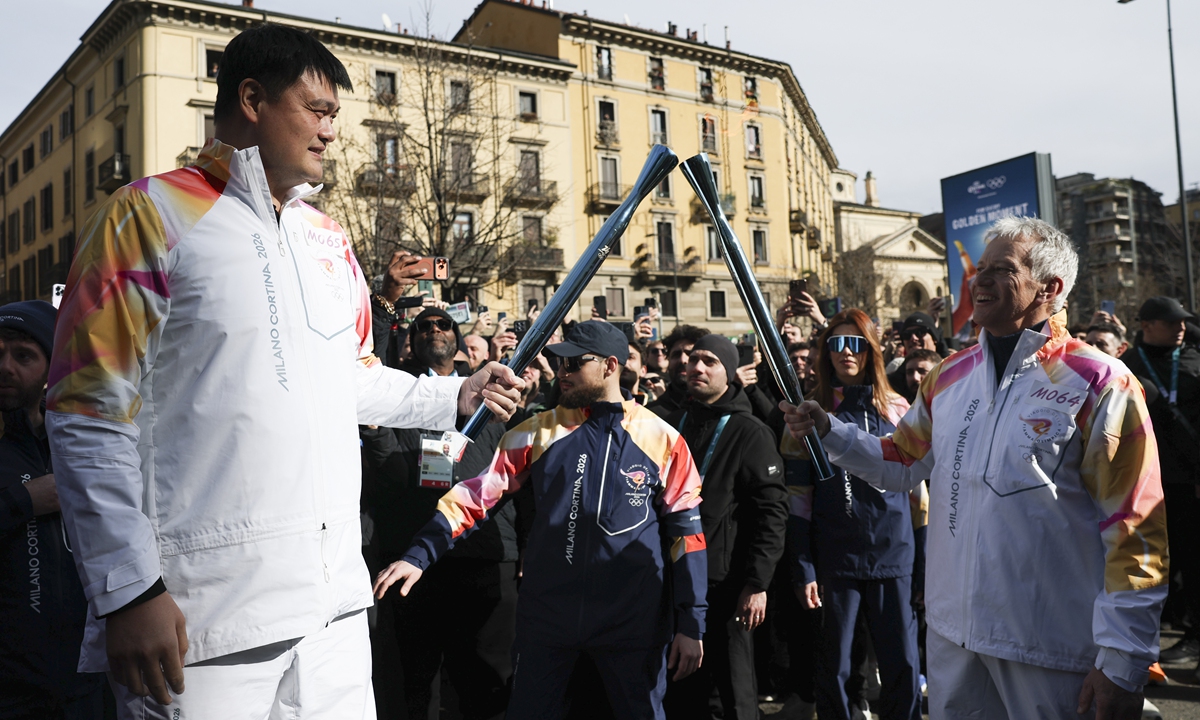
Former Chinese basketball legend Yao Ming and Coca-Cola CEO James Quincey relay the torch for 2026 Milan-Cortina Winter Olympics in Milan, Italy, on February 6, 2026. Photo: Xinhua
Four years after Beijing staged a spectacular Winter Olympics, the Games have now arrived in Italy's Milan and Cortina, carrying forward the enduring Olympic relay of peace and unity amid an international political landscape that has grown more complex and turbulent.Milan-Cortina 2026, to be held from February 6 to 22, is set to be the most widespread Winter Olympics in history, spanning multiple regions and two host cities, the Xinhua News Agency reported. The opening ceremony, held locally on Friday, will take place at the legendary San Siro Stadium under the theme of harmony.
More than 3,500 athletes from over 90 delegations and territories are expected to take part in the grand gala, according to the organizers. The opening event will also bring renowned performers including Italian tenor Andrea Bocelli, Chinese pianist Lang Lang and US singer Mariah Carey to the stage.
Upon arrival at Milan Malpensa Airport on Wednesday, Global Times reporter was instantly immersed in the vibrant atmosphere of the Winter Olympics. From the airport terminals all the way into the heart of the city, Milano-Cortina 2026 was everywhere: Olympic logos, massive posters, colorful banners, and thematic installations lined the paths and streets.
Official shops were packed with tourists, while local residents radiated enthusiasm as well, as many parents brought their children to pose for photos in front of prominent Olympic landmarks, their faces beaming with anticipation and joy.
The warmth and thoughtful service of the volunteers quickly melted away the fatigue from the 10-hour flight, and en route to the opening ceremony in San Siro on Friday, Global Times reporter noticed some Chinese faces waving national flags and standing out in crowds.
Marco Balich, creative lead of the Milan-Cortina 2026 Olympic Winter Games Opening Ceremony, told Xinhua that the ceremony aims to present the beauty and imagination of Italy while celebrating sport and delivering a strong message of peace.
He cited the opening ceremony of the 2008 Beijing Olympics as a lasting inspiration, noting he still keeps photographs from that night, including the drumming sequence and the lighting of the cauldron.
At a press conference on February 1, International Olympic Committee (IOC) President Kirsty Coventry praised the Beijing 2022 Olympic Winter Games, which offered useful lessons during the planning phase for Milan-Cortina 2026, particularly in the increased use of technology in venue development, according to Xinhua.
Breaking new ground
China heads into the Winter Games eager to build on its success from Beijing 2022, where it achieved a best-ever Winter Olympic medal haul of nine gold medals, four silvers and two bronzes on home ice and snow.
As the grand winter sports gala unfolds, the Chinese team has arrived in Italy with its largest-ever overseas delegation. This 286-member team, including 126 athletes, will compete across a record 91 events in 15 disciplines, covering about 78.4 percent of the total 116 events, showcasing the rapid evolution of Chinese winter athletics since the home triumph at Beijing 2022.
The average age of 25 underscores a balanced squad: Nine defending Beijing gold medalists return to defend their legacies, while over 20 athletes born after 2005 inject fresh energy into the team, representing more than half of the newcomers making their Olympic debuts.
The squad that features defending Olympic champions Gu Ailing, also known as Eileen Gu, and Su Yiming, alongside short track speed skating and figure skating gold medalists, underscores China's medal aspirations across both traditional winter sports strengths and emerging disciplines.
In strong events, the Chinese delegation will focus primarily on short track speed skating, freestyle skiing aerials and other disciplines, while also being competitive in certain sub-events of freestyle skiing and snowboarding.
Ru Xiuying, director of the Olympic Research Center of Capital University of Physical Education and Sports, told the Global Times when China successfully bid for the 2022 Winter Olympics in 2015, it set the ambitious goal of engaging 300 million people in ice and snow sports. Over the past decade, China has significantly strengthened the foundation of its winter sports ecosystem. This solid base has played an irreplaceable role in building a deep pool of young talent for the Milano Cortina 2026 Winter Olympics.
But more importantly, China no longer measures success solely by gold medals. What matters more today is winning the "gold medal of the Olympic spirit," Ru said.
The new generation of Chinese athletes is showcasing the full character, demeanor, and values of Chinese sportsmanship both on and off the field, an achievement far more meaningful than any single medal. And this also marks a key milestone in building China into a true sporting powerhouse, said the expert.
Olympic spirit more precious
When the Olympic flame was lit in San Siro, outside the stadium, the world was gripped by escalating turmoil as multilateralism and the UN-centered order were corroded.
Also on Friday, US and Iranian officials convened for high-stakes nuclear negotiations in Muscat, Oman, against a backdrop of their intensifying tensions and American military buildup in the Gulf.
In the Western Hemisphere, roughly one month earlier, US forces launched a dramatic military operation in Venezuela, seizing President Nicolas Maduro and his wife in a swift strike that dramatically altered the region's power dynamics.
As the Russia-Ukraine conflict continued to ravage Europe, transatlantic ties became further strained amid repeated US threats from the current administration to annex Greenland, Denmark's semi-autonomous territory.
The Milan-Cortina Games are "happening in the most fractious political moment in the recent history of the Olympics," Jules Boykoff, an expert in sports politics at Pacific University in Oregon, was quoted by the New York Times (NYT) as saying.
"Since the 1990s, the IOC has called on nations to pause military conflict during the Games, a call it repeated this year. For some Olympians, that peaceful mission, always aspirational, feels particularly dissonant now," reads the NYT's report on Friday.
"If the international landscape in 2022 was one of intertwined chaos and change yet trending toward overall stability, then the geopolitical environment confronting the Milano-Cortina 2026 Winter Olympics is characterized by persistent turbulence. In particular, the wave of globalization has been significantly eroded by US' economic populism, trade protectionism, and unilateralism," Li Haidong, a professor at the China Foreign Affairs University, told the Global Times on Friday.
In today's increasingly divided and fragmented world, the Olympic spirit of peace and unity is more precious than ever and must be promoted and never downplayed or overlooked, Li said.
In her speech to the 145th IOC Session on Tuesday, IOC President Coventry emphasized the critical need to keep sport a neutral ground.
Keeping sport a neutral ground, she said, is paramount, "a place where every athlete can compete freely, without being held back by the politics or divisions of their governments. In a world that is increasingly divided, this principle matters more than ever. It is what allows the Olympic Games to remain a place of inspiration, where the athletes of the world can come together and showcase the best of our humanity," Xinhua reported.
RELATED ARTICLES