AI giants ramp up user competition with pre-Spring Festival digital red envelope campaigns
By Published: Feb 08, 2026 08:43 PM
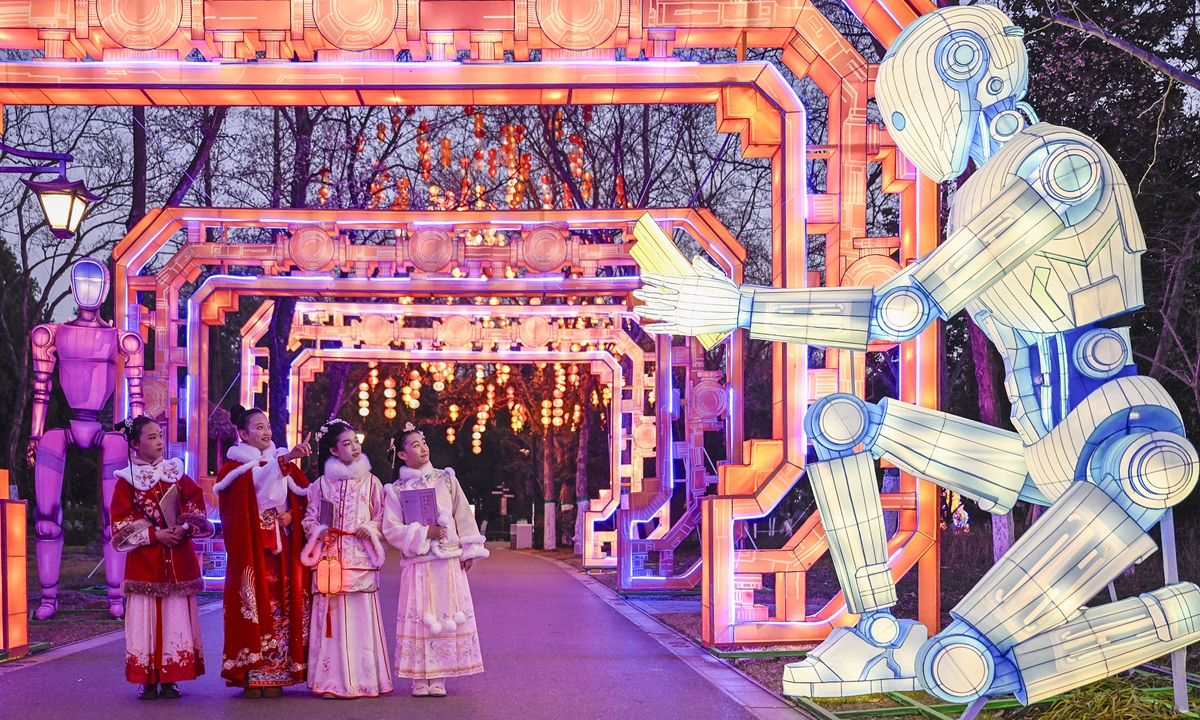
Primary school students show interest in a lantern in the shape of a humanoid robot at a lantern festival in Hefei, East China's Anhui Province on January 12, 2026. Photo: VCG
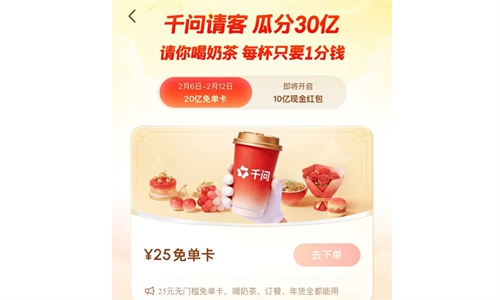
With Alibaba's artificial intelligence (AI) assistant Qwen kicking off a Spring Festival giveaway plan that distributes free milk tea cards, the competition for users among China's major AI large-language model (LLM) companies is heating up and intensifying ahead of the Spring Festival.Photos and videos of an explosion of orders at coffee and tea drink chains went viral on China's social media platforms over the weekend, after the Qwen app on Friday launched a Spring Festival giveaway worth 3 billion yuan ($432 million), under which users were given 25 yuan no-threshold free milk tea gift cards that encourage them to place drink orders directly through the app's chat interface.
The campaign has prompted a lot of discussion online, with many users posting photos showing that milk tea shops were overwhelmed by delivery workers.
In a post titled "Making the History of Global AI shopping," the Qwen app said on its WeChat account on Friday that the cards could also be used for other services, including breakfast, lunch, and dinner options, eggs, vegetables, fresh produce, daily groceries, snacks, Tmall Supermarket items, and even on-site supermarket purchases.
Driven by the huge campaign traffic, the Qwen app surged to No.1 in the China's Apple App Store free chart on Saturday, followed by Tencent's Yuanbao and ByteDance's Doubao in second and third place respectively.
In addition to Qwen, other Chinese AI LLM companies including Baidu, Tencent and ByteDance have rolled out digital red envelope initiatives, with a total estimated value of more than 4.5 billion yuan.
Last week, Tencent's Yuanbao launched a digital red packet campaign, distributing up to 1 billion yuan in digital red packets to users, with individual red packets worth as much as 10,000 yuan. Chinese tech company Baidu's AI assistant Ernie announced that from January 26 to March 12, people who use the app within the Baidu app will have the chance to share 500 million yuan in cash red packets.
Observers said that these campaigns show that competition in the AI industry has evolved from being purely technology-driven to an intensifying contest centered on real-world user experience.
However, some also raised doubts. Some analysts have drawn parallels to the classic retail tactic of "giving away free eggs" to lure foot traffic, questioning whether this high-profile, buzz-driven approach can genuinely convert temporary excitement into loyal, long-term users and deliver sustainable high retention rates.
In an era of technology product homogenization, the Spring Festival serves as a high-frequency social scenario for the masses. Thus, it has become the core window for the public to engage with AI, and for AI LLM companies to seize the hearts and minds of users, Wang Peng, an associate research fellow at the Beijing Academy of Social Sciences, told the Global Times on Sunday.
Wang warned that Chinese companies should not squander too much energy on this marketing tactic.
"It is very important that those tech firms refocus on genuine technological refinement, meticulous polishing of the product experience, and truly building the product core strength — that is the real ticket to the future," Wang said.
RELATED ARTICLES