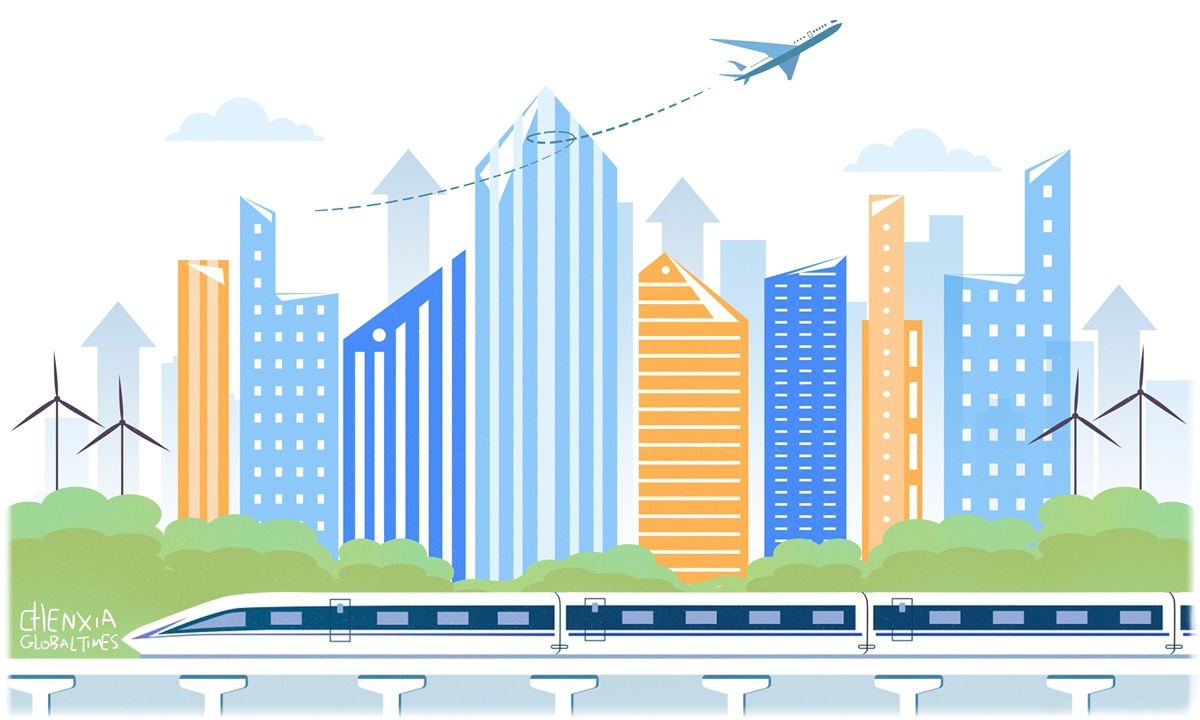
Illustration: Chen Xia/GT
Editor's Note:In the details of everyday life lies the true reflection of a country. The "Everyday China" series invites foreign experts and scholars who have lived in China for several years to share their personal experiences and reflections on seemingly ordinary moments. Through their unique perspectives, the series reveals a more authentic, multidimensional and relatable portrait of China. This is the sixth installment of the series.
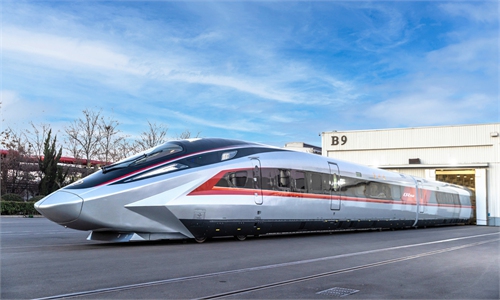
China's systemic thinking in public services finds one of its clearest expressions in urban mobility. In China, transportation has been conceived not merely as a service, but as strategic infrastructure - a backbone for economic development, social cohesion and urban governance.
Faced with an unprecedented scale of urbanization, China moved beyond improvised solutions and embraced long-term planning centered on mass public transportation.
This has now culminated in systems that are deeply integrated, technologically advanced, and digitally coordinated. This model takes a tangible form in what I called "one-stop travel," a seamless, point-to-point journey that many foreign visitors describe as one of the most striking aspects of moving through China. Rather than treating transportation as a collection of isolated modes, mobility is designed as a continuous flow, connecting high-speed rail, metro systems, airports, buses, bicycles and digital platforms into a single experience. Unified ticketing - often linked to digital identity - multimodal hubs, intuitive signage and real-time information reduce uncertainty, cost and time, transforming urban complexity into daily predictability.
Added to this physical infrastructure is a decisive layer: digital infrastructure. The smartphone, the mobile payment systems, and near-universal online access allow travel decisions to be made quickly, and often instantly.
In a short period of time, one can plan, pay for, adjust and execute an integrated journey that moves from metro to bus, from taxi to train and even to national or international flights. Apps concentrate information, payment, access and guidance into a single interface, greatly expanding the individual's ability to seize opportunities that require mobility.
This convergence of physical and digital systems generates greater planning flexibility and strengthens the resilience of transportation dynamics. Routes can be recalculated, connections reorganized, and decisions revised in real time, with minimal friction.
Mobility ceases to be rigid; it becomes adaptive. As a result, certainty increases, the likelihood of successful journeys rises, and the risks associated with delays, missed connections or unexpected changes are sharply reduced.
The core principles behind this policy include multimodal integration and intensive use of digital technologies for management and information. Social accessibility, relatively low fares, wide territorial coverage and environmental sustainability reinforce mobility's public and inclusive character. Transportation thus transcends logistical efficiency and becomes a tool of social inclusion, ensuring access to work, education, healthcare and markets.
These abstract principles become most visible in everyday experience. I frequently travel between Beijing and Wuhan for meetings and business opportunities, and this routine vividly illustrates the integrated nature of the system.
Upon arriving at Beijing West Railway Station, inside the train station I step directly onto Metro Lines 7 and 9, which connect seamlessly to the city's main lines. From that point, virtually any destination in Beijing feels close at hand. The transition between high-speed rail and metro is so fluid that the two seem like chapters of the same journey rather than separate modes.
By weaving together transportation, technology and public governance, China has built a system capable of moving millions each day with efficiency and predictability - transforming mobility from a challenge into a quiet, dependable companion of modern life.
The author is director of the Brazilian Citizens Council in Beijing and member of the Center for China and Globalization. opinion@globaltimes.com.cn
RELATED ARTICLES