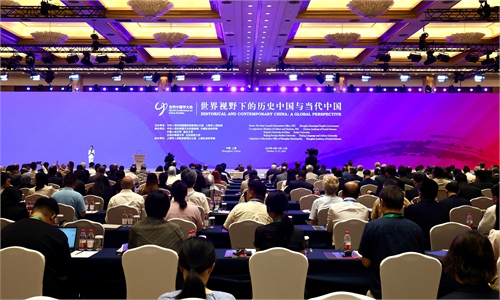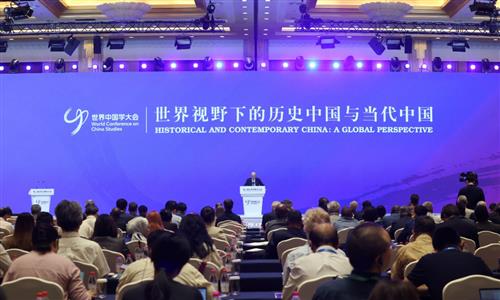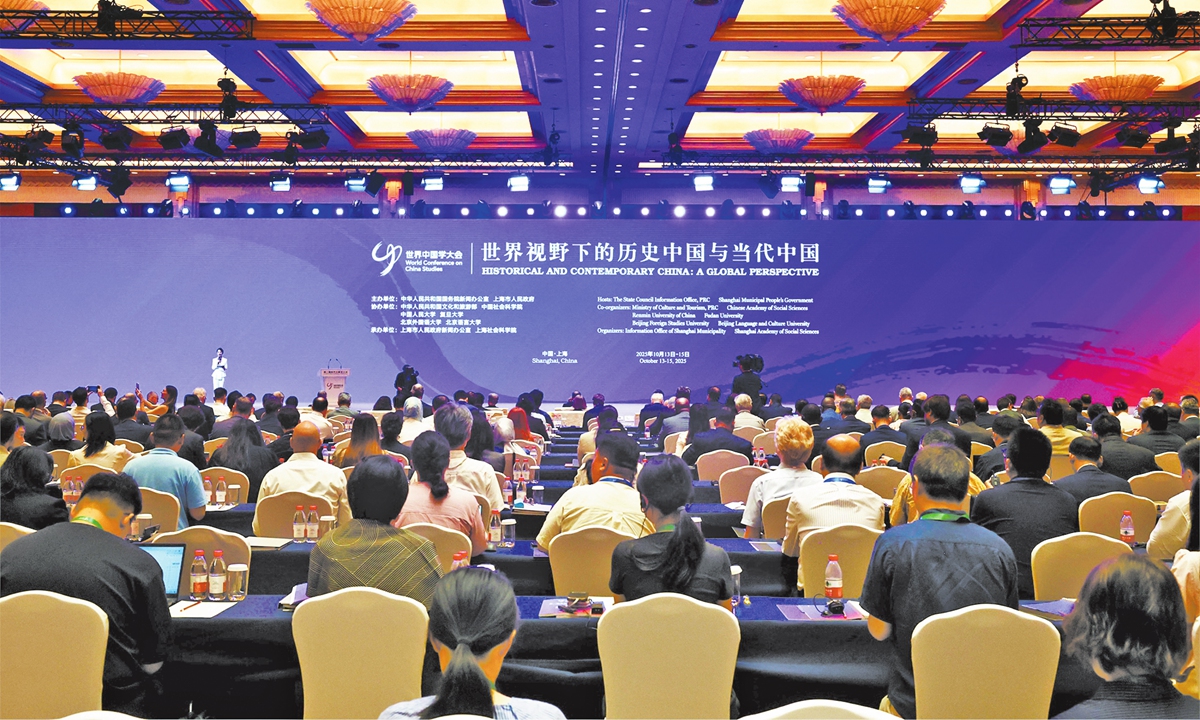
The second World Conference on China Studies kicks off in East China's Shanghai on October 14, 2025. Photo: Chen Xia/GT
Editor's Note:
The second World Conference on China Studies opened on October 14 at the Shanghai International Convention Center. About 500 renowned scholars from around the world participated in the two-day event, engaging in in-depth dialogues and intellectual exchanges under the theme "Historical and Contemporary China: A Global Perspective." Key topics include how to build a global China Studies knowledge system and how Chinese wisdom and ideas can better contribute to the world. This article presents selected highlights from sub-forum three, "The Knowledge System of China Studies: A Multidisciplinary Approach," and sub-forum four, "China Studies in the Era of Digital Intelligence: Opportunities and Challenges."
The era of digital intelligence brings about both opportunities and challenges
Lin Shangli, president of Renmin University of China
China Studies in the era of digital intelligence is a highly cutting-edge topic. This era affords us boundless space with immense opportunities and challenges. It is precisely this coexistence of opportunities and challenges that may carve out entirely new frontiers for academic research and scholarship, opening up a more compelling dimension. Throughout history, changes and innovations in how humans communicate and share ideas have always driven intellectual growth and academic breakthroughs. Without China's traditional movable-type printing, Chinese civilization could not have flourished.
Today, with the advent of the era of digital intelligence, the impact it brings is exponentially greater than that of traditional media such as newspapers and television. This will revolutionize the humanities and social sciences. Using artificial intelligence, we can reconstruct tangible scenes that were inaccessible in original texts - a transformation unprecedented in human history. By reinterpreting China's historical documents and texts through digital and intelligent technologies, we can uncover concepts and experiences within five millennia of Chinese civilization that hold profound significance for humanity and value for human development. In this way, China Studies in the era of digital intelligence is both uniquely Chinese and globally relevant.
Liu Wei, director of the Institute of Information Sciences, Shanghai Academy of Social Sciences
What constitutes China's autonomous knowledge system in digital humanities? Primarily, it involves reconstructing knowledge structures and logical interpretative frameworks through digital and intelligent means. More fundamentally, it represents a re-establishment of knowledge sovereignty, enabling our historical thought and aesthetics to be understood and disseminated within the digital realm in Chinese approach. We are entering an era jointly shaped by algorithms and semantics, where digital humanities have become the bridge connecting traditional culture and artificial intelligence. Yet the technological foundation upon which this bridge is built determines whether we shape China's narrative in our own terms.
Without sovereign AI, our independent knowledge system would remain dependent on others. How can we build sovereign AI that suits China's digital humanities? First, establishing a localized, high-quality data foundation, as constructing China's digital humanities knowledge system necessitates our own corpora. Second, developing specialized models for cultural contexts. Third, building a national-level digital humanities intelligence platform. Fourth, fostering an interdisciplinary talent ecosystem where AI engineers have a better understanding of humanities.
Mutual learning promotes prosperity of global China Studies
Gan Chunhui, executive vice president and research fellow at Shanghai Academy of Social Sciences
President Xi Jinping pointed out that China Studies are not only the studies of historical China, but also the studies of contemporary China. This significant statement profoundly elucidates the fundamental mission of China Studies worldwide. Historical China represents the profound accumulation of five millennia of Chinese civilization, while contemporary China embodies the in-depth practice of the modernization process under socialism with Chinese characteristics. These two dimensions are mutually reinforcing, constituting the entirety of China Studies. As scholars, we must contemplate how to construct, through multidisciplinary integration, a knowledge system capable of both interpreting historical China and comprehending contemporary China.
Reflecting on the development of China Studies worldwide, it stands as a product of mutual learning between Chinese and foreign civilizations. From the exchanges along the Silk Road to the modern scholarly dialogues, and now the formation of transnational academic networks, scholars from diverse cultural backgrounds have continually engaged in communication, mutual learning and exchanges, collectively fostering the flourishing of China Studies. From its inception, China Studies has been characterized by interdisciplinary convergence and cross-cultural dialogues. Today, our emphasis on multidisciplinary perspectives aims precisely to develop new academic methodologies through cross-disciplinary and transnational collaboration, thereby enhancing both the breadth and depth of China Studies.
The construction of a global knowledge system for China Studies not only deepens understanding of Chinese civilization but also fosters mutual comprehension and exchanges among diverse civilizations. It transcends mere academic course, serving as a bridge that promotes dialogues and mutual trust. Notably, technological advancements have opened new possibilities.
Ivone Silva, president of the Lula Institute of Brazil
We wish to take concrete and effective action to enhance mutual understanding between China and Brazil. From 2023 to 2025, Lula Institute has undertaken joint projects and seminars with multiple Chinese think tanks, exploring a wide range of topics that include relations between Latin America and China, as well as cooperation among countries of the Global South. Such collaborations serve as a bond for strengthening inter-state relations, collectively forging a more equitable future for us.
Li Bozhong, chair professor of humanities, Peking University
The interactions between China and other countries have primarily occurred through non-military approaches, mainly through trade. In Chinese, trade and commerce share close connotations. In classical Chinese, the Chinese character shang signified consultation, deliberation, and negotiation. Commercial activities require mutual agreement between buyer and seller. Thus, trade constitutes an important reason why China historically seldom resorted to force or violence in its interactions with other states.
Tang Lei, deputy director of the International Sinology Research Center, Chinese Academy of Social Sciences
The concept of global China Studies encompasses three levels of endeavor. First, we strive to utilize research achievements of the world to advance China's modernization. Second, by comparing and analyzing overseas China studies, we manage to identify the misunderstandings of Chinese culture, and develop our soft power in a more targeted manner to enhance China's discourse influence. Third, by engaging in cultural exchanges and mutual learning, we compare diverse Chinese knowledge systems to identify opportunities for in-depth communication. We are steadfastly committed to conveying a more authentic Chinese voice to the world.
Ruben Tang, head of the Office of Relations with Asia at Pontifical Catholic University of Peru
Even in the 21st century, we still need to learn languages and cultures. China Studies highlights the importance of language - only with sufficient language proficiency can research in this field truly advance. Overall, China Studies is still a young discipline in Peru. We must strengthen cooperation with Chinese universities and build more collaboration with Chinese think tanks. We also hope that an increasing number of Peruvian students will come to China to study.
RELATED ARTICLES