China poised to ‘dominate’ AI and manufacturing backed by leading power capacity: Elon Musk
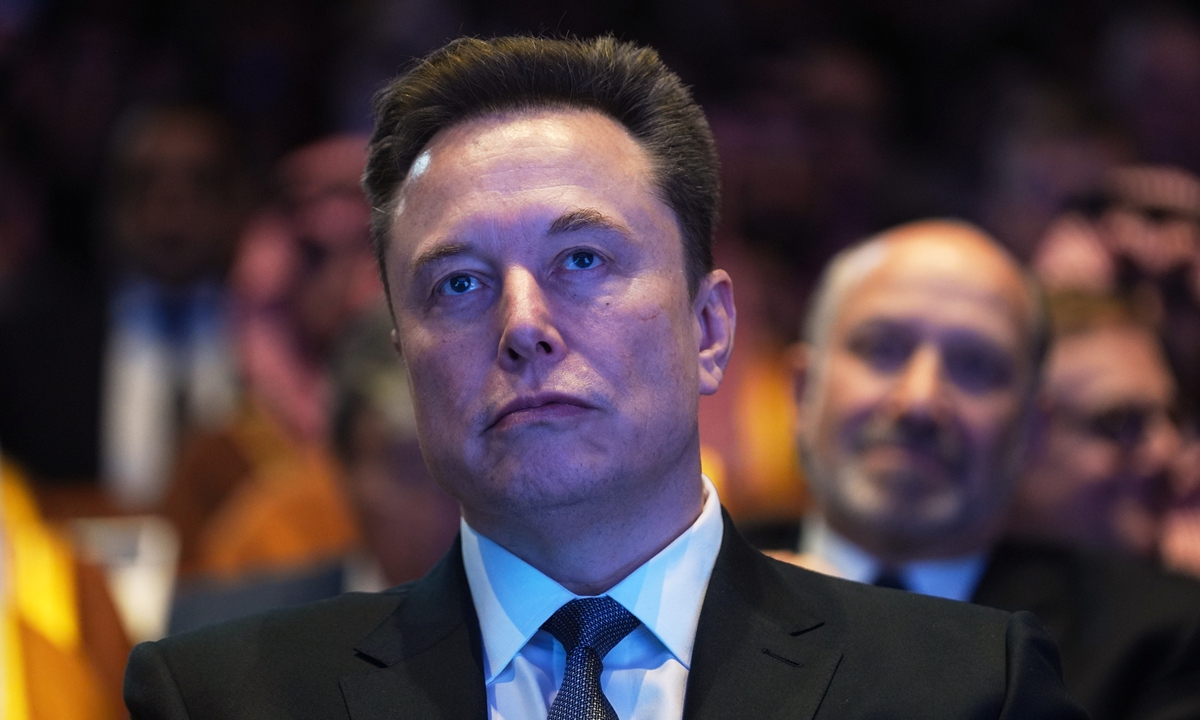
Elon Musk Photo: VCG
Tesla CEO Elon Musk said artificial intelligence (AI) computing power and energy supply will become the biggest challenges to technological development, noting that China would "utterly dominate" sectors such as AI, electric vehicles and humanoid robotics in the "absence of breakthrough innovations" in the US.
The remarks were made during a during a recent three-hour podcast interview with Dwarkesh Petal, where he discussed AI, manufacturing, humanoid robots and the evolving landscape of US-China technological competition.
Global AI chip output is growing exponentially, but terrestrial power generation and heat dissipation are failing to keep pace, said Musk. Outside of China, electricity output is largely flat, he said, making it increasingly difficult to support the power demands of large-scale AI compute clusters. As a result, Musk argued that within roughly three years — around 2029 — deploying massive AI computing capacity in space could become the most economical solution.
He highlighted China's structural advantages in both energy and manufacturing. China produces solar panels at exceptionally low cost and possesses the world's strongest power-generation capacity. Speaking earlier this year at the World Economic Forum in Davos, Musk said that "China, just in solar that can provide steady-state power and batteries, can do half of the US electricity output per year just with solar."
"China is very advanced in manufacturing. There are only a few areas where it is not," Musk said, describing the country as a "next-level manufacturing powerhouse."
He cited ore refining as a core example, estimating that China processes roughly twice as much ore as the rest of the world combined. With a population roughly four times that of the US and a stronger work ethic, Musk said "we definitely can't win on the human front, but we might have a shot at the robot front."
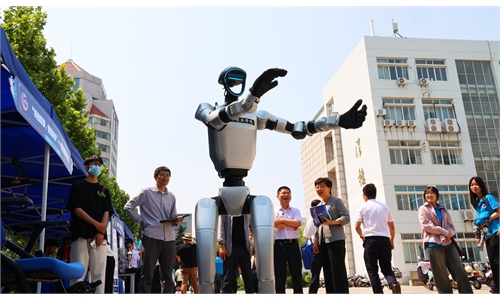
Musk spoke highly of the strategic importance of humanoid robots in manufacturing, particularly in continuous, round-the-clock industrial operations. "The best useful robots in the beginning will be any continuous operations — any 24/7 operation — because then they can work continuously," he said.
Electricity output is a reasonable proxy for the economy, said Musk, estimating that China would exceed three times US electricity output, which means that China's industrial capacity is roughly three times that of the US.
Musk said any given thing is going to have Chinese content because China's doing twice as much refining work as the rest of the world. "And then they'll go all the way to the finished product with the cars. China's a powerhouse," he noted.
In a statement sent to the Global Times by Tesla on Sunday, the company said it plans to allocate more than $20 billion in 2026 to investments spanning AI computing capacity, robotics factories, the Cybercab program, as well as energy storage and charging infrastructure.
Tesla Vice President Tao Lin noted that the $20 billion-plus budget covers Tesla's global markets. While detailed China-specific plans have yet to be disclosed, the strategic direction is clear: stepping up investment in AI software and hardware, along with energy-related technologies. She added that Tesla has already deployed a localized training center in China, dedicated to the local optimization and fine-tuning of Tesla's intelligent assisted driving systems.
RELATED ARTICLES