Comic-con organizers across regions ban ‘Detective Conan’ cosplay over tie-up with boycotted Japanese manga
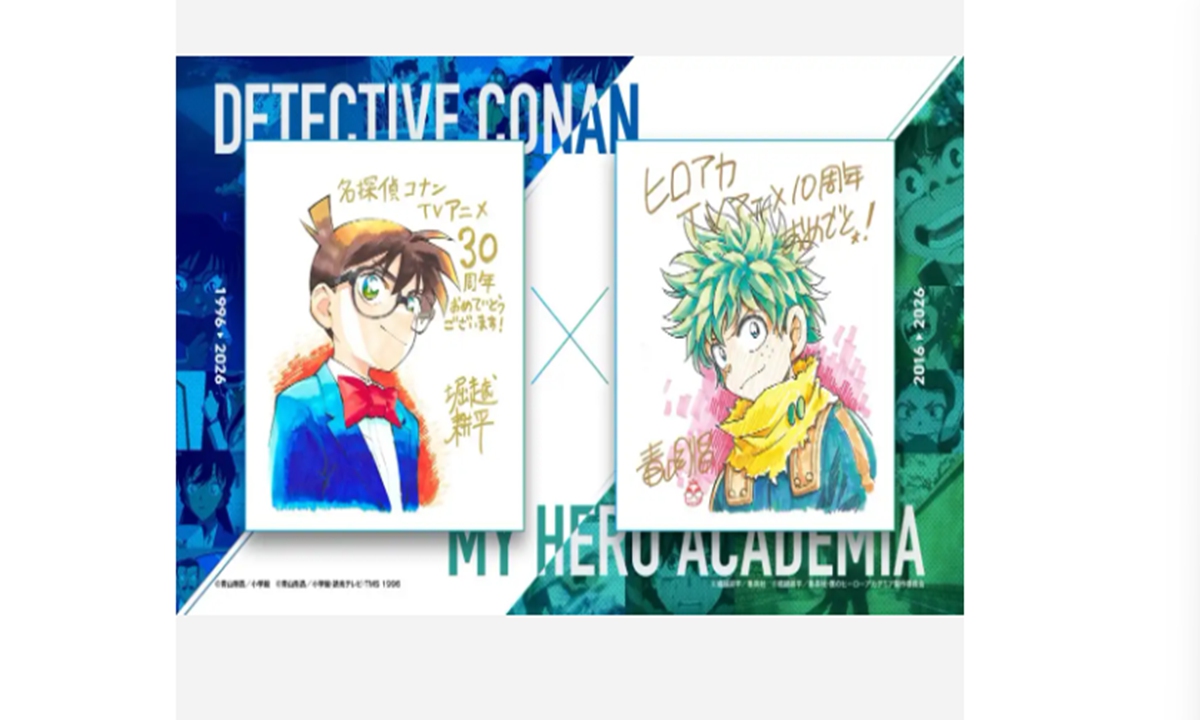
The controversial collaboration of commemorative visual between Detective Conan and My Hero Academia Photo: screenshot of Japanese entertainment website mantan-web
Comic-con organizers in Beijing and several other cities have announced bans on cosplay and merchandise related to the popular Japanese anime Detective Conan, after the series collaborated with My Hero Academia -- another Japanese anime that previously sparked a boycott by Chinese netizens and was removed from streaming platforms over accusations of insulting the feelings of the Chinese people.
The collaboration has sparked widespread attention on Chinese social media platform Weibo, as My Hero Academia once contained a villain character named "Maruta Shiga" in 2020 - a character depicted as conducting human experiments in the series. The character's name "Maruta" is a derogatory term used by the Imperial Japanese Army's Unit 731 during Japanese invasion of China to refer to victims of human experimentation, while "Shiga" is derived from the Japanese bacteriologist Kiyoshi Shiga, after whom "Shigella bacteria" is named, China News Week reported.
Unit 731 was the codename for a covert Japanese military medical unit from 1932 to 1945, responsible for bacterial warfare and human experiments that killed more than 3,000 Chinese, Korean, Soviet Union and Western prisoners of war in brutal tests.
The Chinese mainland copyright agent for Detective Conan then issued a statement on January 31, saying that the series' controversial collaboration with My Hero Academia "carries no stance or implication." But the statement failed to allay the anger of Chinese netizens.
With the growing public concern, some anime expos have started to impose restrictions on controversial works. IJOY Comic-Con, one of Beijing's best-known local Comic-cons, told the Global Times that it had taken note of the collaboration, and after careful evaluation, it had decided to prohibit any cosplay appearances, product displays, or sales related to both My Hero Academia and Detective Conan at the recent event held over the weekend.
Participants are urged to comply with the rule, respect history, uphold fundamental principles and safeguard national dignity and public sentiment, working together to create a positive and healthy environment for the Comic-con, according to the organizer.
A visitor at the event told the Global Times that, as of her visit, she had not seen any Detective Conan cosplay at the site.
A 26-year-old cosplayer from Beijing, who has portrayed characters from Detective Conan for the past three years, told the Global Times that she had originally planned to dress as a Conan character at the IJOY Comic-Con on Saturday. However, she and her friends changed their mind at the last minute and chose a different costume instead. "Although I really love this work, I think it's important to take a clear stance as a Chinese person," she noted.
Another event, the 18th Shenyang SSCA Anime & Game Expo, held in Shenyang, the capital of Northeast China's Liaoning Province from Friday to Sunday, also issued a special notice to ticketed visitors and anime fans on its Weibo account.
The notice stated that, as My Hero Academia contains content that touches on historical traumas and national sentiment, and in light of its crossover with Detective Conan, the expo — acting in line with an industry consensus reached among other domestic anime events — has decided to strictly prohibit all Detective Conan-related cosplay, displays and commercial sales.
Attendees are also asked to refrain from entering the venue in cosplay representing other controversial anime works, it said.
In a recent case, Pokémon, a Japanese media franchise, has been mired in controversy after netizens discovered its plan to hold a card game event at the notorious Yasukuni Shrine, a symbol of Japanese militarism and wars of aggression. Pokémon then issued an apology, saying that the company will fundamentally revise and strengthen its review and verification processes for event information to prevent similar issues from recurring.
An event in Xi'an, Northwest China's Shaanxi Province, held by the ACC Anime Expo, said in a statement on its Weibo that the organizers have noted that certain overseas works — such as Detective Conan, Pokémon, My Hero Academia and Maid Sama! — have raised serious social concerns due to content that harms national sentiment or contradicts historical facts. Such content is in direct conflict with the expo's patriotic stance, cultural standards, and the healthy, positive cultural direction it seeks to promote.
The event prohibits any cosplay representing works that harm national sentiment or contradict an accurate understanding of history, and bans the display, sales, or distributions of related products. The organizers will strictly review all exhibition content, and any violations may result in removal from the venue or cancellation of participation in accordance with the rules, according the statement.
The organizers called on all exhibitors, attendees and partners to strictly abide by this regulation, remember the lessons of history, uphold cultural principles and consciously safeguard national dignity and ethnic sentiment.
On Sunday, China Military Bugle, an official media account under the Chinese People's Liberation Army News Media Center, said on its official WeChat account that recent incidents, such as the Pokémon and the collaboration between Detective Conan and My Hero Academia, serve as stark reminders that Japanese militarism continues to linger in the realms of entertainment and sports, refusing to fade away.
These occurrences are far from coincidental, it said, citing previous examples including Japanese table tennis player Tomokazu Harimoto and Kasumi Ishikawa' visit of Tōgō Shrine, which enshrines a Japanese invader. Japanese right-wing forces are taking the advance of generational shift and the consequent weakening of historical memory. Through sports stars, entertainment idols, anime, games and textbooks — the very media that young people engage with most frequently — they are injecting glorified and distorted versions of history in appealing forms.
The objective is to disrupt the intergenerational transmission of authentic historical truth, thereby establishing the ideological groundwork and social foundation for a potential revival of militarism, according to the article.
The article urges all peace-loving people to remain vigilant against any infiltration of Japanese militarism into cultural, sporting and entertainment spheres.
RELATED ARTICLES