Local authority in E.China’s Jiangsu releases probe findings on management of cultural relics at Nanjing Museum
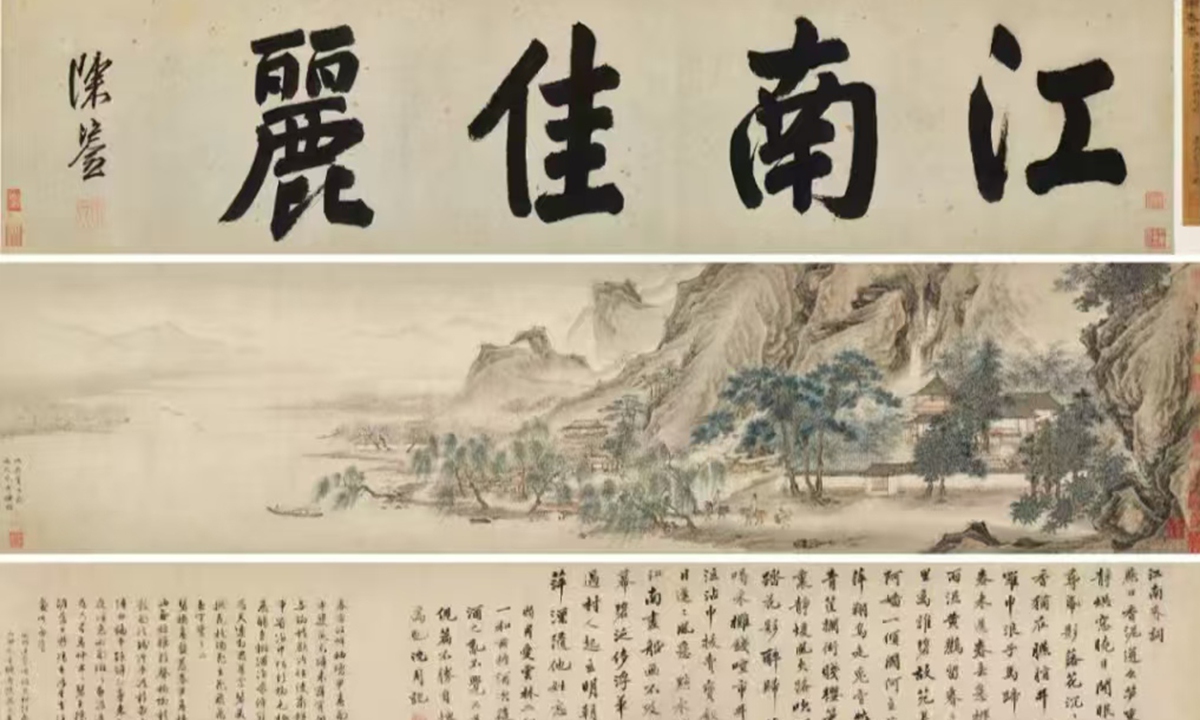
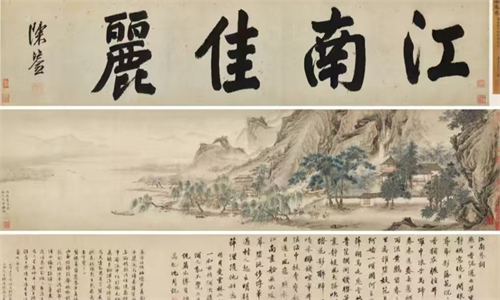
A partial view of the scroll painting “Spring in Jiangnan” by renowned Ming Dynasty painter Qiu Ying Photo: The Paper
Jiangsu authorities released findings and disciplinary actions on Monday on a probe into management of cultural relics at the Nanjing Museum, which involves the whereabouts of some of its collections, China Central Television reported. The probe found that five paintings were illegally transferred to the provincial cultural relics company and sold in the 1990s and early 2000s, resulting in the loss of state-owned cultural assets.
The probe concluded that Xu Huping, who served as former executive deputy director of the Nanjing Museum, failed to follow required procedures and unlawfully signed off on applications to transfer relevant relics. Even after national administrative authorities had clearly banned the unauthorized sale or disposal of museum collections, he still approved the sale of the relevant cultural relics.
Xu also failed to address or properly supervise serious internal management problems at the company, including discrepancies between accounts and physical assets, the improper concentration of duties that should have been separated, and a lack of oversight and checks, actions that are suspected to constitute serious violations of duty, according to the CCTV report.
Also, another 24 responsible individuals have been dealt with in accordance with discipline and law following the probe, with those suspected of criminal offenses transferred to judicial authorities, the CCTV report said.
The Xinhua News Agency reported on December 19 that descendants of late renowned collector Pang Laichen discovered that five out of 137 ancient paintings and calligraphy works donated by their family to the Nanjing Museum in 1959 could no longer be located. The Paper reported that one of the "missing" paintings, "Spring in Jiangnan" by renowned Ming Dynasty painter Qiu Ying, appeared in a preview exhibition of a Beijing auction house in May this year with an estimated value of 88 million yuan ($12.50 million).
Regarding the “Spring in Jiangnan” painting, the probe found out that in early July 1997, Zhang, then a storekeeper and salesperson in charge of the painting and calligraphy storeroom at the former provincial cultural relics company, noticed that the "Spring in Jiangnan" handscroll — illegally transferred to the company — was priced at 25,000 yuan ($3,602.9). Seeing an opportunity for profit, she conspired with her boyfriend Wang to buy the work herself and resell it at a higher price. Taking advantage of her position, Zhang secretly altered the price tag to 2,500 yuan.
To circumvent rules prohibiting company staff from purchasing items sold by the company, and to avoid Wang being recognized by colleagues, Zhang arranged for Wang’s coworker, Chen, to act as the buyer. On July 8 of the same year, Chen purchased the "Spring in Jiangnan" handscroll at the company through Zhang at a 10 percent discount, paying 2,250 yuan. To conceal the price manipulation, Zhang deliberately left the item number blank on the invoice, did not record the buyer’s name, and listed the item as “Landscape Scroll Imitating Qiu Ying” instead of "Spring in Jiangnan".
Afterward, Zhang instructed Wang to falsely claim that the handscroll was a family heirloom and offered it for sale to art dealer Lu (former legal representative of Nanjing Yilanzhai Art Co., Ltd., who died in 2025). By mutual agreement, the "Spring in Jiangnan" handscroll and two other paintings were sold to Lu for 120,000 yuan. Starting in 2016, Lu pledged the "Spring in Jiangnan" handscroll on three occasions to Nanjing Shizhuzhai Art Investment Co., Ltd. In September 2019, Lu failed to redeem the work as agreed due to financial difficulties, and the handscroll remained with Shizhuzhai.
In November 2021, art dealer Zhu purchased the "Spring in Jiangnan" handscroll from Shizhuzhai. In April 2025, China Guardian Auctions was entrusted by Zhu to auction the work, but the sale was withdrawn in May after it was reported by Pang Shuling. On December 28, 2025, the handscroll was placed in the painting and calligraphy vault of the Nanjing Museum, according to the probe result.
The incident exposed long-standing institutional deficiencies and management disorder at the Nanjing Museum over a period of time, particularly the lack of rigorous and standardized systems for managing donated items and weak enforcement of relevant policies and regulations, according to the CCTV report.
A small number of officials and staff showed lax discipline and a poor awareness of the rule of law, resulting in the loss of state-owned assets and undermining the public credibility of state-run museums. The lessons drawn from this case are profoundly serious, the report said.
Also on Monday evening, the Nanjing Museum issued a letter of apology to the public, saying that this incident exposed institutional deficiencies and management disorder at our museum over a period of time, weak implementation of policies and regulations, and a failure to show due respect to donors and their families.
In particular, during the transfer and circulation of the "Spring in Jiangnan" handscroll and other paintings, the museum violated regulations issued by national cultural heritage authorities by arbitrarily “removing” items from the collection, according to the letter.
Review and verification procedures were reduced to a mere formality, applications for the transfer of cultural relics were improperly submitted, and the handover process was handled with extreme irresponsibility, the museum said in the letter.
In a short commentary on the probe, the People’s Daily said on Monday that although the incident at the Nanjing Museum spans several decades and involves multiple responsible entities and individuals, it has proven that when it comes to the protection of cultural relics, any illegal or improper conduct will be thoroughly investigated and never allowed to go unchecked—no matter how much time has passed, how complex the issues are, or who is involved.
Anyone who dares to abuse power for personal gain or engage in self-theft in the name of safeguarding cultural relics will inevitably face severe punishment under the law, the commentary said.
RELATED ARTICLES