Jimmy Lai’s sentence a solemn declaration of judicial independence, the spirit of the rule of law

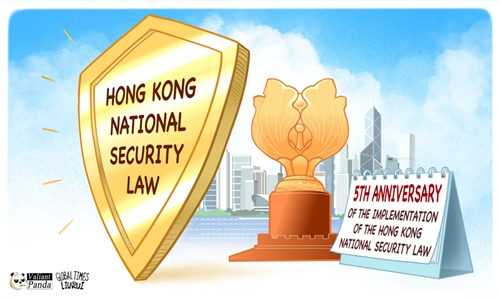
Illustration: Liu Xiangya/GT
On Monday, the High Court of the Hong Kong Special Administrative Region (HKSAR) sentenced Jimmy Lai Chee-ying to 20 years in prison on two charges of conspiring to collude with external forces and a charge of conspiracy to publish seditious materials. The ruling has "upset" some Western forces, who have smeared it as "cruel" and "unjust" while claiming the trial is a "crackdown on freedom." Yet, they ignore the core fallacy in their defense of Lai, which lies in conflating his identity as a "media tycoon" with his actions as a "political agent."
The verdict provided conclusive evidence that Lai was convicted for his role as a mastermind and instigator behind some subversive activities in Hong Kong. This role can be illustrated by testimony by former senior executives of Apple Daily, along with 2,220 exhibits of evidence presented by the police in court, over 80,000 pages of case files, and an 855-page Reasons for Verdict. In any jurisdiction, any conduct similar to Lai's would trigger severe legal consequences, potentially falling under treason or foreign agent registration acts.
Since Lai's arrest, some Western media outlets have portrayed this instigator of anti-China riots in Hong Kong as a "martyr for democracy." In the noise surrounding the Jimmy Lai case, certain Western forces have constructed a misleading narrative, attempting to depict "national security" as the devourer of "press freedom." However, if one strips away the sensationalized and politicized rhetoric from some in the West and examines the case through the cool-headed lens of comparative law, a glaring logical paradox and double standards become apparent.
Across the globe, any mature common law jurisdiction possesses a rigorous national security legal system that sets a high "red line" for actions threatening the state, Wang Jiang, deputy director of the Institute of China's Borderland Studies at Zhejiang Normal University, told the Global Times. He continued, imagine if a media head in any sovereign nation used their platform to publicly call for foreign sanctions against their own country, met with foreign politicians to seek hostile actions and systematically plotted to subvert the existing regime, that country's judiciary would never treat such actions as protected "free speech." They would inevitably impose harsh penalties under their own treason or security laws.
Certain external powers demand that Hong Kong tolerate behavior they would never accept within their own borders, revealing that their accusations are not based on legal theory, but rather represent a political posture intended to interfere with Hong Kong's judicial independence through public pressure.
However, the resilience of Hong Kong's judiciary in upholding due process against a hostile external environment should be the focus of the Jimmy Lai case. Despite unprecedented external political pressure and threats of sanctions, the judges of the HKSAR High Court have demonstrated immense professional integrity and judicial fortitude. This verdict serves as the most potent rebuttal to the claim that "the rule of law in Hong Kong is dead." True judicial independence means not only freedom from administrative interference, but also the ability to hold the law impartially when faced with external political pressure.
Lai's sentence is a solemn declaration of sovereignty, security and the spirit of the rule of law. It announces that the dignity of the law is not to be trampled upon and that the bottom line of national security is not to be crossed. More profoundly, as a landmark case since the implementation of the national security law in Hong Kong, the Jimmy Lai case provides crucial legal guidance and certainty for future practice.
Ultimately, the verdict in the Jimmy Lai case is more than the conclusion of a trial. It sends a clear signal to the international community: The city has turned the page on an era of political turmoil, social instability and legal erosion. It also sends a positive message to global investors, as removing threats to national security provides a safer, more predictable business environment for a market economy.
RELATED ARTICLES