‘Europe needs to be free to pursue its own global strategies in a more autonomous way’ : Italian expert
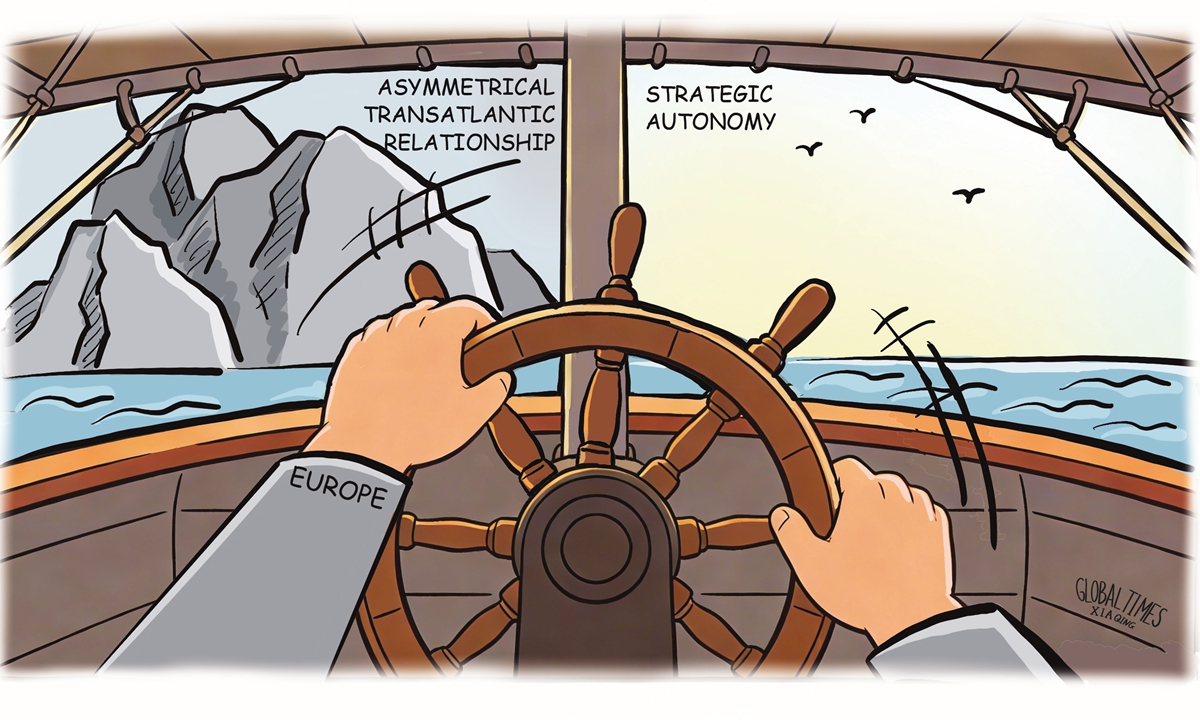
Illustration: Xia Qing/GT
Editor's Note:Across the Atlantic, transatlantic unity has begun to show significant cracks, as disagreements between the US and the EU have resurfaced over issues of trade, industrial policy, and strategic autonomy following a substantial shift in US foreign policy under the current administration. In this context, the Global Times (GT) has launched a commentary series, "The widening transatlantic rift," inviting scholars and experts at home and abroad to share their views. In an interview with GT reporter Wang Wenwen, Raffaele Marchetti (Marchetti), director of the Center for International and Strategic Studies at Luiss University, Italy, said that Europe needs to be self-sustaining, or at the very least, embark on a path that will lead to self-sufficiency over the next 10 to 20 years.
GT: The history of the transatlantic alliance between the US and its European partners is filled with tension, mistrust and crises. Recent events, such as the US imposition of tariffs on European countries last year and its recent threat to take over Greenland, provide further evidence. How do you see the asymmetrical transatlantic relationship? Do you think it is time for Europe to wake up?
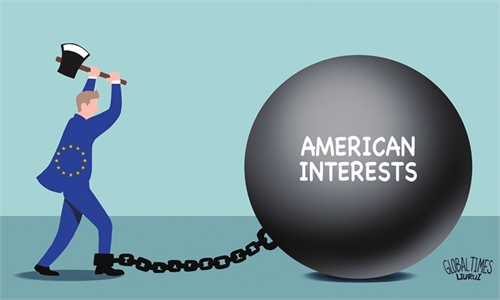
Marchetti: The relationship has always been mixed. In economic terms, the sizes of the European and American economies are more or less balanced. However, from both a political and military perspective, the relationship has been unbalanced, especially since WWII. At times, this imbalance has been evident, while at other times, it has been less so. This is part of the history of the transatlantic relations.
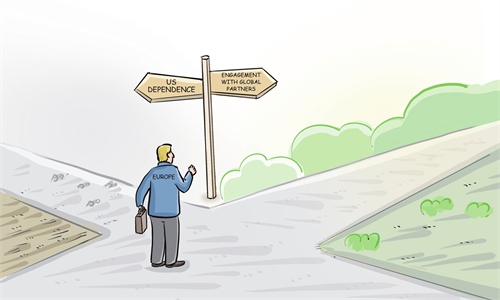
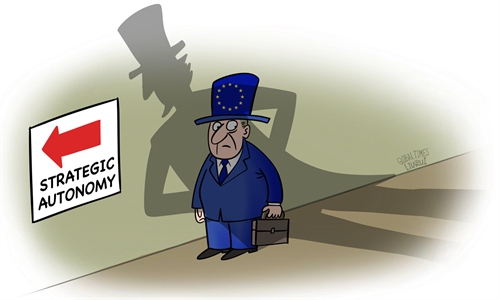
There has been, for a number of years, discussion about the "European strategic autonomy." There is an internal reflection in the EU on the need for Europe to become more autonomous. This is not an easy task; there are many challenges involved. However, I believe that there is a growing recognition among European leaders that Europe needs to take a more autonomous path of development. That doesn't mean severing ties with the US; rather, it means that Europe needs to be self-sustaining, or at the very least, embark on a path that will lead to self-sufficiency over the next 10 to 20 years.
Global competition has become fiercer. Europe feels that support from the US is increasingly conditional. Therefore, Europe needs to be free to pursue its own global strategies in a more autonomous way.
GT: You mentioned challenges - what are the challenges Europe faces on the path to achieving strategic autonomy?
Marchetti: I would say there are mostly economic, military, and technological challenges. In terms of the economy, the American market is important for European goods and American finance plays a role as an important investment actor in Europe. Militarily, a very significant portion of European military equipment is American. We are dependent on American supplies. In terms of technology, it's a well-known fact that Europe is lagging behind both the US and China - if you look at all the big techs, they are either in China or in the US. These three dimensions are obvious examples of the European dependency on the US.
GT: Many European leaders are now engaging more with China, believing this serves their national interests. How do you evaluate such moves?
Marchetti: They're autonomous from the US. The EU has recently signed two important trade agreements, one with Mercosur and one with India, both of which are in favor of EU interests. There are also some openings toward China. China is one of the largest markets in the world and it is important for Europe to have access to such a market.
Additionally, China is an important partner on many issues related to global governance and multilateralism, areas where the US is currently less engaged. Furthermore, China could become an important technological partner. There are already significant trade exchanges, people-to-people exchanges, and academic cooperations between Europe and China. For these cooperations to develop, significant steps need to be taken by both sides. The EU needs to decide to relaunch and deepen its relations with China, and China also needs to address some of the EU's requests.
GT: In a previous interview, you noted that if the situation around Greenland evolves into a conflict, then it means the end of the Western world. Can you elaborate on this?
Marchetti: Greenland is a very important test case. There are two issues here - military and political. The military dimension centers around NATO. Now if we found ourselves in a situation where there is a war or conflict between two NATO members, then the alliance is severely damaged.
Politically, the concept of the "West" was constructed in the 20th century and strengthened a lot after WWII. Before that, there was no "West;" there was Europe, North America, and other parts of the world. In the 19th century, Europeans considered themselves Europeans, not Westerners. At some point in the 20th century, the idea of the "West" was created in a bizarre way. Many Europeans started to think themselves more as Westerners than Europeans, sometimes identifying more with transatlantic ties than with Europe itself (this was particularly true for Italy during certain years). This shift went on for political reasons, and was part and parcel of a certain liberal Western world that was created in the second half of the 20th century.
But if there is a military breakup of NATO, or if there is a political rift between the US and Europe, then it will be inevitable for Europeans to start thinking about themselves again as Europeans, rather than Westerners.
To some extent, I don't think the US will be so silly to push hard on Greenland. But if the situation in Greenland deteriorates, if other cases emerge, then these trends of bifurcation from the US and the EU could continue. And if it continues, I think the only option for Europeans will be to become Europeans again, rather than Westerners.
GT: How do you envision an ideal transatlantic relationship?
Marchetti: The most straightforward answer is that this can only be achieved when Europe becomes self-sufficient in defending itself. When Europe is able to defend itself militarily and economically, it can develop a more equal relationship with the US and with other countries in the world. But the point is that Europe has given up its defense to the US in terms of military bases, military equipment and military industries. One condition for Europe to develop a more equal and balanced relationship with the US is for Europe to develop its own defense industry.
Additionally, Europe needs to achieve technological autonomy. The civil use of technology is important for Europe. We are talking about artificial intelligence, quantum computing, and many innovations that need to be mastered by the EU in an autonomous way, in order for Europe to be able to negotiate on an equal footing with the US.
Politics is always full of dilemmas. Some Europeans continue to believe that the future needs to be totally integrated with the US, while others think that Europe needs to move toward a more autonomous path. The issue is timing. Timing is essential, because even those who want to have a more autonomous Europe know very well that this transition is not possible within the next 10 or 15 years. If Europe severs its relations with the US today, Europe will be totally defenseless. It takes time to reach a degree of strategic autonomy.
Most Europeans would say, let's try to make it a deal with the US and in the meantime we can develop our strategic autonomy. Americans know this, so they are not very happy. So there is a mistrust from Washington. The level of mistrust is reciprocal. Americans think Europeans are cheating, and Europeans think Americans are untrusted. It's a bit difficult relationship, and it's not easy to change it.
RELATED ARTICLES