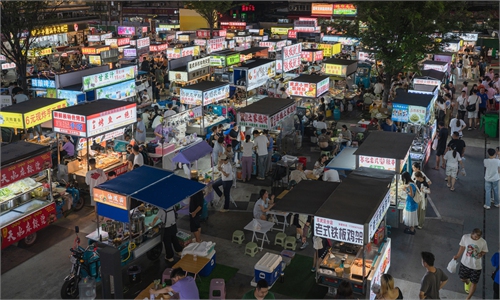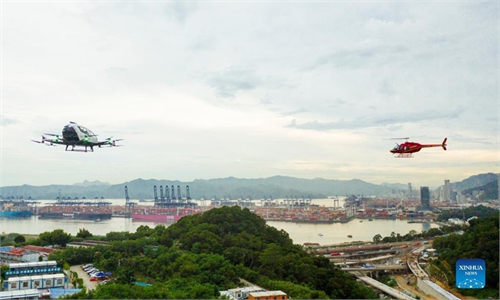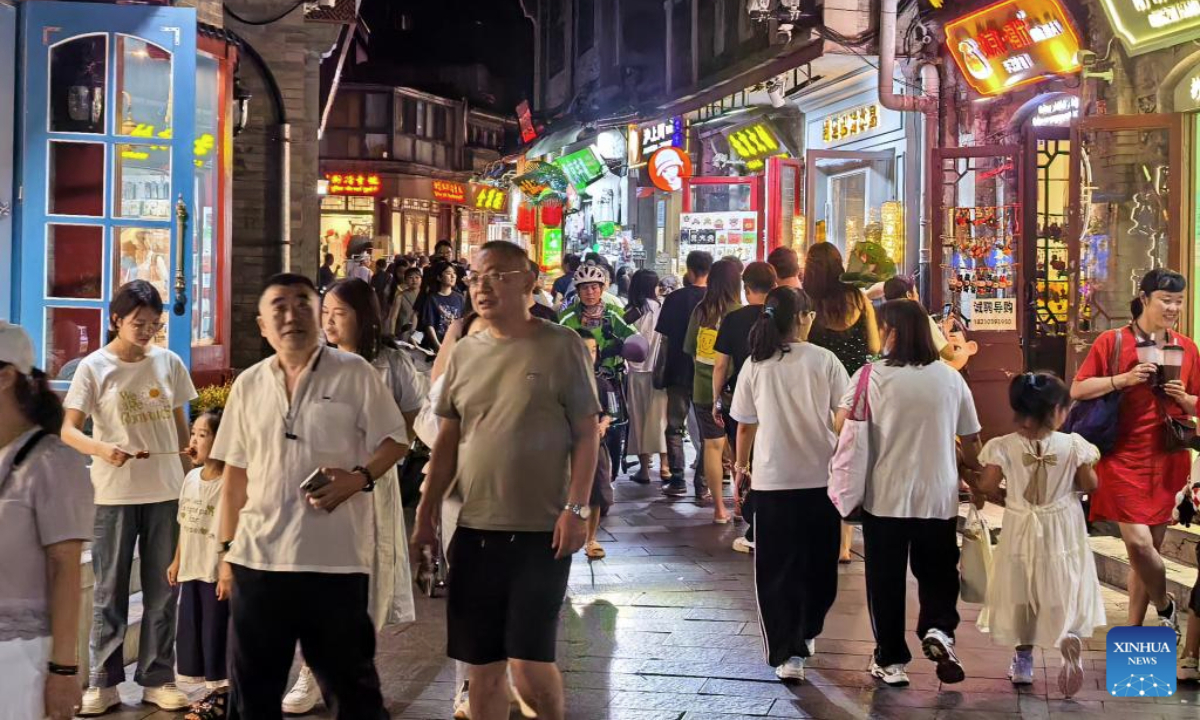
People walk at a pedestrian street near Shichahai scenic area in Beijing, capital of China, July 30, 2025. Beijing has vigorously developed its night economy since the beginning of this summer, featuring local cuisine, outdoor films, music festivals, and night markets. (Xinhua/Li Xin)
Several Chinese regions have included the nighttime economy in their local government work reports, aiming to stimulate consumption through a range of policy tools and make it a key driver for expanding and improving services consumption.
Shanghai has proposed to "further expand services consumption by developing the debut economy, nighttime economy, livestreaming economy, and silver-haired economy."
East China's Fujian Province said that it aimed to innovate the development of the "ticket-stub economy" and "nighttime economy," as part of efforts to lift consumption.
East China's Jiangsu Province specified efforts to cultivate distinctive consumption by creating new scenarios such as first-release stores and debut exhibitions and shows, supporting new business models such as performances and nighttime consumption, and fostering new models such as instant retail.
The nighttime economy has become a key driver in activating consumption potential, Liu Dingding, a veteran industry analyst, told the Global Times on Tuesday.
In his view, the core value of nighttime economic activity lies in its ability to augment limited daytime consumption.
By extending operational hours and broadening experiential settings, it supports growth across the hospitality, cultural tourism, and retail sectors, transforming latent demand into measurable economic gain.
A joint report released by the China Tourism Academy and Landsky Technology Group Co in January showed that in 2025, the demand side of the nighttime economy increasingly sought an upgraded experience characterized by diversity, novelty, and social engagement.
Nighttime tourism demand in China has shown steady growth. From January to October 2025, such expenditures accounted for 32.9 percent of total daily tourism spending, with the proportion of nighttime transactions reaching 28.3 percent, the report said.
In September 2025, the Ministry of Finance and the Ministry of Commerce jointly issued a notice pledging to launch pilot programs for new forms, models, and scenarios of consumption. As part of these efforts, the notice emphasized the need to innovate and diversify services consumption scenarios, explicitly including the development of nighttime culture and tourism consumption hubs as a key initiative.
The notice said that China has solid consumption fundamentals, underpinned by an extensive transport network and significantly enhanced supply of consumer goods. At the same time, it points out that supply quality in certain sectors still needs improvement.
Traditional business models often fail to meet the diverse and personalized needs of consumers, while new consumption formats, models, and scenarios remain underdeveloped, constraining their potential to fully drive growth, it said.
The development of the night economy aligns with the government's policy direction, as consumption now serves as a key driver of China's economic expansion.
On February 6, the Ministry of Commerce (MOFCOM) said at a press conference that China will take multiple measures to promote the development of services consumption.
Kong Dejun, a MOFCOM official, said that services consumption is increasingly becoming a crucial engine for high-quality economic development.
"In the coming period, the development of services consumption will enter a key strategic opportunity phase, playing a significant role in boosting household consumption rates and driving high-quality economic growth," he said.
From 2020 to 2025, China's per capita services consumption grew at an average annual rate of 8.5 percent, with services spending accounting for 46 percent of consumption expenditures in 2025, Kong said.
The night economy has also attracted companies to explore business opportunities.
On January 7, Alibaba's location-based services platform Amap launched "Flying Street View," a new feature that allows users to take immersive, 3D virtual tours of restaurants and other venues. The feature is designed to help users gain a clearer sense of a place, such as the layout, seating areas and private rooms, before deciding where to go, while also helping local businesses attract on-site traffic.
Alibaba said that since its debut last September, Amap Street Stars has served more than 660 million users and brought 860,000 merchants on board.
RELATED ARTICLES