Chinese FM introduces key tasks of APEC China 2026, calls to enhance connectivity amid protectionism headwinds
China’s vision and practice offering world with predictability and certainty: expert
By and Li Yu Published: Feb 10, 2026 11:43 PM

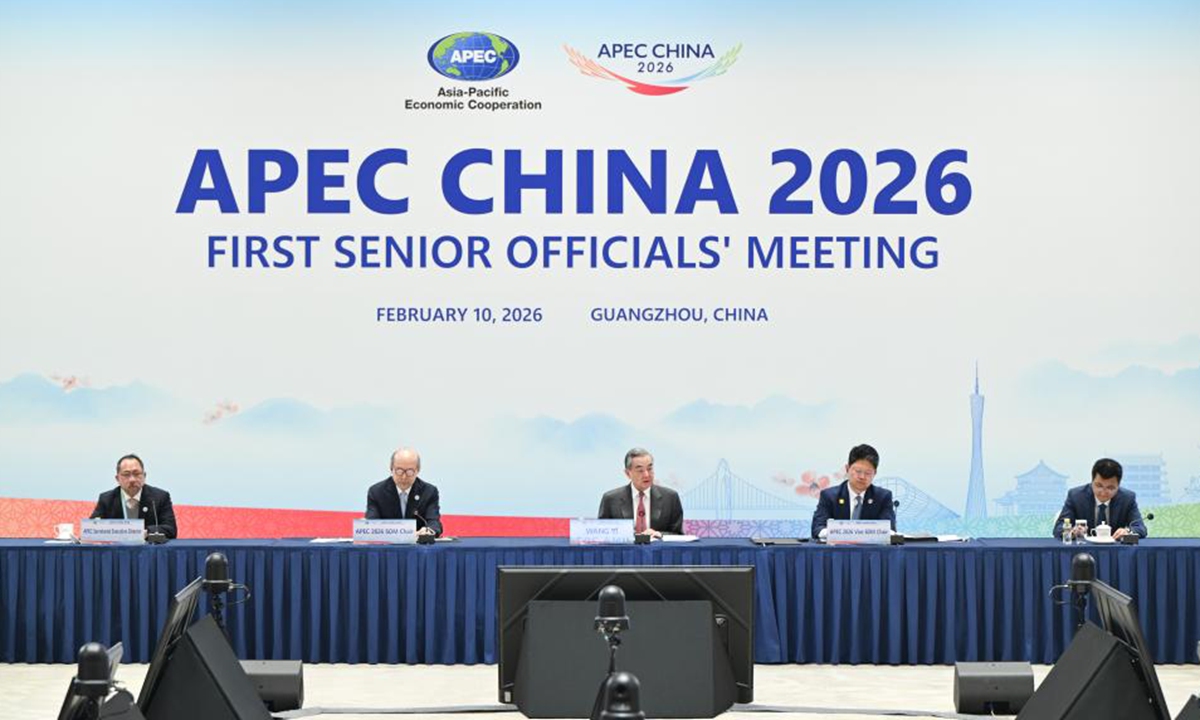
Chinese Foreign Minister Wang Yi, also a member of the Political Bureau of the Communist Party of China Central Committee, delivers a speech while attending the opening session of the First Senior Officials' Meeting of APEC China 2026 in Guangzhou, south China's Guangdong Province, Feb. 10, 2026. Photo: Xinhua
Chinese Foreign Minister Wang Yi on Tuesday addressed the opening session of the First Senior Officials' Meeting of APEC China 2026 in South China's economic powerhouse of Guangzhou, where he outlined the key tasks for APEC China 2026, with openness, innovation and cooperation as the three priorities, against a backdrop of rising unilateralism and protectionism across the globe.According to Chinese Foreign Ministry's release on Tuesday, the senior officials' meeting in Guangzhou marks the first official event hosted by China as APEC host in 2026, attended by more than 1,400 representatives from member economies. All parties held in-depth discussions around the theme of the APEC "China Year" and the three priorities, fully launched cooperation in various fields, and laid the groundwork for outcomes at the APEC Economic Leaders' Meeting to be held in November.
This year marks the APEC "China Year," with the theme of "Building an Asia-Pacific Community to Prosper Together," according to the Xinhua News Agency.
Wang, also a member of the Political Bureau of the Communist Party of China Central Committee, said on Tuesday that the Chinese side will work to promote the adoption of an outcome document that is clear in direction and rich in content at the Leaders' Meeting this year.
We should foster greater connectivity among various regional free trade agreements, and gather momentum toward a Free Trade Area of the Asia-Pacific (FTAAP), Wang said.
He stressed that we should build consensus on cooperation in trade, investment, regulation, and industrial and supply chains, and explore ways to better synergize the Regional Comprehensive Economic Partnership (RCEP) and Comprehensive and Progressive Agreement for Trans-Pacific Partnership (CPTPP) to broaden the path toward the FTAAP.
Driven by innovation, the Chinese side will promote the digital, intelligent and green transition for APEC members, Wang said, noting that the Chinese side will also work for deepening practical cooperation in various fields around development-related governance issues.
Li Haidong, a professor at the China Foreign Affairs University, told the Global Times on Tuesday that this senior officials' meeting is an important step for relative parties to work toward a truly pragmatic and operable blueprint for an Asia-Pacific community with a shared future. And the integration of mechanisms, rules and concepts, as well as the consensus on actions proposed by China, will lay a solid and substantive foundation for the effective development of an Asia-Pacific community.
This once again demonstrates China's growing leading role in international affairs, the expert said.
In his speech on Tuesday, Wang said that the world has entered a new period of turbulence and transformation, and the challenges facing Asia-Pacific development are mounting.
"Unilateralism and protectionism are spreading, economic fragmentation is worsening, and regional economic integration faces headwinds. Against this backdrop, China fully recognizes that our third time as APEC host carries with it significant responsibilities as well as a glorious mission," Wang said, according to a release from the Chinese Foreign Ministry.
Wang called for building a prosperous and stable Asia-Pacific, an open and interconnected Asia-Pacific, a universally beneficial and inclusive Asia-Pacific and a united and mutually supportive Asia-Pacific.
Chen Fengying, a research fellow at the China Institutes of Contemporary International Relations, stated that historically, APEC is a regional integration arrangement formed under the framework of the WTO and globalization. However, with the WTO's functions severely impaired, the priority now is to reconsolidate forces in the Asia-Pacific, restructure regional relations that have been disrupted, and explore future-oriented regional order arrangements.
Against the backdrop of deglobalization sentiment around the world, China has actively promoted platforms for dialogue, stability and cooperation, highlighting China's role in building consensus and steering the direction, Chen told the Global Times.
In the past, China was more of an initiator and participant in Asia-Pacific cooperation. Today, China has evolved into a builder, a leader and a force that unites forces, countering the tide of deglobalization, Chen added.
The APEC "China Year" coincides with the opening year of China's 15th Five-Year Plan (2026-30). According to Wang, China will further deepen reform comprehensively, continue expanding high-standard opening up, and deliver new opportunities for the Asia-Pacific and the wider world with the new achievements of Chinese modernization.
Li noted that China's vision and practices are long-term and strategic, ensuring a high degree of stability and continuity in its policies, offering the world predictability and certainty.
"Thus, in multilateral mechanisms such as APEC, China is able to provide the world with a development blueprint that transcends pessimism and embraces an optimistic future," Li added.
RELATED ARTICLES