US threats further highlight the necessity for Canada to pursue a multipolar approach
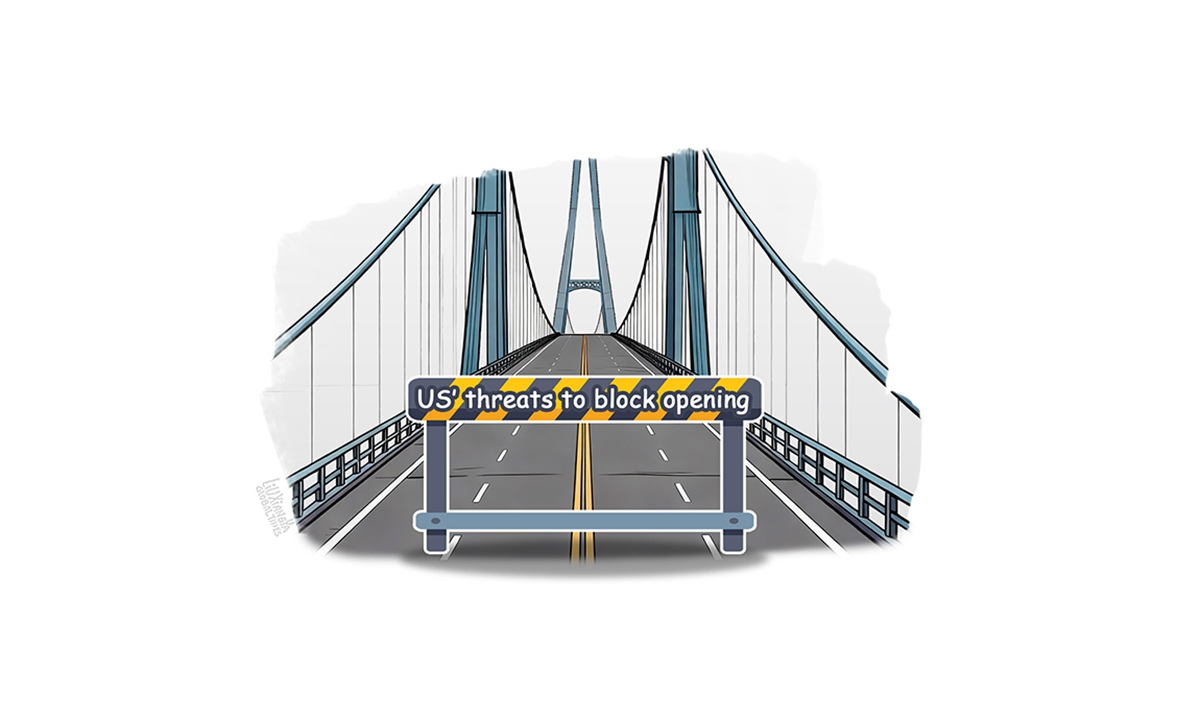
Illustration: Liu Xiangya/GT
For some time, the US has intensified its pressure on its neighbor Canada, and as relations between China and Canada have begun to warm, Washington's irritation has become increasingly evident. According to Bloomberg, US President Donald Trump claimed on social media on Monday that the US will start negotiations with Canada over a new bridge connecting Michigan and Ontario, the Gordie Howe International Bridge. Trump also threatened to block its opening until the US was given compensation and ownership of "at least one half of this asset."
Tensions escalated after Canadian Prime Minister Mark Carney openly criticized US policies at the Davos Forum, prompting Washington to launch a series of harsh attacks against Canada. Bloomberg reported that another factor behind the US pressure is Canada's trade arrangements with China, reached in January, which the US has deemed a "threat." Trump claimed on Monday that making a deal with China "will eat Canada alive."
According to Bloomberg, the Gordie Howe International Bridge was fully financed by the Canadian government, with an estimated total cost of about $4.7 billion. In 2017, the US and Canada issued a joint statement describing the bridge as "a vital economic link between our two countries." However, it has now been reduced to a bargaining chip for Washington to exert pressure on Ottawa.
Liu Dan, a research fellow at the Center for Regional Country Studies at Guangdong University of Foreign Studies, warned that if the US follows through on its threats, it could significantly harm Canada's interests. The Windsor-Detroit crossing is one of North America's busiest land corridors, and blocking the bridge from opening could disrupt the North American automotive supply chain, which relies heavily on cross-border logistics, Liu told the Global Times.
Historically, while US-Canada relations have been deeply integrated, they have been fundamentally asymmetric. Liu noted that this asymmetry has evolved from economic frictions into disputes involving economic and even national sovereignty. The US has made threats to "annex Canada," labeled it the "51st state," and has repeatedly used tariffs and now infrastructure as leverage, revealing a disregard for Canada's sovereignty and a hegemonic mind-set. The US actions reflect anxiety over Canada, its closest geopolitical ally, actively seeking diversification in its international relationships.
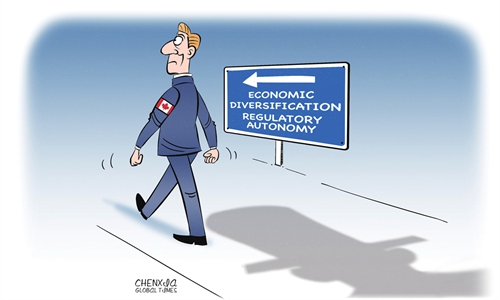
The persistent pressure from the US has become a significant external factor driving Canada's strategic shift toward cooperation with diverse partners, including China. Canada's recent pivot — from following the US in adopting a tougher stance toward China to actively seeking collaboration — demonstrates its increasing focus on economic security, industrial development, and diplomatic autonomy. China has long been Canada's second-largest trading partner. Following Carney's visit to China, the two countries reached agreements in eight areas, including agrifood and food security, green and sustainable trade, and e-commerce cooperation. These collaborations have garnered positive domestic feedback; a recent poll by North American market research company Leger indicated that 61 percent of respondents supported allowing more Chinese electric vehicles into the Canadian market.
The US has repeatedly threatened Canada, underscoring the practical necessity for Canada to pursue economic diversification and embrace a multipolar approach. China and Canada have established a new type of strategic partnership, and made some specific arrangements on properly handling the economic and trade issues between the two countries. In stark contrast, the US continues to use political pressure to constrain Canada's policy options.
The claim that a deal with China would "eat Canada alive" seems more like a projection of Washington's own unilateral actions. In this context of increasing US pressure, Canada's efforts to strengthen engagement with China, diversify its economic and trade relationships, and secure greater autonomy in a multipolar world represent a rational strategy to protect its long-term interests and reduce dependence on a single ally.
RELATED ARTICLES