Xi visits people in Beijing ahead of Spring Festival, extends greetings to all Chinese
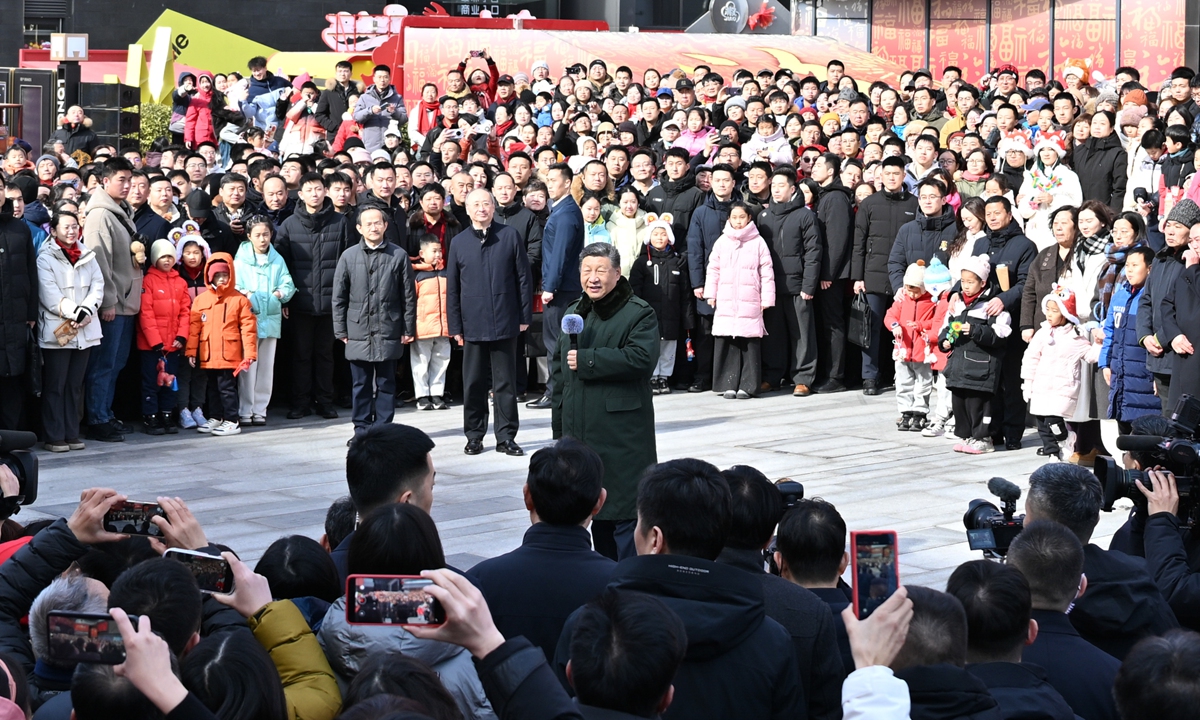
Chinese President Xi Jinping extends Spring Festival greetings to Chinese people at home and abroad ahead of the festival at the Longfusi commercial area in Dongcheng district, Beijing, on February 10, 2026. Xi visited primary-level officials and residents in Beijing during a two-day inspection tour from February 9 to 10. Photo: Xinhua
Chinese President Xi Jinping visited primary-level officials and residents in Beijing during a two-day inspection tour from Monday to Tuesday, extending Spring Festival greetings to Chinese people at home and abroad ahead of the festival, the Xinhua News Agency reported.
Xi, also general secretary of the Communist Party of China (CPC) Central Committee and chairman of the Central Military Commission, wished them good health, career success, and family happiness. He also wished the country peace and prosperity in the Year of the Horse.
The inspection marked Xi's first local inspection tour in 2026, the opening year of the 15th Five-Year Plan period (2026-30), according to a separate report of the Xinhua News Agency.
Putting the people first
On Tuesday morning, Xi came to a Beijing downtown community which was renovated to be barrier-free and age-friendly. He visited a community canteen for seniors to learn about the meal services provided there, Xinhua reported.
In Xicheng district, Xi also visited an apartment complex for seniors, where he spent time with the elderly, wishing them health, longevity and a happy Spring Festival.
Xi talked with three delivery workers who were having a rest in the canteen, asking about their work and life, Xinhua reported.
"You've worked hard to meet the needs of countless households, and the city couldn't function without workers like you. I hope you all can lead good lives and work well," Xi said.
Xi urged Party committees and governments at all levels to care for workers in new forms of employment and provide quality services for their work, daily life and study.
Arriving at the Longfusi commercial area in Dongcheng District, Xi was briefed on urban renewal efforts there. He stopped by a store of the traditional bakery brand Daoxiangcun, where he watched pastry-making.
At a Spring Festival market, he visited various stalls selling festive goods and talked with people there, sharing memories of his visits to the area when he was young. He also bought some specialty food and culture-themed products.
Xi said he was very pleased to see the bustling, vibrant festive scene and well-stocked holiday goods there.
Since the 18th National Congress of the CPC in 2012, it has been a long-standing practice for the country's top leader to visit grassroots officials and people from various walks of life across the country during festive occasions, offering greetings and extending best wishes, Xinhua said in a separate report.
This people-centered approach is also reflected in the formulation of the 15th Five-Year Plan, whose recommendations stress "putting the people first" and identify "further improvements in quality of life" as one of the main objectives of economic and social development during the new five-year plan period.
The Chinese leader's choice of inspection sites carries clear and deliberate policy signals, reflecting both important demand-side considerations and the people-centered development philosophy, Hu Qimu, deputy secretary-general of the Forum 50 for Digital-Real Economies Integration, told the Global Times on Tuesday.
"The 'silver economy' is emerging as a major source of domestic demand growth, as many retirees today have both the financial capacity and the willingness to consume," Hu said, adding that it will stimulate supply across a wide range of sectors - particularly services and emerging technologies like AI - creating new growth points.
On the policy front, the central government allocated 141 billion yuan ($20.37 billion) in central fiscal funds in advance to support people in need at the start of the year, as local governments moved to shore up the social safety net and ensure disadvantaged groups stay warm through the winter and enjoy a safe and festive holiday season, CCTV reported on Monday.
Achieving greater tech self-reliance
On Monday morning, Xi visited a national information technology innovation park in Beijing E-Town, where he viewed displays showcasing sci-tech achievements in fields such as artificial intelligence and robotics, and spoke with researchers and heads of technology enterprises.
Xi said he was "even more confident" in the country's sci-tech innovation after seeing what was presented during the visit.
He stressed that sci-tech self-reliance and strength is the "key" in China's efforts to build a great modern socialist country and urged the Chinese capital to leverage its unique strengths to make greater contributions in this regard.
Built in 2019, the park centers on IT innovation while expanding into frontier areas including artificial intelligence, quantum information, 6G communications and intelligent hardware, according to a statement the park sent to the Global Times on Monday.
The Chinese leader's visit to an information technology innovation park highlights the central government's focus on scientific and technological innovation as the core driver of the transition toward new-quality productive forces, Su Jian, a professor at Peking University's School of Economics and director of its National Center for Economic Research, told the Global Times on Tuesday.
Information technology, Su said, is a core enabler for cutting-edge fields such as AI, the digital economy and even aerospace, and the visit clearly signals a push to tackle bottlenecks in key technologies, including semiconductors.
The recommendations for the 15th Five-Year Plan call for achieving greater self-reliance and strength in science and technology and steering the development of new quality productive forces, emphasizing that Chinese modernization is underpinned by modernization in science and technology.
Liu Gang, chief economist of the Chinese Institute of New Generation Artificial Intelligence Development Strategies, said 2026 is a decisive starting point for determining the successful implementation of China's science-and-technology self-reliance strategy over the next five years. "The inspection helps clarify strategic goals in emerging and future industries and sends a clear, positive signal to both industry and society," he told the Global Times.
At the park, Galaxy General - an embodied multimodal foundation-model robotics company - demonstrated its Galbot G1 robot. In a statement sent to the Global Times, founder and chief technology officer Wang He who took part in Monday's meeting said the company stands ready to serve as a core vehicle for China's participation in global tech competition and Beijing's efforts during the 15th Five-Year Plan period to build world-class technology enterprises.
Amid increasingly pronounced major-power competition, the push for scientific and technological self-reliance is aimed not only at the 15th Five-Year Plan but at laying a solid industrial foundation and accumulating momentum for a much longer horizon to advance Chinese modernization, Su said.
The inspection's dual focus on people's livelihoods and technological innovation reflected the top leadership's enduring care for public well-being and commitment to a people-centered development philosophy, while also sending a clear signal of policy continuity as China doubles down on breakthroughs in technology sectors to accelerate new growth engines and underpin long-term economic transformation, Chinese experts said.
Regional hubs gain traction
During the trip, Xi heard a work report by Beijing municipal authorities and gave his approval for the city's progress across the board, Xinhua reported.
He asked the Chinese capital to seize the opportunity of enlarging the Beijing (Beijing-Tianjin-Hebei region) international sci-tech innovation center to strengthen its innovation coordination and industrial cooperation with Tianjin and Hebei, per Xinhua.
China's innovation drive is backed by the collaboration of regional clusters. Cities such as Beijing are also accelerating the building of international sci-tech innovation centers, markedly lifting innovation capacity, competitiveness and spillover effects. A report released last month by Peking University showed that the Beijing-Tianjin-Hebei collaborative innovation index rose from 100 in 2013 to 388.0 in 2024, with an average annual growth rate of 13.1 percent, according to the Beijing Daily.
Su said the choice of Beijing as the first stop reflects recognition of the city's role as a national - and increasingly global - innovation hub, aligning with the central government's emphasis on the layout of innovation and demonstrating continuity and sustained policy support.
RELATED ARTICLES