Illustration: Xia Qing/GT
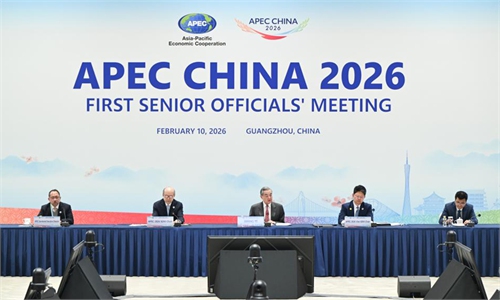
The opening session of the First Senior Officials' Meeting of APEC China 2026 was held in Guangzhou on Tuesday. This meeting not only built consensus for the subsequent activities and cooperation of the APEC "China Year," but also demonstrated China's more proactive, open, and pragmatic approach. Approximately 300 APEC-related meetings and events will take place across multiple Chinese cities throughout the year.
The global economic recovery remains fragile. Geopolitical conflicts, trade frictions, and the restructuring of supply chains are deeply intertwined, while unilateralism and protectionism are on the rise. Against this backdrop, countries around the world are grappling with unstable expectations and a lack of confidence. The launch of APEC "China Year" at this critical juncture injects a stabilizing force into Asia-Pacific cooperation, sending a clear signal of China's resolve to uphold multilateral cooperation and remain committed to open development.
Since its inception, APEC has consistently championed open regionalism, adopting a cooperative approach based on consensus-building and voluntary participation. This has enabled it to demonstrate unique resilience amid complex and volatile international conditions. The First Senior Officials' Meeting of APEC China 2026 and related sessions will feature in-depth discussions on several key topics, such as trade and investment, science and technology innovation. These topics directly address the real challenges facing Asia-Pacific economies and respond to the international community's shared expectations for a stable development environment, reflecting the practical relevance and forward-looking nature of APEC's cooperation agenda.
As the host of the 2026 Asia-Pacific Economic Cooperation, China will hold the 33rd APEC Economic Leaders' Meeting in Shenzhen, Guangdong Province, in November.
As one of the key venues hosting events for the APEC "China Year," Shenzhen holds profound symbolic significance. Since the launch of reform and opening-up, Shenzhen has evolved from a remote border town into a globally influential hub of innovation. Its development journey is a vivid microcosm of China's commitment to integrating into the global economy. Through APEC, Shenzhen will showcase China's practical achievements in the digital economy, technological innovation and green transformation. It will also provide a tangible platform for all parties to strengthen experience exchange and expand practical cooperation. What Shenzhen demonstrates is not only its urban development experience but also a concentrated embodiment of China's comprehensive institutional innovations in opening up to the world, offering valuable insights for Asia-Pacific economies as they navigate structural transformation and development challenges.
Looking ahead, the key to advancing APEC cooperation lies in translating consensus into action and turning vision into tangible outcomes. Amid a complex global environment, APEC must continuously enhance inclusive, stable and forward-looking cooperation.
Capacity building is key to enhancing the inclusiveness of APEC cooperation. Given the disparities in development levels within the region, we should encourage economies to strengthen policy experience exchanges, technical support and talent training, building an open, jointly constructed and shared capacity-building system. Through the APEC platform, we can facilitate the better integration of developing economies into the regional cooperation process, narrow the gaps in areas such as digital transformation, green development, and industrial upgrading, and consolidate the social foundation for regional cooperation.
Focusing on policy coordination and communication of rules could enhance the stability of APEC cooperation. In the face of increasing fragmentation and uncertainty in global economic and trade rules, we should strengthen policy transparency and engage in rule dialogue to foster replicable and scalable institutional arrangements.
Using innovation as a driving engine can enhance the forward-looking nature of APEC cooperation. Focusing on cutting-edge fields such as the digital economy, artificial intelligence and green low-carbon development, we can promote policy exchanges, technological cooperation and demonstration projects to foster an ecosystem for applying innovative outcomes. Against the backdrop of a new global wave of technological revolution and industrial transformation, APEC will enhance its leadership on emerging issues by sharing development experiences, accelerating technology diffusion and cultivating demonstration projects.
Amid heightened global uncertainty, certainty has become the scarcest resource. Through a series of high-level meetings and pragmatic cooperation during APEC "China Year," a clear signal has been conveyed to the international community: The direction of Asia-Pacific cooperation remains unchanged, and the founding spirit of openness and inclusiveness remains unwavering. China stands ready to work with all parties to continuously deepen and solidify APEC cooperation, injecting greater stability and positive expectations into the development of Asia and the world.
Lan Qingxin is the director of the BRICS Research Center, University of International Business and Economics. Xue Yuanjie is a scholar at the School of International Trade and Economics, University of International Business and Economics. opinion@globaltimes.com.cn
RELATED ARTICLES