China breaks final bottleneck in realizing nuclear clock, extending ultra-stable laser technology into vacuum ultraviolet for the first time
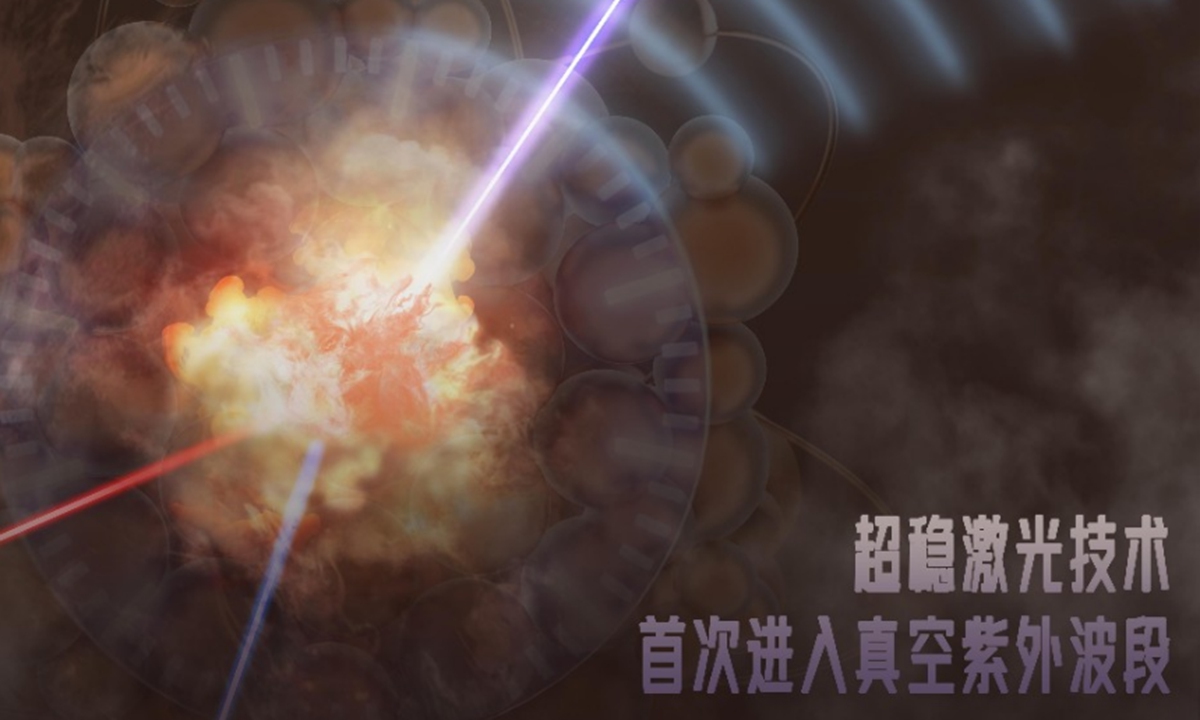
Schematic diagram of the nuclear clock light source Photo: Courtesy of Tsinghua University
Chinese research team achieved a major breakthrough in continuous-wave vacuum ultraviolet (VUV) light sources, a longstanding bottleneck in the development of the nuclear clock, Science and Technology Daily reported on Thursday.
The team successfully developed a 148 nm continuous-wave ultra-narrow-line width laser source, marking the first extension of ultra-stable laser technology into the vacuum ultraviolet region and overcoming the "last core bottleneck" in nuclear optical clock research. This advance fills a key technological gap for nuclear clocks, opens new paths for precision measurement, and highlights China's leadership in quantum science and basic research, per report.
The breakthrough was achieved by a team led by associate professor Ding Shiqian from Tsinghua University, and the result was published on Nature.
A nuclear clock is a new type of timekeeping system that measures time by using vacuum ultraviolet lasers to induce transitions in the thorium-229 nucleus and employing frequency comb technology to count the oscillation cycles of the laser's electromagnetic field. In theory, its measurement precision can reach beyond 10⁻¹⁹, meaning it would lose or gain no more than one second over a timescale of 300 billion years, according to the information released by Tsinghua University's official Wechat account.
While current atomic optical clocks already achieve extremely high precision, they are susceptible to electromagnetic interference and can only operate stably under controlled laboratory conditions. Nuclear optical clocks promise even higher precision and stronger resistance to environmental perturbations, but progress has been hindered by the lack of a suitable 148 nm continuous-wave laser source, according to Science and Technology Daily.
The team innovatively proposed a new scheme using four-wave mixing in metal vapor and achieved continuous-wave output at 148 nm. They reduced the laser's linewidth by nearly six orders of magnitude, laying the technical foundation for ultra-stable lasers in the vacuum ultraviolet band and securing a critical first international breakthrough in this specialized area.
The technological impact of this result is significant: beyond enabling nuclear clock research, the new laser platform could support fields including atomic clocks, quantum information science, autonomous navigation, and deep-space exploration. It also holds potential for independent development of vacuum ultraviolet metrology and advanced testing equipment, per report.
Global Times
RELATED ARTICLES