ARTS / CULTURE & LEISURE
DIY Chinese New Year crafts turn tradition into personal statements
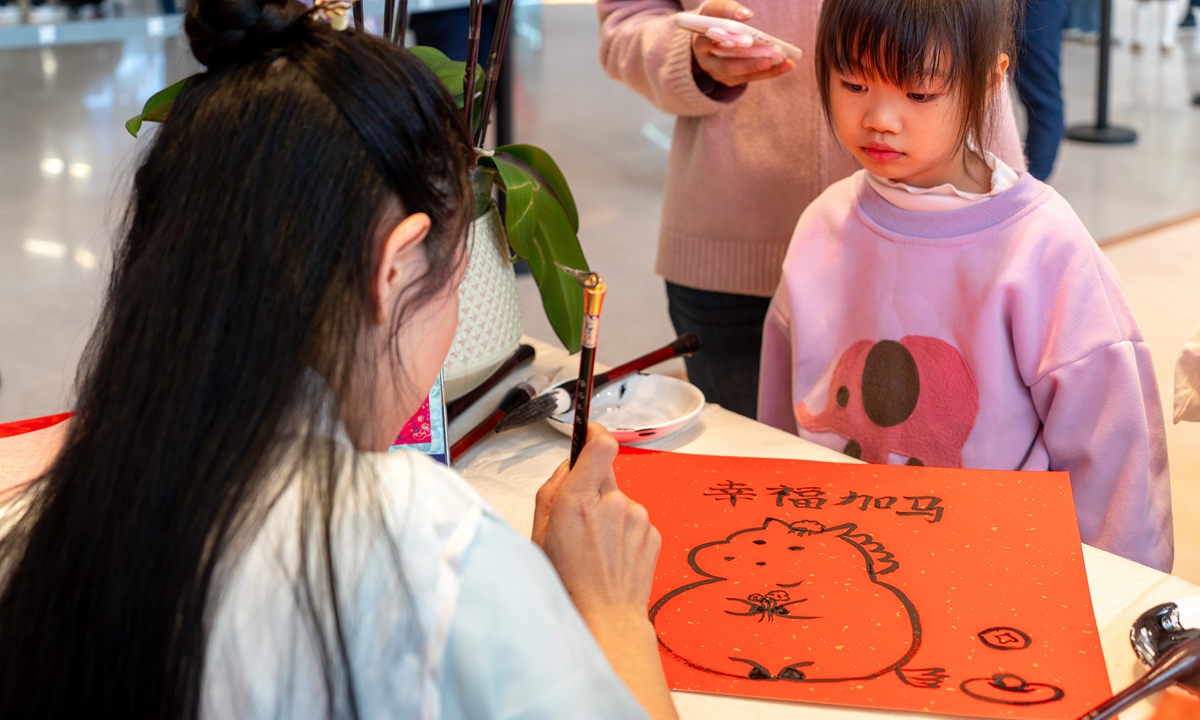
A young girl waits for her handcrafted nianhuo in Guangzhou, South China's Guangdong Province, on February 10, 2026. Photo: VCG
From 3D-printed horse ornaments to Chinese Spring Festival couplets featuring viral internet memes, a DIY craze for nianhuo, or Chinese New Year items, is spreading online. To highlight the handmade nature and the originality of these DIY creations, netizens have also dubbed this trend "all-hand nianhuo."On platforms such as Xiaohongshu, known in English as RedNote, netizens are sharing their diverse all-hand nianhuo. Some are writing encouraging messages or blessings onto traditional red envelopes, known as hongbao in Chinese, others have turned 2025's viral catchphrase "Aini Laoji" (lit: love you, my dear self) into couplets for friends. With 2026 being the Year of the Horse, some are even using 3D printers to create horse-shaped "cyber nianhuo."
These diverse creative expressions actually prove the inclusive nature of New Year items. These items have always encompassed a diverse range, from snacks such as dried fruit and pastries to home decorations like couplets and the Chinese knot. For the Chinese, who have celebrated the Chinese Spring Festival for over 4,000 years, preparing New Year items is a ritual as traditional as the holiday itself.
With both supermarkets and online platforms already offering a dazzling array of choices to consumers, why are these handmade items such a popular option? The answer lies in people's, especially the young generation's, shifting interpretations of New Year items. Be it for personal consumption or to give as gifts, the meaning behind these items lies not in how they are used, but in what they symbolize - the Chinese Spring Festival's spirit of renewal, celebration, and the passing on of blessings. That is to say, these items are a tangible representation of how people see the festival.
For older generations, celebrating the Spring Festival seems to follow a rather traditional script. Their choices of New Year items are practical and closely tied to the unique cultural and social context in which they grew up.
In the 1950s and 1960s, when food coupons were still in use, essentials such as rice, flour, oil, and meat were like the "hard currency" of the time. A bit of brown sugar or a piece of new fabric were considered premium New Year items.
As the times evolved, the hot picks for New Year items have shifted from new electronic appliances and Western tin-box cookies brought from abroad to health product gift boxes reflecting people's growing concern for well-being. These choices reveal how different generations envision hopes for a new year. The occasion of the Chinese Spring Festival serves as the most fitting moment to express that very vision.
So when it comes to the trend toward DIY items, there reasons are twofold. On the one hand, the abundance of material goods in modern society makes them feel that off-the-shelf products no longer suffice to convey one's hopes for the new year. On the other hand, they are also trying to break away from the fixed festive script, redefining the way they participate in the Spring Festival.
What are the fresh ways they use to express themselves? They have begun to reject the consumption of the festival as a mere symbol, and are instead focusing on creating meaning. The red envelope is a typical symbol, but the DIY version is no longer treated as merely a container for money. Instead, by writing messages on the envelope, "each banknote inside comes wrapped with a blessing that corresponds to its value," Cheng Mi, a designer of such DIY red envelopes in Chengdu, told the Global Times.
"With such a design, we can also break away from the popular but tedious numbers like '888' and '666.' Also, opening a special red envelope can create a fun memory for my daughter," Cheng noted.
Additionally, young people are also trying to bring the 4,000-year-old Spring Festival closer to their times.
Moving past florid yet formulaic blessings, the "Love You, My Dear Self" Spring Festival couplets - born from youth subculture and internet memes - offer a more pop-culture-infused way of demonstrating that genuine festival blessings must resonate with the spirit of the times and speak the language of their own generation.
If young people are interpreting the Spring Festival in ways that resonate with their times, this also reflects tradition's enduring ability to adapt and stay meaningful across generations. Whether it's the older generation's "rice, flour, oil, and meat" or the younger generation's meme couplets, the evolution of New Year items reveals how a changing era and an enduring tradition have found a way to meet each other.
The author is a reporter with the Global Times. life@globaltimes.com.cn
RELATED ARTICLES