Munich Security Conference to open amid frayed transatlantic ties
Europe undergoing unprecedented strategic awakening but security dependence on US persists: expert
By and Li Yu Published: Feb 12, 2026 11:52 PM

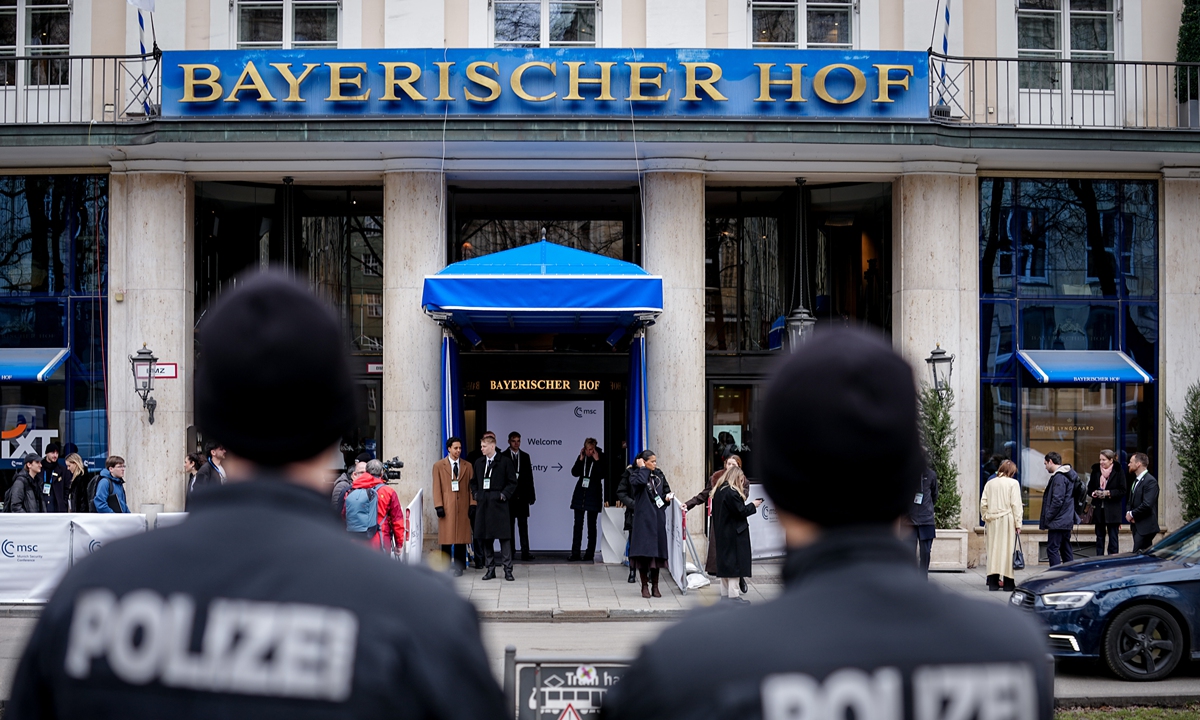
Security staffers guard the Hotel Bayrischer Hof on February 12, 2026, where the 62nd Munich Security Conference (MSC) will take place from February 13 to 15, 2026. Photo: VCG
Amid rising anxiety and insecurity in Europe driven by strained transatlantic ties - including deepening divisions over the Russia-Ukraine conflict, the US' aggressive Greenland acquisition ambitions and punitive tariffs targeting longtime allies - prominent security officials and academics are set to gather in southern Germany, for the 62nd Munich Security Conference (MSC) which lasts from Friday through Sunday.
MSC marks another vital multilateral event held in Europe in 2026, following the Davos World Economic Forum weeks before, during which Canadian Prime Minister Mark Carney warned that the US-led global system of governance is enduring "a rupture."
According to German media DW, the 2026 MSC will bring together about 65 world leaders, including German Chancellor Friedrich Merz, along with nearly 100 foreign and defense ministers, top military brass and high-level policymakers for three days of discussions.
Chinese Foreign Minister Wang Yi will attend the 62nd MSC and deliver a speech at the China session, according to Chinese Foreign Ministry.
'Deeply wounded, but not dead yet'
Last year, US Vice President JD Vance lectured Europe at the conference in a patronizing tone, leaving many European elites visibly rattled. This year, the US delegation will be led by Secretary of State Marco Rubio. MSC chairman Wolfgang Ischinger said more than 50 members of the US Congress were expected to attend as well.
Wang Yiwei, director of the Center for European Union Studies at Renmin University of China and an attendee at this week's MSC in Munich, told the Global Times that unlike last year's MSC, where US Vice President JD Vance and Secretary of State Marco Rubio were present, this year's US participation is led solely by Rubio, a clear step down in protocol and seniority.
Ahead of MSC, leaders of major EU powers have also shown a tough stance toward the US.
Speaking to CEOs and senior industry representatives at the European Industry Summit in Antwerp on Wednesday, German Chancellor Friedrich Merz said that "we are neither naive nor defenseless. We have instruments at hand," warning that the EU will not hesitate to retaliate if the US threatens new tariffs again.
In an interview with European newspapers on Tuesday, French President Emmanuel Macron warned that Europe should brace for more moments of US hostility, per a Reuters report.
"When there's a clear act of aggression, I think what we should do isn't bow down or try to reach a settlement. I think we've tried that strategy for months. It's not working," Macron said, per the AP.
"Transatlantic relations will be the core issue at this year's MSC. Europe is expected to use the MSC platform to signal its clear attitude toward its future US policy," Jin Ling, director and senior research fellow of the Department for Global Governance and International Organizations at the China Institute of International Studies, told the Global Times.
To be more specific, in a context where the US increasingly treats security issues as tools for pressuring and extorting Europe, pursuing strategic autonomy and avoiding endless concessions and blackmail would be the thorny issue Europe must confront head-on at the MSC.
Beyond tariff disputes threatening Europe's economic security, green industries have emerged as another key flashpoint as the US administration's energy policies starkly diverge from Europe's green transition goals. While the Ukraine crisis has accelerated Europe's efforts to de-risk from Russia, the reality is that reliance on US LNG has deepened significantly, prompting Europe to reassess its overall energy security architecture, according to Jin.
The latest Munich Security Report released on Monday has sounded the alarm over the systematic dismantling of the international order and the rise of what it calls "wrecking-ball politics." It added that the transatlantic rift has left the US "unrecognizable" to most Europeans, according to Xinhua News Agency.
"At the moment, transatlantic relations are, in my view, in a considerable crisis of trust and credibility," Ischinger told a press conference on Monday in Berlin, per Reuters.
Amid Europe's pessimism, the American political media outlet Politico commented in a Wednesday report that the alliance between Europe and America is "deeply wounded,'' but "it's not dead yet."
Europe hopes that the US-Europe relationship will become more like an equal partnership between husband and wife, but at present, the US-Europe dynamic is more akin to a father-son relationship, Wang Yiwei said.
Generally speaking, Europe, overshadowed by the US, is mired in helplessness and a deep-seated disorientation toward the future world order, Wang Yiwei said.
Where is Europe headed?
Ahead of the MSC, 27 EU leaders on Thursday gathered in Belgium for a summit to discuss how to make Europe more competitive as it seeks to reduce dependence on the US, per Politico.
Although Europe is experiencing an unprecedented strategic awakening - realizing that it must de-risk from the US - its greatest weakness lies in the domain of security, Jin said.
In the short term, Europe will inevitably still need to make compromises with the US, but at the same time, it will accelerate the expansion of networks with other partners, during which China's role can hardly be overlooked, Jins aid.
In early 2026, leaders from multiple European countries, including Ireland, Finland, and the UK, successively visited China. According to Wang Yiwei's observations, the number of invited Chinese scholars attending this year's MSC has increased, indicating that Europe still holds considerable expectations toward China and hopes to hear more voices from China.
"Compared to the highly disruptive policies adopted by the US in multilateral affairs, China is broadly viewed as a more stable and predictable force," Jin said. "Following the launching of the 15th Five-Year Plan, China is likely to release even more opportunities for opening up to the outside world."
She said Europeans feel an even greater urgency regarding global governance and will place greater emphasis on cooperation with China in international affairs and multilateral domains.
RELATED ARTICLES