From hometown flavors to global feast: two decades of change on Chinese festival dinner table
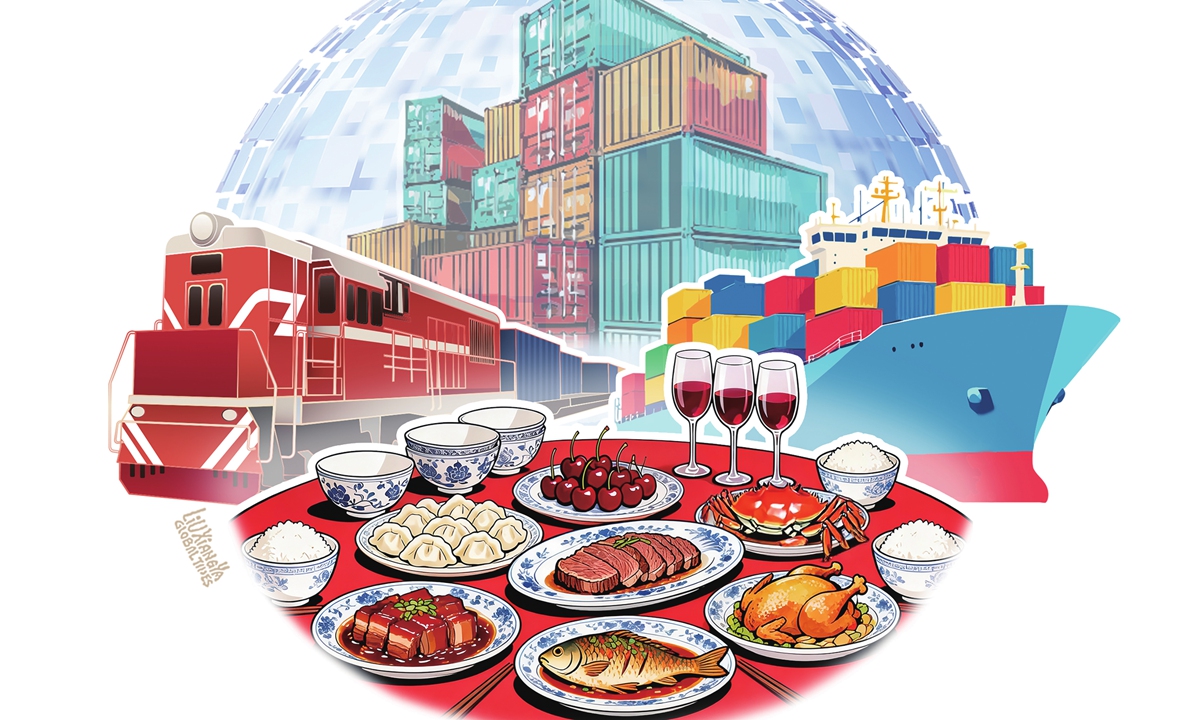
Illustration: Liu Xiangya/GT
Dear reader, as you read this, the curtain is rising on the most significant and heartwarming moment of the year for countless Chinese families.
Wanderers have returned to their nests, and lights are glowing in millions of homes. The opening act of this grand festival is, and always will be, the Nianyefan - the Chinese New Year's Eve reunion dinner. It is more than just a carnival for the taste buds; it is a totem of emotion and belonging.
However, if we zoom out and look at the rising steam from these meals for over 20 years, we see something more: a condensed history of China's opening-up to the world.
Twenty years ago, the reunion dinner was a soulful "folk ballad." Today, it has evolved into a grand "global symphony."
Let us rewind the clock to the early 2000s. At that time, China had only recently joined the World Trade Organization (WTO). Back then, the menu was dominated by the "Big Four" staples: chicken, duck, fish, and pork.
In the north, the table wouldn't be complete without a steaming pot of pork stewed with vermicelli, or homemade fried pork bites and meatballs. In the south, there had to be a whole chicken (symbolizing good luck) and a whole braised fish (symbolizing abundance or "surplus" for the coming year).
The luxuries of that era might have included a box of ribbonfish transported from the coast, or a tin of fancy candies brought back from a big city.
The "flavor of the year" was almost purely Chinese, or more accurately, purely local.
The circulation radius of ingredients rarely exceeded a few hundred kilometers; the meal was introspective and self-sufficient. If a bottle of imported red wine or a plate of unnamed foreign fruit appeared on someone's table, it became the ultimate showpiece for conversation during holiday visits.
In those days, our trade was primarily about "selling out." We exported shirts, shoes, and toys to earn capital for national development, while families focused simply on having a meal that was "rich and substantial."
Now, take a close look at the tables of Spring Festival holidays this year. You will find that while the "hometown filter" remains the base, it is now overlaid with a dazzling "international light."
The Chinese reunion dinner has become a stage for premium ingredients from around the globe.
Traditional dishes now share tables with global delicacies like sashimi, king crab, and imported meats. After dumplings, Chilean cherries or Brazilian nuts appear. Kids get cookies or chocolates, adults get imported wine. This shift is disruptive.
The appetite of the Chinese people has evolved: from "eating to fill up" to "eating well", and now to "eating for health and quality." Imported food has shifted from a "novelty" to a "daily routine," from a "garnish" to a "necessity."
This transformation on a small dinner table reflects a seismic shift in China's foreign trade landscape.
From homegrown flavors to a cosmopolitan spread, this 20-year transformation in the Chinese festival dinner table bears witness to China's embrace of the world.
China is no longer just a producer in the global supply chain; it is an indispensable consumer in the global industrial chain.
When we peel a Chilean cherry, we are enjoying the dividends of the China-Chile Free Trade Agreement, the leap in cold-chain logistics technology, and the roar of the "Cherry Express" chartered flights.
Every "foreign dish" placed on the table represents a micro-circulation of the global economy. Through these millions of dinner tables, China has issued its most tangible invitation to the globe: "Sharing opportunities with the world."
Yet, the roots of the feast remain unchanged. We consume the best the world offers, but what we savor is Chinese unity and family bonds. In this modern footnote to an ancient festival, we see not only material abundance but also why a major power can embrace the world with such confidence.
With every lift of the chopsticks, we pick up not just the good fortune of the coming year, but the fruits of two decades of magnificent change.
RELATED ARTICLES