New Year on the Frontlines: Post-2000 generation workers stack 'building blocks' near the Taiwan Straits
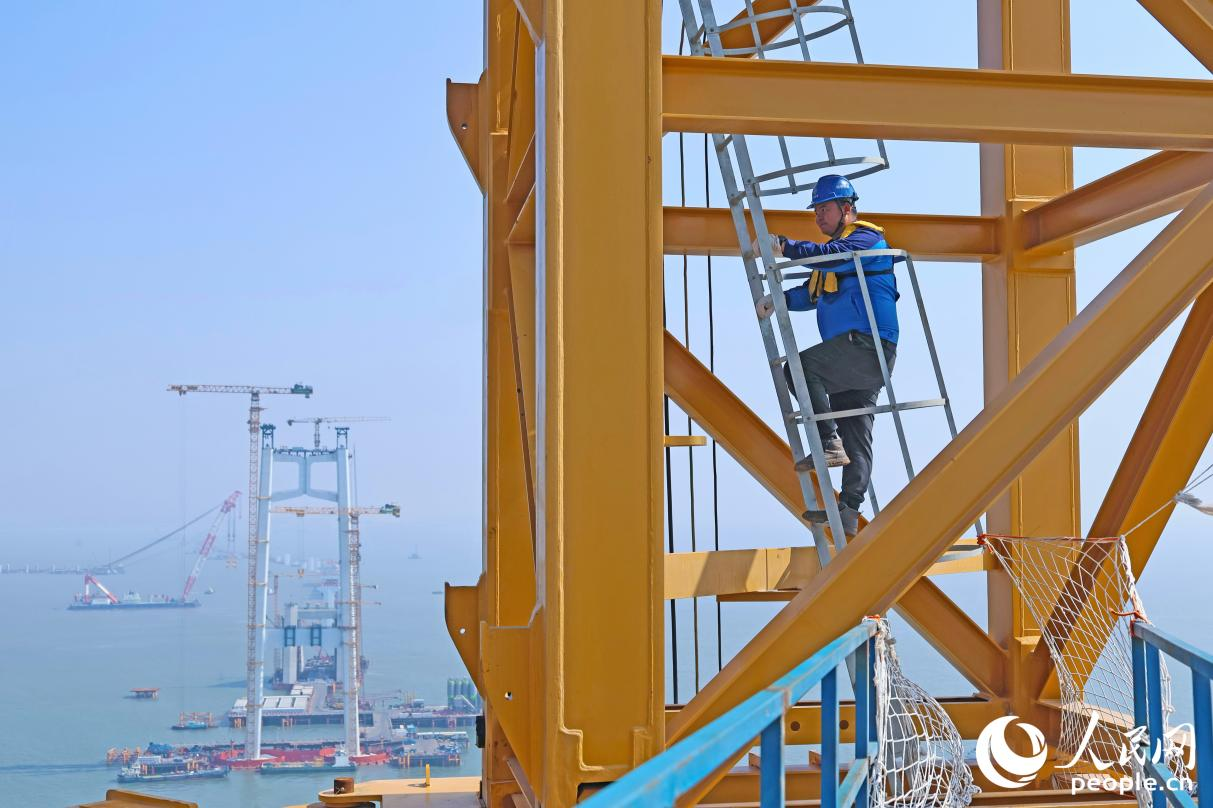
Tower crane operator Liu Guozheng at the construction site of the Xiamen-Kinmen Bridge (Xiamen Section) in Fujian Province Photo: Li Changqian/People's Daily Online
Editor's Note:
This year marks the 105th anniversary of the founding of the Communist Party of China (CPC) and the opening year of the 15th Five-Year Plan (2026-30). A new year begins with new resolve and new momentum. The call to "fight for our dreams and our happiness, and turn our great vision into beautiful realities" continues to inspire action across China.
In the column "New Year on the Frontlines," reporters from the People's Daily traveled to the grass roots to witness the vitality of a vast nation, see its mountains and rivers in motion and its fields in abundance, and listen to the stories of people finding fulfillment in both life and work.
Through these stories, the column seeks to present a vivid portrait of Chinese modernization.
In the Xiamen-Kinmen waters off the coast of China’s Fujian Province, along the western edge of the Taiwan Straits, the sound of crashing waves mingles with the distant rumble of machinery.
In the morning at the construction site of the Xiamen section of the Xiamen-Kinmen Bridge, the reporters met Peng Shizhou, section project administration supervisor from China Communications Construction Company's Second Harbor Engineering Company. A smile lit his young face. “Just call me Xiao Peng,” he said, pointing to the bridge structure not far away. “Look, that’s the bridge’s east‑west main tower. It was capped at the end of last year.”
A 2023 circular jointly issued by the CPC Central Committee and the State Council to make Fujian Province a demonstration zone for the integrated development across the Taiwan Straits, proposed exploring a model for Xiamen-Kinmen joint infrastructure development, facilitating the supplies of electricity and gas and the construction of bridges from Xiamen to Kinmen. At the end of 2023, the Xiamen-Kinmen Bridge (Xiamen section) officially began construction.
“We’re using an unreinforced steel‑shell concrete composite structure, so there’s no need to tie rebar inside the shells,” Peng explained. “That reduces on‑site labor and improves construction efficiency.”
“For non-navigation-span bridges, we use prefabricated, assembled construction, which can greatly reduce disturbance to the seawater environment and help protect marine habitats,” he added.
Leading the reporters around the site, Peng talked about the project nonstop. When asked how many years he had been involved in bridge construction, Peng replied, “I was born in 2001. This bridge is the start of my career — it’s been less than two years.”
“So you came here right after you graduated?” the reporter asked.
“Yes. When I came here after graduating from university in 2024, there was almost nothing on the sea,” Peng said. He started as a project specialist and gradually became familiar with the project department’s overall work. “I also like photography. Whenever I have time, I use a camera to record the project as it ‘grows up.’”
He showed a set of photos on his phone documenting the bridge’s changes from August 2024 to February 2026 — the towers rising “out of the sea” like stacks of building blocks.
In the afternoon the reporter rode the construction elevator up the west main tower with Peng to get a close look at that “stacking block” process. The attendant pushed the control lever and the elevator slowly rose. After a 160-meter elevator ride, they still had to climb three flights of stairs. Tower crane operator Liu Guozheng has been “commuting” like this for nearly 300 days.
“Go slow…great, stop!” In the tower crane cab, the radio kept crackling with instructions. Liu kept his eyes on the hook, making fine adjustments to the controls with practiced skill. "We're hoisting the bridge cable saddle now — a lot easier than the 'big building blocks,'" he said.
The “big building blocks” Liu referred to are steel shells weighing up to 155 tons. As key components in the construction of the bridge’s main tower, 60 steel shells must be hoisted up section by section; after being welded and filled with concrete they become the bridge’s “backbone.” “The higher the hook goes, the greater the wind resistance, and the stricter the requirements on swing amplitude and landing position,” Liu said. “Each hoisting operation is a huge test of both skill and nerves — there’s no room for error.”
To meet the goal of opening the main sea route by the end of the year, the bridge builders will stay on duty over this Spring Festival. "A few days ago, we just completed the pilot cable installation for the Liuwudian navigation bridge — another major milestone after the main tower was capped," Peng said. Everyone is highly motivated, working hard to lay the groundwork for the upcoming main-cable and steel box-girder installations. "I won't go home this Spring Festival. Besides doing my job, I especially want to use camera to capture my coworkers' spirit and energy."
As dusk fell, Peng and his coworkers stood high on the bridge tower, gazing out over the quiet sea, the once‑wide strait seemed to have become “shallower”…
RELATED ARTICLES