IN-DEPTH / IN-DEPTH
New Year on the Frontlines: Post-2000s ‘rail beauticians’ power Beijing South Railway Station’s grinding team, safeguarding Spring Festival travel rush
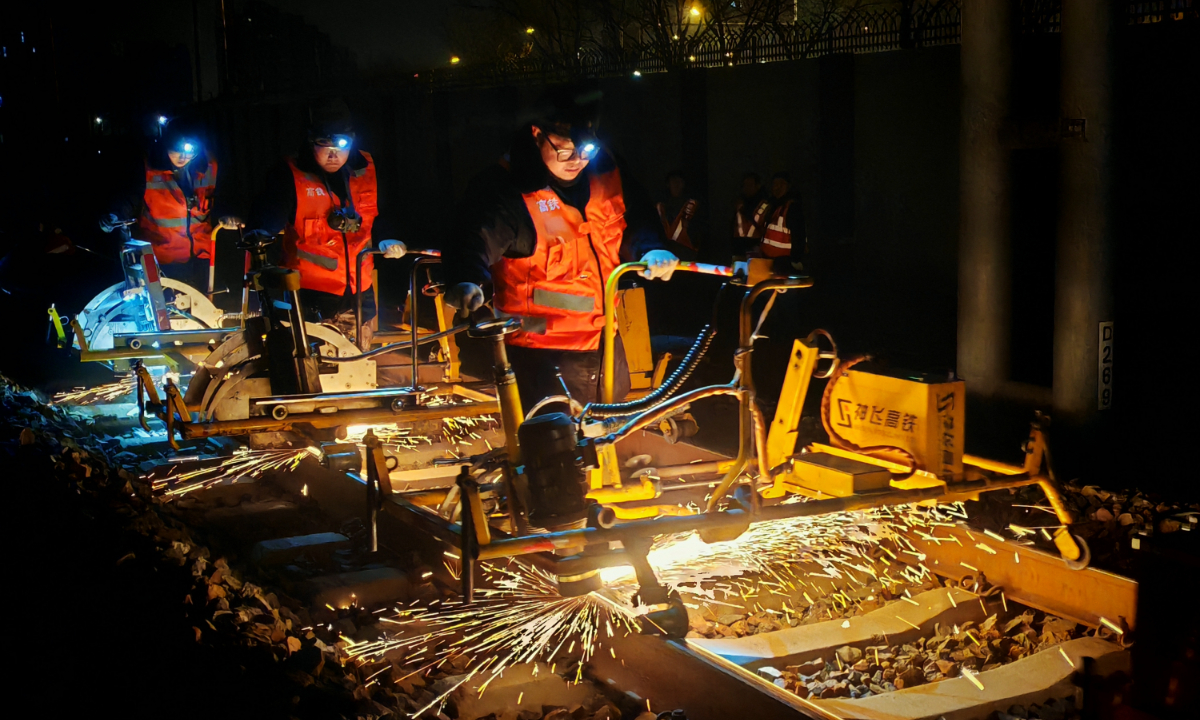
The rail-grinding team of the Beijing High-Speed Railway Engineering Section carries out rail grinding operations on the high-speed railway tracks at Beijing South Railway Station in the early hours of January 30, 2026. Photo: Liang Rui/GT
Editor’s Note:
"We joined hands to build a better life and enjoyed it together," Chinese President Xi Jinping noted. "When the happy hum of daily life fills every home, the big family of our nation will go from strength to strength." At the Spring Festival (Chinese New Year), when families come together, it is those who stay at their posts who make that quiet warmth all the more tender.
As the 2026 Spring Festival approaches, the Global Times has launched a series of feature stories themed "New Year on the Frontlines: Perseverance and Warmth Across Mountains and Seas." From a 5,000-meter icebound outpost to a tropical port on the shores on the South China Sea; from high-speed trains that carry the scent of home to the craftsmanship shared along Belt and Road - countless ordinary yet remarkable individuals, standing firm at their posts during this most cherished Chinese festival, together paint the truest portrait of an open, hospitable big family of the Chinese nation.
In the third installment, the Global Times visits the tracks of Beijing South Railway Station to tell the frontline story of a young rail grinding team. They use the rails as their canvas and grinders as their brushes, sculpting with millimeter precision to safeguard the journey home for millions during the Chinese New Year travel rush.
One night ahead of the 2026 Chinese Spring Festival of the Year of the Horse, a Global Times reporter arrived at the platforms behind Beijing South Railway Station in the early hours before dawn. Stripped of its daytime bustle, the station lay quiet in the night, with steel rails reflecting a cold, silvery sheen under the moonlight.
“Check grinding-head angles. Lower the wheels. Begin grinding.”
As the command was issued, team members slowly pushed the handles forward, lowering the grinding wheels. Clusters of orange sparks suddenly burst and danced between the rails. Accompanied by the steady hum of machinery, the rail-grinding team of the Beijing High-Speed Railway Engineering Section of the China Railway Beijing Group Co., Ltd. – composed largely of workers born in the 2000s – went into operation.
Liu Qiang, the grinding team’s leader born in 2000, told the Global Times that rail grinding removes surface defects left by repeated train loads, extending rail service life and improving track smoothness. Such high-precision work demands exceptional attention to detail, earning the workers the nickname “rail beauticians.”
For the Spring Festival holiday, China’s annual travel rush, “chunyun,” is often described as the world’s largest human migration, according to the Xinhua News Agency.
The latest data from China Railway shows that approximately 15.05 million passenger trips are expected to be made on Thursday, with 2,039 additional passenger trains scheduled to operate. Since the 2026 chunyun began on February 2, national railway passenger volume has exceeded 10 million trips per day for 10 consecutive days, reported CCTV News on Thursday.
As train frequency increases during chunyun and rail wear accelerates, safeguarding rail integrity becomes a critical task. When festive lights illuminate the night sky, and families gather around reunion dinners, rail guardians across the country remain at their posts, quietly protecting the safe journeys of millions during the Spring Festival travel rush season.
Beauticians in the dark
“During the Spring Festival, train services at Beijing South Railway Station are intensified. Under repeated dynamic loads imposed by high-speed trains, the rail surface is prone to developing tiny defects,” Liu explained. “These ‘skin problems,’ often less than a millimeter deep, may seem insignificant but directly affect ride comfort.”
“At such times, the grinding team must work during nighttime service windows to repair the rails, restore their profile, and ensure proper wheel-rail contact, guaranteeing speed and stability,” he added.
Despite his young age, Liu speaks with calm confidence. He joined the railway system in 2022 and began rail grinding work in early 2023. Within just two years, he became a team leader, guiding a group of young colleagues who write their own story of responsibility and dedication on cold steel tracks.
The Beijing High-Speed Railway Engineering Section was established in 2013 and is responsible for maintaining more than 1,500 kilometers of high-speed lines, according to Xinhua. Liu’s grinding team shoulders the demanding task of maintaining the extensive track network at Beijing South Railway Station.
Liu said that his team uses small grinding machines, which are more flexible than large grinding vehicles and capable of addressing defects that large machines cannot fully repair. “Large machines are efficient, but they’re not all-purpose. Our small-machine teams must carry out fine-grained daily maintenance on every track, guarding the last line of defense in rail upkeep.”
Xu Leigang, deputy director of the Safety Production Dispatch and Command Center of the Beijing High-Speed Railway Engineering Section, described rail grinding as an indispensable component of high-speed railway maintenance.
“It includes pre-grinding, corrective grinding, and periodic grinding,” Xu told the Global Times. “Small-machine grinding serves as a complementary and supplementary function to large-machine grinding, falling under the category of corrective grinding. Its core purpose is to precisely eliminate fatigue damage on the rail surface and restore its smooth profile.”
Although it may appear physically demanding, rail grinding is a highly technical process that requires patience and professional expertise at every step.
Liu explained that rail defects follow predictable patterns. Initial surface marks can evolve into cracks that spread deeper into the rail, eventually leading to spalling or internal damage, and in severe cases, broken rails.
“Distinguishing between ‘fish-scale patterns’ and oblique cracks is crucial,” he said. “Fish-scale patterns can be removed through grinding, but oblique cracks run deeper. Excessive grinding can distort the rail profile or even cause structural failure, so extreme caution is required.”
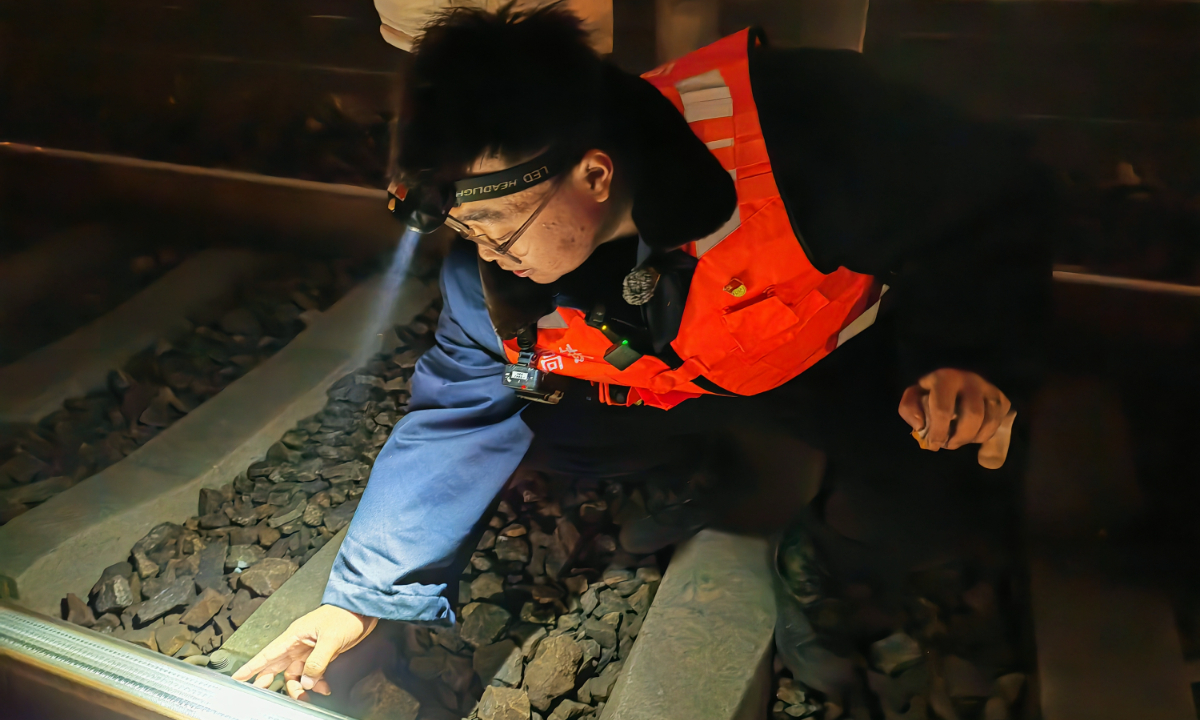
Liu Qiang, head of the rail-grinding team, briefs the Global Times reporter on the rail grinding operations at Beijing South Railway Station, on January 30, 2026. Photo: Liang Rui/GT
At its core, grinding preserves the wheel-rail relationship, ensuring smooth operation and passenger comfort. Liu noted that the famous high-speed rail experience, where “a cup of water doesn’t ripple, and a coin doesn’t topple,” is the result of their daily, millimeter-level precision work.
Behind that precision lies immense physical strain.
All grinding operations take place during nighttime “window periods,” typically from 0:30 am to 4:30 am. Team members are accustomed to reversed sleep cycles. “We get up at 10:30 pm, check and transport equipment, arrive on-site by 11:30 pm, and only begin work after midnight once clearance is given,” Liu said. “During Spring Festival support periods, we sometimes work six or seven days straight before getting two or three days off.”
Each grinding machine weighs over 200 pounds. Workers must bend low and push the machines repeatedly along the rails. Grinding just 120 meters requires 25 back-and-forth passes, amounting to nearly six kilometers of walking. During one window period, six machines operate together to repair at least 200 meters of track. Workers adjust angles from 12 to 45 degrees step by step, logging over 18,000 steps per night.
Switch grinding is the toughest nut to crack in this demanding work. With their complex A-shaped design, switches require repeated grinding on both sides. Crew members constantly shuttle heavy grinding machines back and forth, often working up a sweat. “While equipment is constantly being optimized for weight reduction to ease our burden, we can’t simply cut weight indiscriminately. Otherwise, the machines become top-heavy and unstable during operation.”
As Liu spoke, sparks flew behind him as his teammates pushed grinding machines forward, casting warmth into the cold night.
The load on rail lines during chunyun also imposes higher demands on rail condition. “Starting January 26 this year, railway authorities have added numerous temporary passenger trains and adjusted timetables. On busy trunk lines like the Beijing-Shanghai High-Speed Railway, train intervals have been compressed to just three minutes, resulting in extremely dense service. This places extreme, higher, and stricter demands on rail condition,” said Xu.
“Grinding work happens quietly at night, unseen by passengers,” Xu said. “But it is precisely this invisible dedication that translates into visible smoothness and comfort.”
Inheritance, innovation, and cooperation
Such professionalism and dedication are rooted in the railway tradition of mentorship.
Liu recalled his early days struggling with heavy machines and unfamiliar techniques. “I didn’t understand why the machine had to be swung left and right, or how much force to apply. It was my mentor’s guidance and daily practice that helped me find the rhythm.”
Xu explained that the railway system uses structured mentorship programs. “Mentors and apprentices are formally paired and work together for a full year, supported by certification-based training, enabling young workers to grow quickly.”
Watching the team mature has been deeply rewarding for Xu. “These post-2000s workers are quick learners with strong adaptability. Through professional training, they rapidly integrate theory with practice.”
Xu acknowledged the challenges of nighttime work but praised the resilience of younger staff. “They have now become the backbone of routine high-speed rail maintenance. As earlier generations retire, young Millennials and Gen Zers are steadily taking the lead in safeguarding China’s high-speed rail system.”
Alongside generational continuity comes technological advancement.
Since joining the railway system in 2022, Liu has witnessed rapid upgrades in maintenance equipment. “We used to rely on diesel-powered grinders that struggled in winter. Now everything is electric – more stable and efficient.”
Xu recalled that early grinders weighed over 400 pounds, requiring workers to manually carry them onto elevated bridges. Today’s equipment is lighter, smarter, and far more efficient.
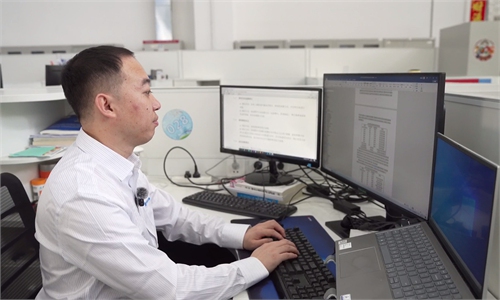
“We now use rail profile inspection analyzers to precisely measure wear patterns on rails, develop scientifically tailored grinding plans, and restore them to standard profiles. This ensures safety while reducing train sway,” said Liu.
Xu added that most equipment is now domestically produced, reducing labor intensity while improving accuracy.
Meanwhile, team collaboration ensured the grinding work proceeded smoothly. “Beijing South Railway Station is enormous: The intercity platform alone has seven tracks, the high-speed platform has 18 tracks, and there are 75 sets of turnouts, including 25 in the intercity platform and 50 in the high-speed platform. Such a massive scale far exceeds what our single team can handle. Every workshop has grinding crews, and when we’re overwhelmed, ‘sister workshops’ step in to support us,” said Liu.
“We rely on detailed inspection logs to scientifically formulate daily plans, ensuring every curve and joint receives timely maintenance.”
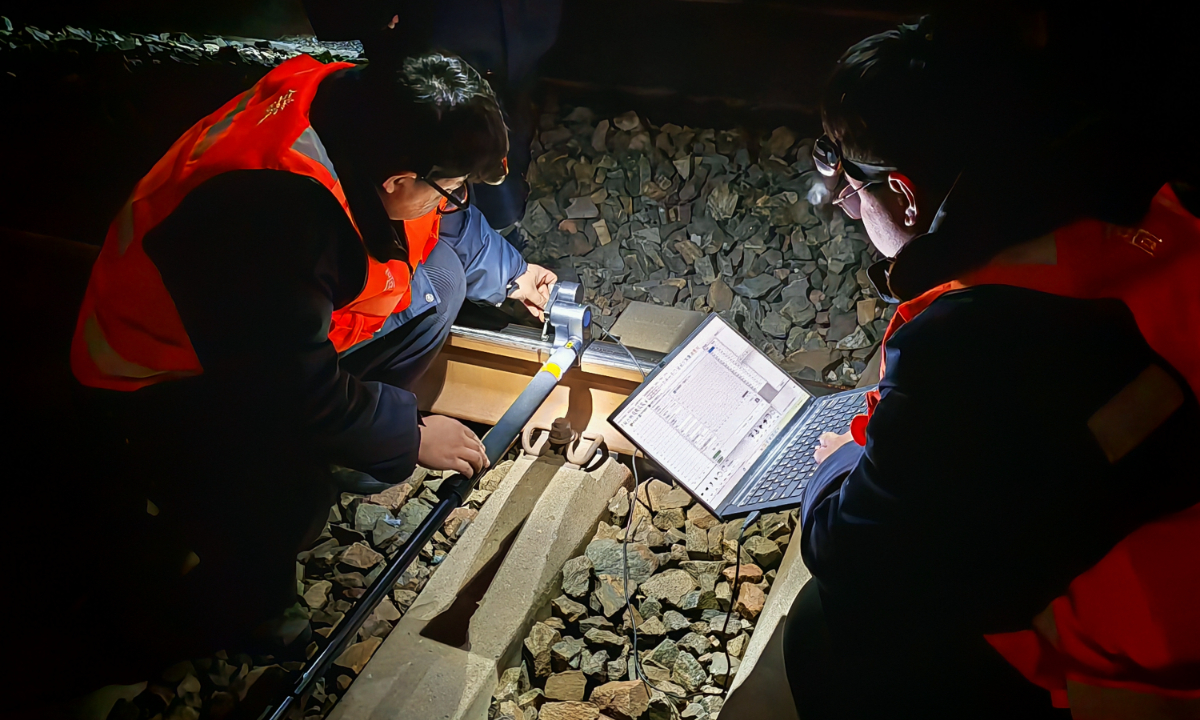
Members of the grinding team use a rail profile inspection analyzer along with related computer software to precisely measure rail wear patterns at Beijing South Railway Station, on January 30, 2026. Photo: Liang Rui/GT
Comprehensive system safeguards chunyun
Just as coordination between workshops ensures smooth operations at Beijing South Railway Station, rail maintenance forms a crucial link within the broader Spring Festival travel protection system. Their work operates in tandem with inspection, scheduling, dispatching, and emergency response units, creating an integrated maintenance network that underpins the safe and efficient operation of high-speed rail during peak travel periods.
Across the country, countless rail workers stand firm during the travel rush.
In Baoji, Northwest China‘s Shaanxi Province, a group of female track inspectors with an average age of 27 patrol mountainous routes through the Qinling Mountains, carefully identifying defects and safeguarding the safety of trains on the Longhai Railway. Covering up to 30,000 steps a day, the seven women conduct precise checks in wind and snow, committing every defect to memory, reported Xinhua on Saturday.
On the Shanghai-Chongqing-Chengdu High-speed Railway, a major rail replacement project began on October 14, 2025, involving 73.15 kilometers of track. Some rails dated back to 2009 and showed wear, corrosion, and deformation after years of service. To ensure Spring Festival travel rush safety, multiple units accelerated progress. By early February, the nearly four-month overhaul was quietly completed before chunyun began, reported the Workers’ Daily on Monday.
At the same time, a well-functioning Spring Festival support system relies on clear policy guidance and institutional coordination.
According to the 2026 comprehensive transportation Spring Festival safety and service support plan issued by relevant national departments and enterprises, transportation equipment safety management must be strengthened. Ahead of the travel rush, thorough maintenance and standardized inspections are required to ensure sound technical conditions. The plan also emphasizes care and support for frontline workers through grassroots assistance initiatives.
As a frontline railway worker, Liu takes pride in his role. “When I ride on tracks I’ve personally ground, especially switch sections, I can feel how much smoother the train runs. That sense of achievement is incredibly strong.”
As for the Spring Festival, whether Liu can return home depends on duty schedules. While Liu’s words carried a hint of guilt regarding his family, his resolve was firm. “I’m deeply grateful for my partner’s understanding. Choosing this profession means shouldering heavy responsibility. If our efforts help millions travel home safely, then everything we do is worth it.”
RELATED ARTICLES