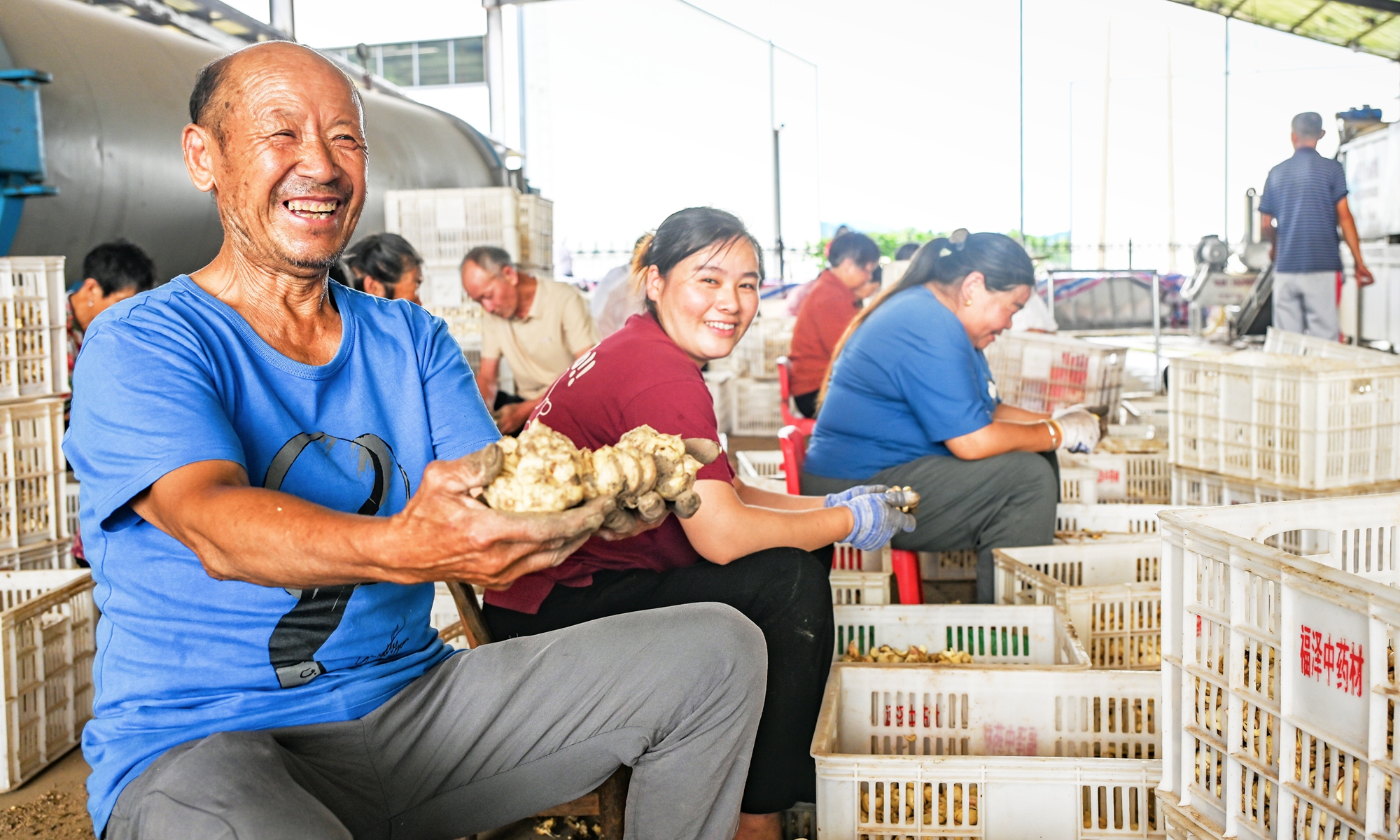
Villagers from Tiantang village in Yingshan county sort traditional Chinese medicinal materials. Photo: Courtesy of the Publicity Department of Yingshan county
Editor's Note:This year marks the 105th anniversary of the founding of the Communist Party of China (CPC) and the opening year of the 15th Five-Year Plan (2026-30). A new year begins with new resolve and new momentum. The call to "fight for our dreams and our happiness, and turn our great vision into beautiful realities" continues to inspire action across China.
In the column "New Year on the Frontlines," reporters from the People's Daily traveled to the grass roots to witness the vitality of a vast nation, see its mountains and rivers in motion and its fields in abundance, and listen to the stories of people finding fulfillment in both life and work.
Through these stories, the column seeks to present a vivid portrait of Chinese modernization.
As Chinese New Year approaches, in Yingshan county, Central China's Hubei Province, known as the "land of medicinal herbs," Wang Zaiping, a villager from Tiantang village in Shitouzui Township, has been busy. On a sunny mountainside slope, she and her husband diligently turn over pine logs. The logs, about 40-centimeter long and as thick as a fist, are neatly stacked. "Once cracks appear at both ends, it's time to 'put them in the pit,'" Wang said. "Growing Poria cocos depends entirely on these logs, so we have to take good care of them."
Upon closer inspection, the logs had strips of bark peeled away from top to bottom, each strip about 3 to 5 centimeters wide. "This is called 'peeling the bark while leaving the veins,'" Wang explained. Poria cocos grows on gentle forest slopes under the trees and relies on locally produced Masson pine as its nutrient source. Around China's traditional solar term Grain Rain, the logs are inoculated with the fungal spawn and buried in the soil, a process called "putting into the pit."
"One mu of land can accommodate more than 1,000 pits, earning several thousand yuan. In recent years, growing Poria cocos and gastrodia has brought pretty good returns," Wang said.
"Although the benefits are good, it's become difficult to keep increasing income further," Yang Zonglin, Party secretary of Shitouzui Township, chimed in.
"Why is that?"
"The root problem lies in the shortage of land and the long growth cycles. Poria cocos takes at least five months from growth to harvest, and the land then needs 3 to 5 years of rest to recover; gastrodia requires two years to harvest, and after one crop the land also needs rest — sometimes as short as 3 years, sometimes as long as 10 years. With the old methods, we're still at the mercy of the weather," Yang said.
"Is there a new method then?" a reporter asked.
"You've hit the nail on the head!" Yang laughed. "We've got some capable people in the town who are exploring new approaches. Come on, let me take you to see them."
Down the mountain, at the Hubei Senrong Traditional Chinese Medicine Development Co, Ltd, villager Shen Guoxian poured corn, wood chips, and other materials into a mixer. With the light press of a button, the uniformly mixed culture medium moved steadily along the conveyor belt toward the bagging machine.
"This is for producing Poria cocos spawn. We can make more than 4,000 bags per hour, and in 2025, we sold a full 5 million bags," said the company's head, Liu Xi. "Over there is the gastrodia production line, which can produce 600,000 bottles a year."
"How do you use it? Do you still bury the raw materials and spawn in the soil?"
"No, no." Liu waved his hand with a smile. "We put them in baskets and place them in greenhouse sheds. No soil needed, and there's certainly no need to go up the mountain."
The greenhouse is right next door at the Hubei Chukang Pharmaceutical Co, Ltd, which serves as the downstream processor for Senrong company's products.
Zhou Dezhi, Party chief of Tiantang village, is the general manager of Chukang company. He and his staff were busy stacking baskets, laying plastic film, spreading the spawn, and covering it with ash. Inside the greenhouse, it felt warm as spring.
"This shed is for growing gastrodia. We cultivated it in October 2025, and it'll be ready for harvest by May," Zhou said as he turned over the wood chips in a basket. "These are the spawn we bought from next door. After use, they can still be sold as fuel or biomass pellets, both eco-friendly and cost-saving."
Tiantang village leverages its resource advantages to grow traditional Chinese medicinal (TCM) herbs, generating over 15 million yuan ($2.17 million) in annual economic benefits. "As a Party member, it's my responsibility to lead the villagers to prosperity," Zhou said.
With modern transportation well developed, getting good products out of the mountains is no longer difficult, but the real challenge is getting them out at a higher value. "In the past, many authentic medicinal herbs were exported abroad. Foreign companies would take them for deep processing and earn the lion's share, while we could only sell by the ton and get the scraps," said Zheng Guangwen, a local official at Yingshan county. "Yingshan has 280,000 mu of TCM medicinal herb planting area. Increasing added value is now the key focus."
By overcoming the technical challenge that Poria polysaccharides are insoluble in water, Jili Traditional Chinese Medicine Company collaborated with Huazhong Agricultural University to develop more than 50 "medicine-food homology" products, shifting from "selling by the ton" to "selling by the gram." At Chenmei Traditional Chinese Medicine Company's preparation workshop, various medicinal raw materials undergo steaming, purification, and other processes to become ready-to-drink formula granules, with added value increased five- to 10-fold.
During the interview, the reporters noticed that many village houses along the way were two-story buildings built against the mountains. As local officials put it: "Yingshan's advantage is its ecology, and development must rely on ecology. The county's industrial foundation is relatively weak, but by getting mountain products out and bringing consumption in, the people can still benefit substantially."
RELATED ARTICLES