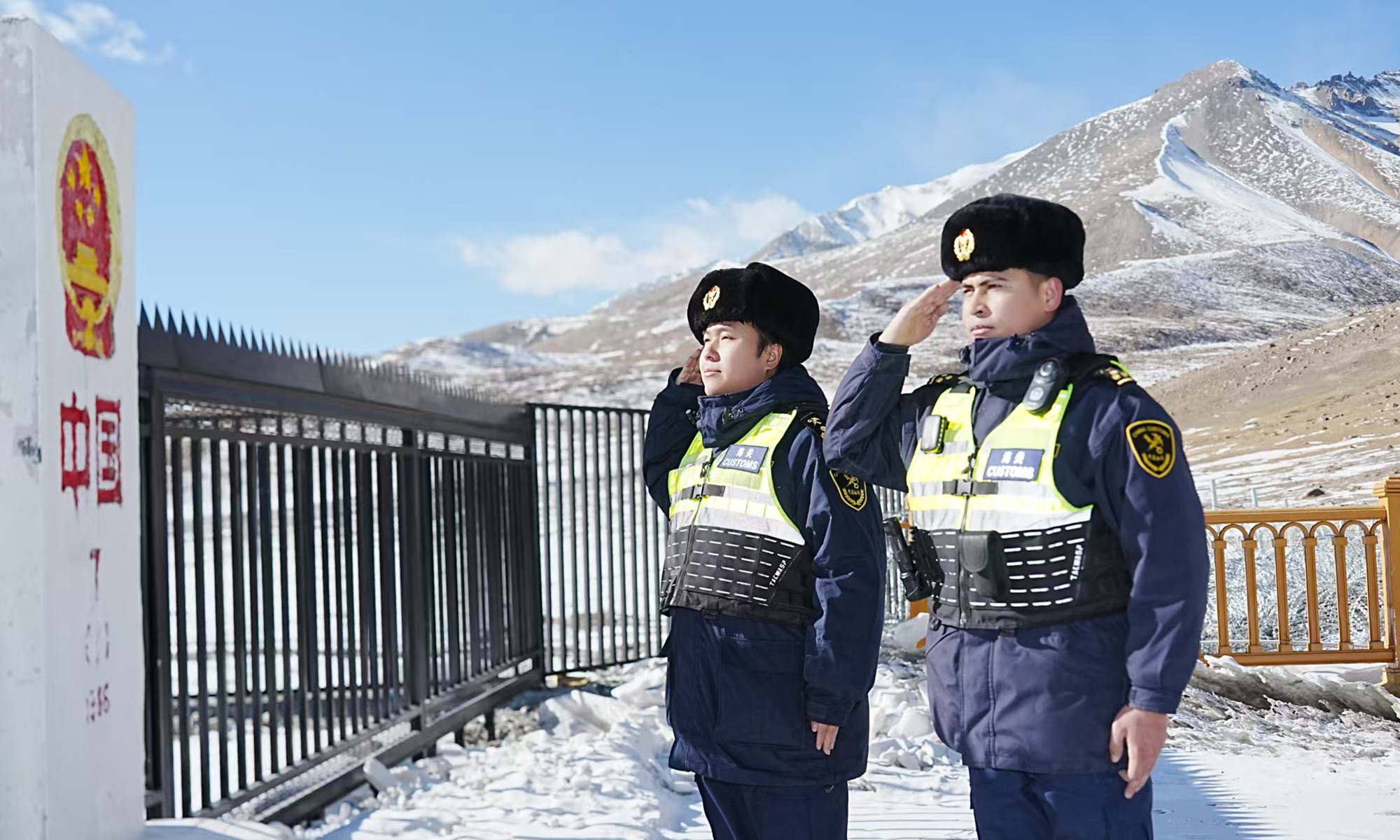
Customs officers of Khunjerab Customs are on duty at the Khunjerab Pass in Northwest China's Xinjiang Uygur Autonomous Region. Photo: He Yong/People's Daily
Editor's Note:
This year marks the 105th anniversary of the founding of the Communist Party of China (CPC) and the opening year of the 15th Five-Year Plan (2026-30). A new year begins with new resolve and new momentum. The call to "fight for our dreams and our happiness, and turn our great vision into beautiful realities" continues to inspire action across China.
In the column "New Year on the Frontlines," reporters from the People's Daily traveled to the grass roots to witness the vitality of a vast nation, see its mountains and rivers in motion and its fields in abundance, and listen to the stories of people finding fulfillment in both life and work.
Through these stories, the column seeks to present a vivid portrait of Chinese modernization.
At an altitude of 5,100 meters, Khunjerab Pass braces for the bitter cold of winter.
As dawn breaks, China's highest-altitude border gate eases open. The temperature plummets to -25 C, with oxygen levels barely half those at sea level.
"Vehicle number 47 today, documents verified, release!" Zhu Yan, a customs officer at the Khunjerab Pass affiliated with Urumqi Customs, braves the biting wind as he approaches the slow-moving truck.
With the Spring Festival approaching, this sole land route between China and Pakistan has entered its busiest time of the year.
The Khunjerab Pass is located in Taxkorgan Tajik Autonomous County, Northwest China's Xinjiang Uygur Autonomous Region. "Every procedure must be safe and efficient now that more vehicles pass through," Zhu said, his hands bright red from the cold.
"In the past, clearing customs at Khunjerab could take one or two days. During winter, I would have to spend the night in the driver's cabin, shivering under two layers of quilts," said Qin Heyan, a truck driver who frequently travels between China and Pakistan. "But now it's different. From loading goods in Kashi to completing exit procedures at Khunjerab, the whole process takes just over six hours. It's faster and much easier."
The transformation Qin describes stems from Urumqi Customs' "Highway Port plus Local Direct Clearance" supervision model.
Plagued by high altitude, harsh weather, geographic constraints, and cumbersome old procedures, cross-border trucks once faced lengthy delays in Khunjerab Pass. "To address this challenge, we overhauled clearance processes—streamlining 16 tedious steps into 7 and eliminating unnecessary inspections," explains Li Zhuo, head of Khunjerab Customs. "Initiatives like 'advance declaration, inspection upon arrival,' and 'intelligent image review, on-the-go inspection' have streamlined workflows and boosted efficiency."
At the customs checkpoint, a large H986 container inspection system stands guard like a "smart eye" beside the passage. Trucks glide through without stopping, undergoing full-body scans in just 30 seconds. The system automatically identifies cargo information and cross-references it with declarations.
"This system ensures precise cargo verification while cutting inspection time drastically," Zhu noted, adding that manual checks used to take at least 40 minutes per truck, longer for complex goods. With smart technology, efficiency has skyrocketed."
Efficiency gains also come from enhanced collaboration.
Khunjerab Customs has established a linkage mechanism with the Kashi Comprehensive Bonded Zone, implementing a "bonded zone stocking, port express clearance" model. Enterprises pre-deliver goods to the bonded zone to complete declarations and inspections in advance. Upon shipment, they only need to complete exit verification at Khunjerab for rapid clearance.
Additionally, electronic declaration and online verification services allow drivers to submit documents and check statuses via mobile apps, eliminating the need for physical paperwork.
As dusk falls, the day's last exit truck slowly crosses the border. Zhu and his colleagues tally data, review the day's work, and prepare for the next day's operations.
On the monitor, the China-Pakistan Friendship Highway winds through the Karakoram Mountains like a silk ribbon.
"This will be my fourth Spring Festival here," Zhu said, gazing out at the Chinese national flag fluttering atop the border gate against the snow-capped peaks. "I can't go home for family reunions, but guarding this 'sky road' to ensure the smooth flow of goods and people makes the commitment worthwhile."
RELATED ARTICLES