Japan's $36b US investment, part of $550b deal, seen as political 'pledge of allegiance': Chinese expert
By Published: Feb 18, 2026 01:30 PM

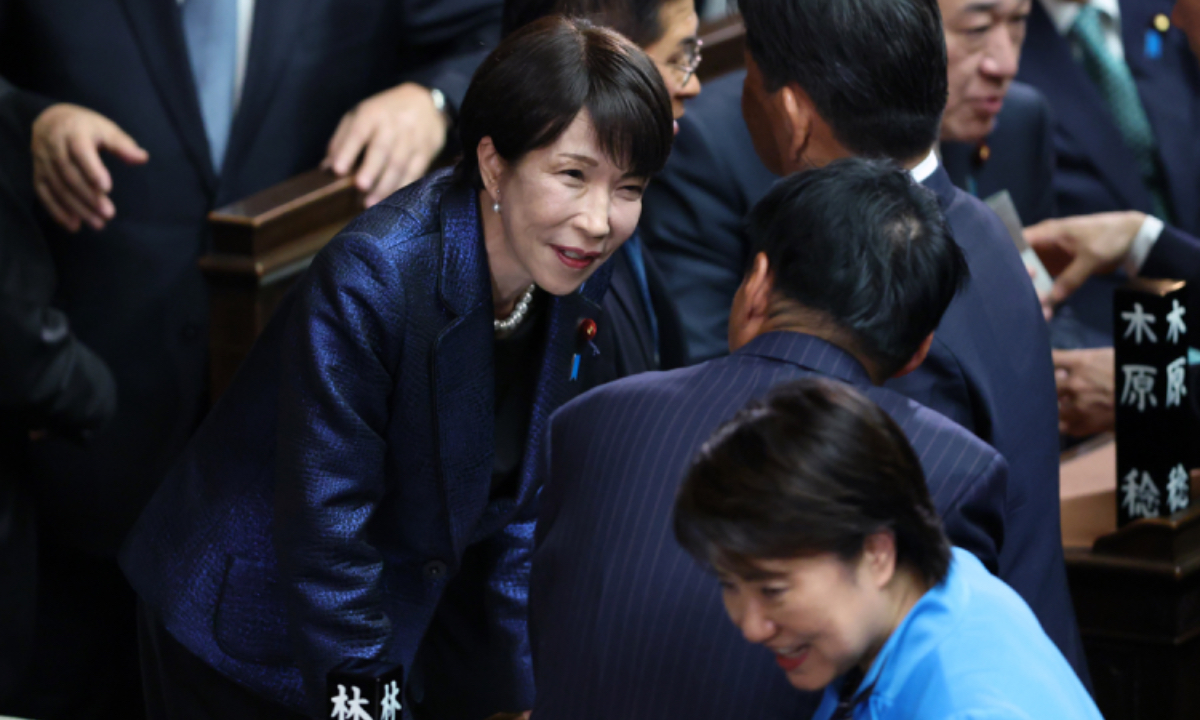
Sanae Takaichi, Japan's prime minister, center, attends a special session at the lower house of parliament in Tokyo, Japan, on February 18, 2026. Japan plans to invest up to $36 billion in US oil, gas and critical mineral projects, the first tranche of its $550 billion commitment. Photo: VCG
Japan plans to invest $36 billion in US oil, gas and critical mineral projects, the first tranche of its $550 billion commitment under the trade agreement it struck with Washington, Bloomberg reported Wednesday. However, a Japanese industry leading think-tank has labeled the investment “unequal,” and business and state-backed finance circles are concerned that the projects may be “less than bankable,” according to media reports.
By unveiling the investment in oil, electricity and minerals before Japanese Prime Minister Sanae Takaichi’s potential US visit, Tokyo is offering not merely an economic gift package but a political "pledge of allegiance" — designed to win Washington's favor and secure US political support, a Chinese expert commented Wednesday. However, this move will also render Japan's economy more vulnerable to fluctuations in US domestic policy and economic cycles, risking a long-term loss of economic autonomy, the expert said.
“Our MASSIVE Trade Deal with Japan has just launched!” US President Donald Trump posted Tuesday on social media. “The scale of these projects are so large, and could not be done without one very special word, TARIFFS.”“America is building again,” Trump wrote, according to Bloomberg.
In a statement on Tuesday, US Commerce Secretary Howard Lutnick said Japan would provide capital for three projects: a natural gas plant in Ohio, a crude oil export facility along the US Gulf Coast, and a synthetic diamond manufacturing site. The projects represent a $36 billion commitment and are expected to generate thousands of jobs, Lutnick said, the New York Times (NYT) reported Wednesday.
According to NYT, the energy and manufacturing projects represent the first phase of funding under a trade framework agreed in July, under which Tokyo pledged $550 billion in funding to US-based projects. In exchange, the Trump administration agreed to impose a 15 percent blanket tariff on Japanese exports — a reprieve from the more aggressive duties it had threatened.
Takaichi on X on Wednesday claimed that the projects were designed to build resilient supply chains through cooperation in areas crucial for economic security, including critical minerals, energy and artificial intelligence.
“We believe this initiative is fully aligned with its core objectives: promoting mutual benefits between Japan and the US, ensuring economic security, and fostering economic growth,” she claimed.
NYT commented that Tokyo is eager to show progress before Takaichi’s scheduled visit to the US in March. In Japan’s lower house election last week, Trump endorsed Takaichi and her Liberal Democratic Party (LDP) before the party won in a landslide, and Trump congratulated the prime minister, wishing her success in her “conservative, peace-through-strength agenda,” according to media reports.
NYT, citing two people familiar with the plans, disclosed that around the time of Takaichi’s visit to the US, Japanese officials are considering making several additional investment announcements.
Although Nikkei Shimbun previously reported that Japan’s economy minister, Ryosei Akazawa, who led the country’s tariff negotiations with the US, has framed the investments as a “win-win” for both countries, the NYT noted that “a different sentiment prevails within some business and state-backed finance circles, where the projects are often described as ‘strategic but less than bankable’.”
Nomura Research Institute, a leading Japanese industry think-tank, released an article on Friday, stating that “this investment plan represents an extremely unequal arrangement for Japan.” The think-tank noted that whether these projects will contribute to strengthening Japan's own economic security remains unclear.
Yomiuri Shimbun published an editorial on Wednesday on the investments, noting that“the financial aspect of each project will be borne by the Japanese side, under a framework where institutions like the Japan Bank for International Cooperation provide equity, loans, and loan guarantees. If massive losses occur, it would ultimately mean a loss of taxpayer money, placing a heavy burden on the public.”
A Japanese business news site Diamond reported earlier this month that “It is a fact that a lingering sense of discomfort pervades Japanese industry regarding this massive investment,” questioning whether this investment in the US is “truly a worthwhile deal for Japan.”
Despite concerns among Japanese industry over the investment, Japanese officials including Takaichi appeared active in the projects. But why? Xiang Haoyu, a distinguished research fellow at the China Institute of International Studies, told the Global Times on Wednesday that the timing of the first investment projects announcement involved careful political calculation.
“It was clearly coordinated to coincide with Takaichi's reelection as prime minister today and the launch of her new cabinet, while also setting the stage for her upcoming visit to the US,” Xiang said.
According to media reports, the Japanese prime minister resigned with her cabinet on Wednesday, as parliament is set to convene for a new session in the afternoon to elect a new prime minister. Takaichi, president of the ruling LDP, is expected to be reinstated as prime minister, given that her party currently holds more than two-thirds of the seats in the powerful lower house.
Xiang commented that as the US-Japan alliance is under pressure from Washington's tariff threats and the Trump administration's “America First” policy, Takaichi urgently needs to demonstrate Japan's sincerity as America's “most reliable ally” and “top investor” before her US visit.
“This represents not merely an economic package but a political ‘pledge of allegiance.’ By converting investment commitments into tangible projects, Takaichi seeks to curry favor with Washington and secure its potential political endorsement and geopolitical bargaining chips for Japan, in an attempt to stabilize the foundation of her new cabinet,” Xiang said.
“For Japan, this resembles a high-stakes investment,” Xiang said. The expert analyzed that economically, massive capital outflows and industrial relocation may exacerbate concerns about domestic industrial hollowing-out, impacting Japan's long-standing export-oriented development model; socially, this could heighten risks regarding job outflows and insufficient domestic investment.
Politically, while the Takaichi administration packages this as an achievement in reshaping the alliance resilience, the investments would increase Japan's economic susceptibility to US domestic economic and policy fluctuations, risking long-term loss of economic autonomy, Xiang added.
RELATED ARTICLES