China launches more than 120 remote-sensing satellites in 2025, ranks second globally
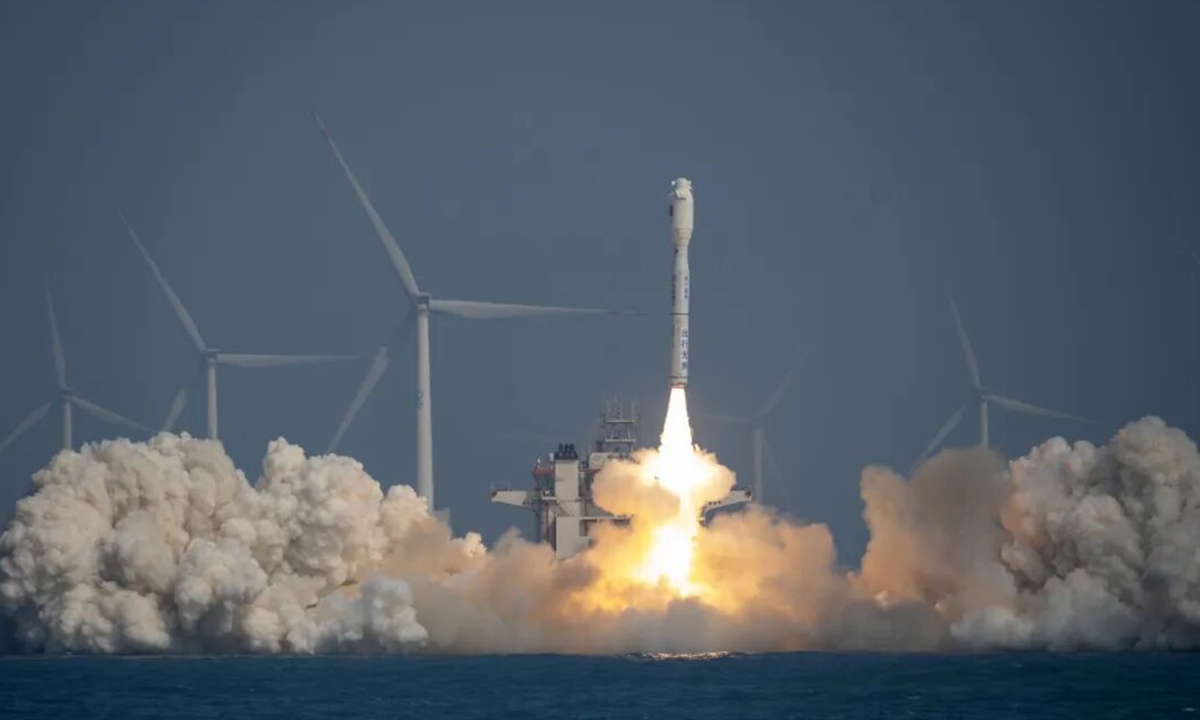
CUHK No.1, the world's first artificial intelligence (AI) large-model satellite developed by the Chinese University of Hong Kong (CUHK), is launched from waters off Yangjiang in South China's Guangdong Province on February 12, 2026. Photo: Official WeChat account of CUHK
China launched more than 120 remote-sensing satellites in 2025, bringing the number of civilian remote-sensing satellites in orbit to more than 640, continuing to rank second globally, the Xinhua News Agency reported on Monday. The satellites have enabled all-weather, round-the-clock Earth observation.
The nation's commercial remote-sensing satellite sector has sustained rapid growth. Significant progress has been made in technological breakthroughs, constellation networking and application expansion, the report said. These achievements have been underpinned by the accelerated clustering and concerted efforts across China's commercial satellite industry chain.
At China's first commercial space launch site, the Hainan commercial spacecraft launch site in South China's Hainan Province, construction continued through the Spring Festival holidays as crews pressed ahead toward an ambitious target of achieving 60 launches per year.
The main structure of the second-phase project at the launch site has been completed and the project will next enter the equipment installation and commissioning stage, China Media Group (CMG) reported on Monday. By the end of this year, the No.3 and No.4 dual launch pads are expected to become operational. Together with the two pads from the first phase, the four pads will have an annual launch capacity of 60 missions.
At the Wenchang Spacecraft Launch Site located in Wenchang, another satellite launch base in Hainan, commercial aerospace development goes beyond launch facilities. The city has attracted more than 700 aerospace enterprises. One company is building a rocket propulsion system test base, with work continuing during the Spring Festival holidays to accelerate progress. The facility, which functions as a "physical examination center" for rockets, is expected to be operational by June this year, according to CMG.
With launch sites such as the one in Wenchang emerging as core hubs, companies are no longer operating in isolation, said Wang Peng, an associate research fellow at the Beijing Academy of Social Sciences. Through high-level spatial clustering, research and development, testing and launch activities are now seamlessly integrated, significantly reducing coordination costs and improving overall efficiency, he told the Global Times on Monday.
As commercial aerospace continues to thrive, space tourism is becoming increasingly integrated into the sector's development.
Since 2025, Wenchang has received more than 1 million visitors who traveled to watch rocket launches. During each launch window, nearby homestays are fully booked.
Commercial aerospace was included in the government work report for two consecutive years in 2024 and 2025, and the proposals for the 15th Five-Year Plan (2026-30) period explicitly call for working faster to boost China's strength in aerospace. A steady stream of supportive policies has continued to inject momentum into the sector's development.
Wang said that the sector's growth model is shifting from being driven mainly by national missions to being led by market demand. The involvement of commercial players has accelerated iteration in key areas such as rocket propulsion testing, while a mass-production mindset is reshaping aerospace manufacturing.
He added that China's commercial satellite industry is entering a phase of frequent constellation deployment and rapid application expansion. As commercial launch capacity is fully released, large-scale satellite networking will become routine, and the use of low-Earth orbit resources will accelerate. Satellite data will evolve from a niche resource into essential infrastructure, integrated with autonomous driving, the low-altitude economy and mass communications, he said.
In 2025, China conducted 50 commercial space launches, accounting for 54 percent of the country's total space missions for the year, data from the China National Space Administration showed. A total of 311 commercial satellites were placed into orbit, representing 84 percent of all satellites launched by China in 2025, the administration said.
RELATED ARTICLES