AI, robotics fuel new year spending surge
Inclusive innovation emerges as key growth driver: expert
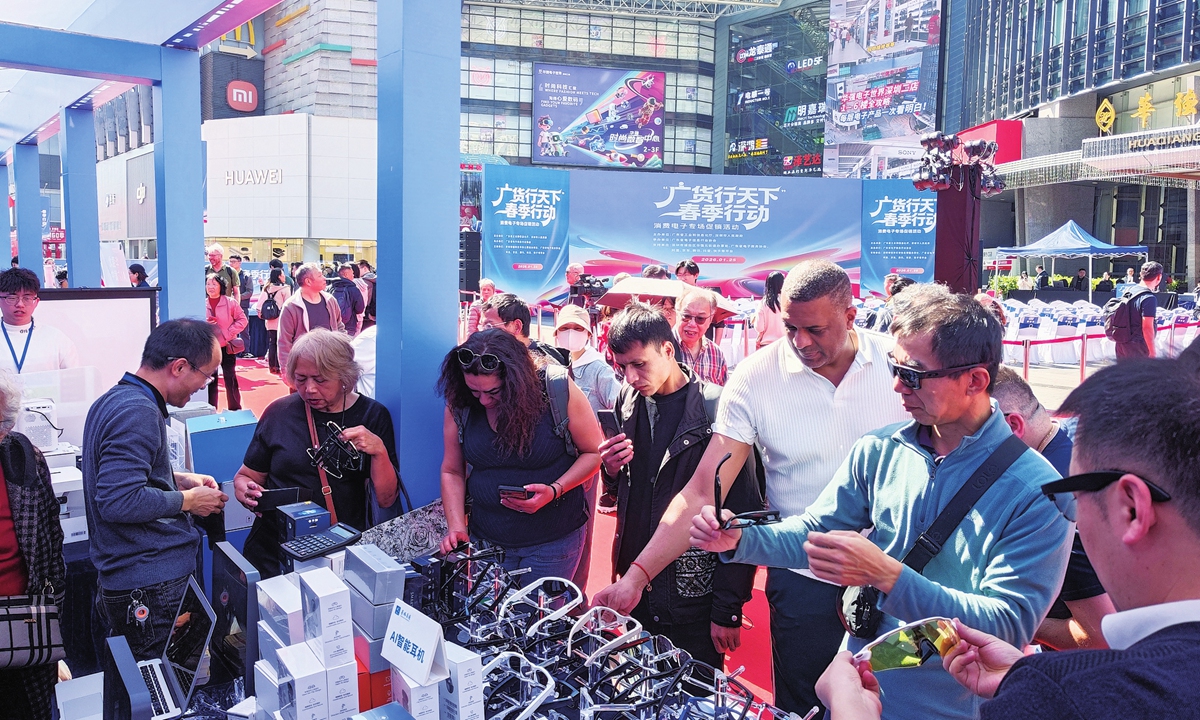
Domestic and overseas consumers shop for electronic products in Huaqiangbei, Shenzhen, South China's Guangdong Province, on January 25, 2026. Photo: VCG
China's consumer market has kicked off the year with a surge in demand for high-tech products, as strong sales of drones and artificial intelligence (AI) glasses, combined with heightened interest in robots following their appearance at the Spring Festival Gala, fuel a broader wave of technology-driven spending.
An industry insider said that China's tech development is increasingly characterized by civilian adoption and accessibility, making it a key engine for consumption growth early in the year.
Ahead of the Spring Festival, the Huaqiangbei electronics market in Shenzhen, South China's Guangdong Province, dubbed "China's Hardware Silicon Valley," compiled real sales data from the previous two months and released a top eight AI sales list. The ranking included drones and robots, as well as AI glasses, toys, watches and translators, along with AI learning devices and AI speakers.
The list spanned core AI hardware segments such as the low-altitude economy, smart companionship, wearable intelligence, cross-border communication, education, health management and immersive experiences, according to Shenzhen government's official WeChat account.
As of Sunday, overall revenue across Huaqiangbei had risen 35 percent year-on-year. Around the Spring Festival holidays period, total sales of technology products increased by more than 30 percent compared with normal levels. Sales of AI glasses rose 70 to 80 percent, the Guangzhou Daily reported.
Liu Dingding, a veteran technology industry analyst, told the Global Times on Monday that consumer-grade AI products are now increasingly embedded in daily life, as companion-style AI robots priced at a few hundred yuan, often designed as puppies, plush toys or dolls, along with other AI products are capable of fluent conversations and interactive responses.
"Their [AI products'] core competitiveness stems from the nation's integration of industrial manufacturing capabilities with large-language AI models," Liu noted.
Humanoid robots once again drew global attention during this year's Spring Festival Gala, with four start-ups showcasing their products.
According to data sent from robot leasing platform BOTSHARE to the Global Times on Monday, its orders during the Spring Festival holidays rose nearly 70 percent from the previous week. Orders tied to festive scenarios including New Year greetings, temple fairs, lantern festivals and shopping mall holiday events accounted for more than 54 percent of total demand, becoming the primary driver of robot rentals during the holiday period, the platform said.
Hangzhou-based robot leasing company Zhejiang Jike Robot Technology Co operates multiple brands and models of humanoid robots.
Yu Jian, the company's founder and CEO, told the Global Times on Monday that demand for robot rentals during the Spring Festival holidays was exceptionally strong. Most bookings were made in advance, with hundreds of robots fully reserved before the holiday began and no single-day rental slots remaining.
Policy support further underpinned the nation's tech-related spending expansion ahead of the 2026 Spring Festival holidays. In December, the National Development and Reform Commission, China's top economic planner, and the Ministry of Finance announced that the consumer goods trade-in programs would be extended to 2026, explicitly supporting purchases of digital and smart products.
In 2025, the policy drove sales of more than 220 million digital and home appliance products, generating more than 700 billion yuan (101.32 billion yuan) in revenue and benefiting 160 million consumers, official data showed.
On February 2, nine of China's government departments announced the launch of a special consumption campaign throughout the nine-day Spring Festival holidays. On the first day of the holiday, 62.5 billion yuan in consumption subsidies were allocated to local governments, covering digital, smart and home appliance categories, further unlocking consumption potential in technology products.
Liu noted that China's technological progress has been strikingly rapid.
Liu emphasized that China's innovation drive increasingly focuses on products that ordinary consumers can access and use in daily life.
"As technology becomes more closely integrated with mass consumption, it is expected to maximize consumer momentum while reinforcing a virtuous cycle with industrial development," he said.
RELATED ARTICLES