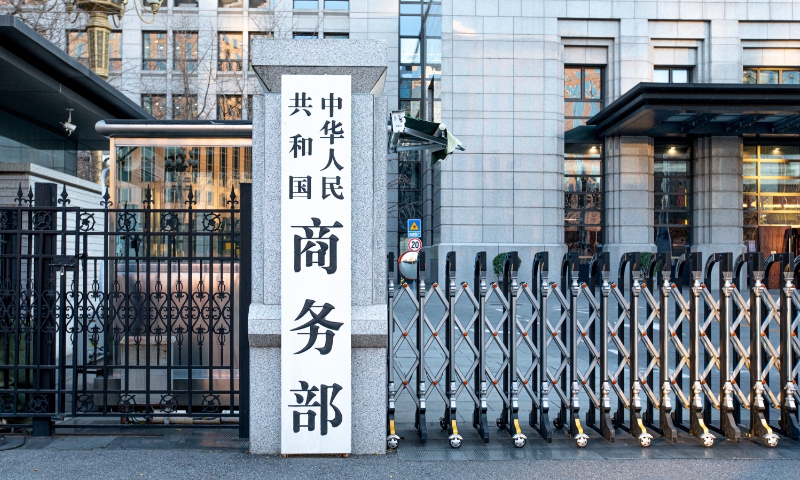
The Ministry of Commerce of China File photo: VCG
China has consistently opposed all forms of unilateral tariff measures and urges the US side to cancel and refrain from imposing any such unilateral tariffs, a spokesperson of China's Ministry of Commerce (MOFCOM) said on Tuesday, noting that practice has repeatedly proven that cooperation between China and the US benefits both sides, while confrontation harms both.
The remarks were made in response to a media inquiry regarding that, in the early hours of Tuesday (US Eastern Time), US Customs and Border Protection agency, in accordance with relevant US announcements, halted the tariffs imposed under the International Emergency Economic Powers Act (IEEPA) and, pursuant to Section 122 of the Trade Act of 1974, imposed import surcharges on all trading partners. The media asked whether China would take any corresponding measures.
The MOFCOM spokesperson said that we have taken note of the situation. In early February and early April 2025, the US, under the IEEPA, successively imposed a 10 percent so-called fentanyl tariff and a 34 percent reciprocal tariff on Chinese goods. Of these, the 24 percent reciprocal tariff has been suspended, making the actual tariff rate on Chinese goods 20 percent, according to the spokesperson.
According to the rulings in US Supreme Court tariff cases and relevant US administrative orders and announcements, the US has suspended the above-mentioned tariffs, but at the same time it has imposed a 10 percent import surcharge under Section 122.
China also notes that the US has claimed on multiple occasions that it may impose tariffs through investigations under Sections 301 and 232, said the MOFCOM spokesperson.
China is closely monitoring the situation and will conduct a comprehensive assessment of the relevant US measures, said the spokesperson, noting that it will make timely decisions on adjusting countermeasures to the original US fentanyl and reciprocal tariffs as appropriate. China reserves the right to take all necessary measures to firmly safeguard its legitimate rights and interests, the spokesperson said.
China is willing to engage in frank consultations with the US in the upcoming sixth round of China-US economic and trade talks. China hopes that the US will meet China halfway, and work together to uphold the consensus reached during the meeting between the two heads of state in Busan, South Korea in October and the phone call on February 4, said the spokesperson.
On the basis of mutual respect and equal consultation, both sides should address each other's concerns, properly manage differences, and safeguard the healthy, stable, and sustainable development of China-US economic and trade relations, said the spokesperson.
On Monday, when asked to comment on the ruling that multiple tariffs imposed by the US government were unlawful, a MOFCOM spokesperson said that "We have noted the US Supreme Court's announcement of its ruling in the tariff litigation case and are conducting a comprehensive assessment of the relevant content and implications."
The halt of arbitrary tariffs is a positive trend that benefits both the US and the global economy, Lü Xiang, research fellow at the Chinese Academy of Social Sciences, told the Global Times on Tuesday, noting that using tariffs as a tool for fiscal revenue or "extortion" contradicts their essential role as an instrument of national industrial policy, and such practices are bound to fail.
The US Supreme Court ruling has limited the Trump administration's authority to impose tariffs, and available policy tools are now constrained. However, on Saturday, US president said he would raise his newly announced global tariff to 15 percent, less than a day after announcing a 10 percent worldwide duty, following a US Supreme Court ruling on Friday that struck down many of his previous country-specific tariffs.
The move sparked widespread international reactions, ranging from frustration and delayed trade talks to a wait-and-see approach amid renewed uncertainty, international media outlets reported.
The US administration needs to reflect on the impact of its tariff policies on the global economy and on itself, and drop the unilateral, zero-sum mindset of using tariffs as a tool of hegemony to serve its politically motivated purposes, Lü said, noting that only the permanent removal of such tariffs would have a truly positive effect on the global supply chain, including the US itself.
"The reported plans by the US demonstrate its strategy to rebuild the tariff framework following the Supreme Court's decision, showing that it will continue to exert pressure on other countries to achieve its goals," Zhou Mi, a senior research fellow at the Chinese Academy of International Trade and Economic Cooperation, told the Global Times on Tuesday, noting that the planned tariffs will further cause price fluctuations and supply chain disruptions and undermine mutual trust among countries.
RELATED ARTICLES