ARTS / CULTURE & LEISURE
Museum ‘horse hunt’ fever gallops ahead across China
2,000-year-old bronze statue becomes viral mascot
By Published: Feb 24, 2026 10:45 PM

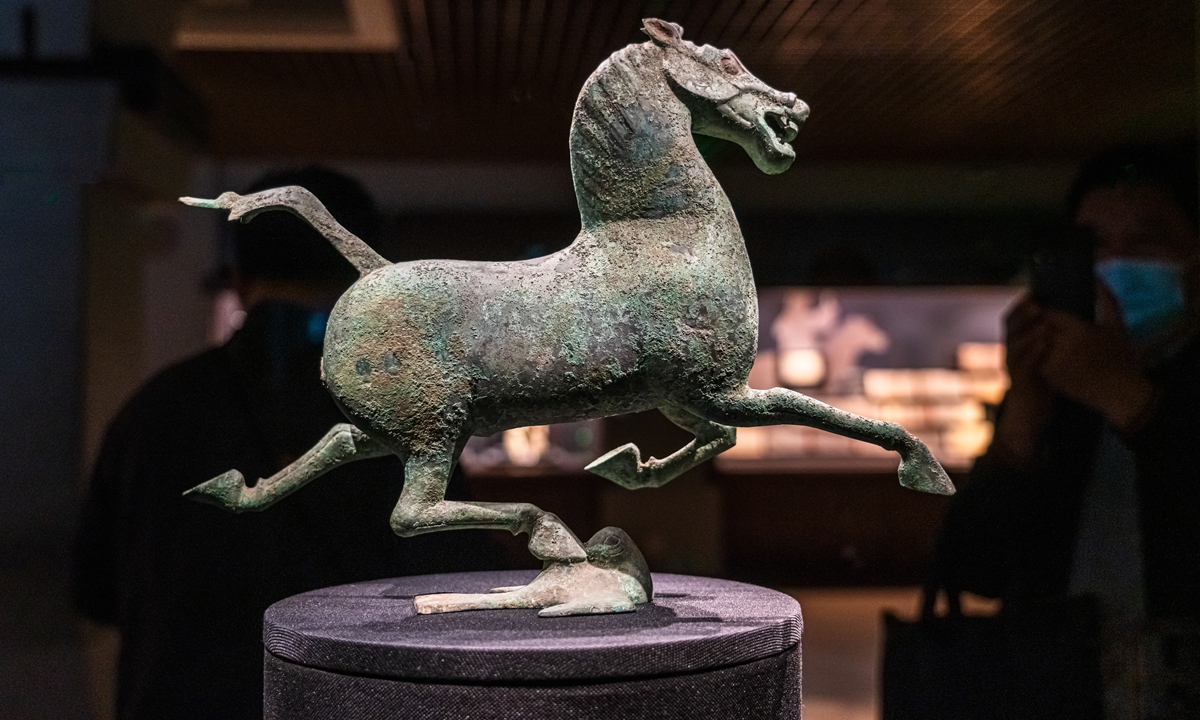
"Bronze Galloping Horse Treading on a Flying Swallow" of the Eastern Han Dynasty Photo: VCG
During the Spring Festival in 2026, China's museums turned into treasure hunts, with visitors thronging to catch a glimpse of cultural relics related to the nation's revered animal, the horse, driving a new cultural travel trend as the nation celebrates the Year of the Horse.Amid the nationwide fever for exploring horse-related culture, one special bronze horse statue in the Gansu Provincial Museum, known as the Bronze Galloping Horse Treading on a Flying Swallow, is taking the lead.
A tourist surnamed Huang from Shenyang, Northeast China's Liaoning Province, experienced the frenzy firsthand. At the Gansu Provincial Museum, she joined a snaking queue that wrapped around the cultural creativity store. Twenty minutes later, she emerged clutching a bright red plush horse with a goofy grin.
"I waited so long for this 'Red Luck' limited edition of the bronze horse statue," she told the Global Times. "It's the museum's mascot, but dressed up for its zodiac year."
The object of her desire is the latest incarnation of a cultural phenomenon: the "Green Horse," a playful, wide-eyed plush interpretation of the Bronze Galloping Horse Treading on a Flying Swallow, one of China's most iconic archaeological treasures.
Unearthed in Gansu Province in the late 1960s, the Eastern Han Dynasty (25-220) statue is a masterpiece of balance and motion, a powerful horse mid-gallop, its right hind hoof resting gracefully on a flying swallow. For decades, it has been a star of Chinese museum collections, a symbol of the vitality and spirit of the Silk Road.
But its modern rebirth as a cuddly toy has catapulted it to new heights of fame.
"The year 2026 is the Bingwu Year of the Horse, also the zodiac year of the bronze horse statue. We launched six new products with the theme 'Full of Momentum,'" Cui Youxin, head of the museum's cultural creativity center, told the Global Times.
"This is the animal's zodiac year. We wanted to give this millennia-old spiritual totem a fresh, festive flavor," Cui added.
It is not just about cuddly toys, though. Across China, the Year of the Horse has triggered what local media is calling a "horse-hunting" fever in museums.
In Central China's Henan Province, the traditional heartland of Chinese civilization, museums welcomed a record-breaking 6.8 million visitors over the holidays, a year-on-year increase of over 80 percent, the Henan Provincial Administration of Cultural Heritage announced on Tuesday.
In Anyang, Henan Province, home to the ancient Yin Ruins, a local museum's zodiac exhibition has drawn crowds with over 100 artifacts that show the evolution of equine culture over millennia.
The Xi'an Museum in Northwest China's Shaanxi Province has gathered more than 400 cultural relics and images, with a Tang Dynasty (618-907) tri-color glazed galloping horse and a Western Han Dynasty (206BC-AD25) painted bronze mirror with human figures and chariots becoming key photo spots.
At the Anhui Museum in East China's Anhui Province, parents and young visitors joined hands to "hunt for horses" at a special zodiac exhibition. Among the over 50 exhibited horse-themed relics, a Han Dynasty (206BC-AD220) bronze lamp with a figure standing on a horse boasts an ingenious design, a Qing Dynasty (1644-1911) white jade ornament depicting a horse and a monkey (a homophone for "promotion") is exquisitely crafted, and a Qing Dynasty brick carving with human figures features delicate craftsmanship.
Many museums have also organized activities such as AI horse treasure hunting, making rubbings of horse relics and exploring intangible cultural heritage handicrafts with horse elements.
Ban Rui, director of the Gansu Provincial Museum, told the Global Times that horses symbolize progress, auspiciousness and pioneering spirit in Chinese culture, while the exhibitions integrate zodiac culture with historical heritage, conveying a spirit of "vigor and perseverance."
RELATED ARTICLES