Sanae Takaichi's sinister scheme to meddle in Taiwan Straits is doomed to fail: People’s Daily commentary
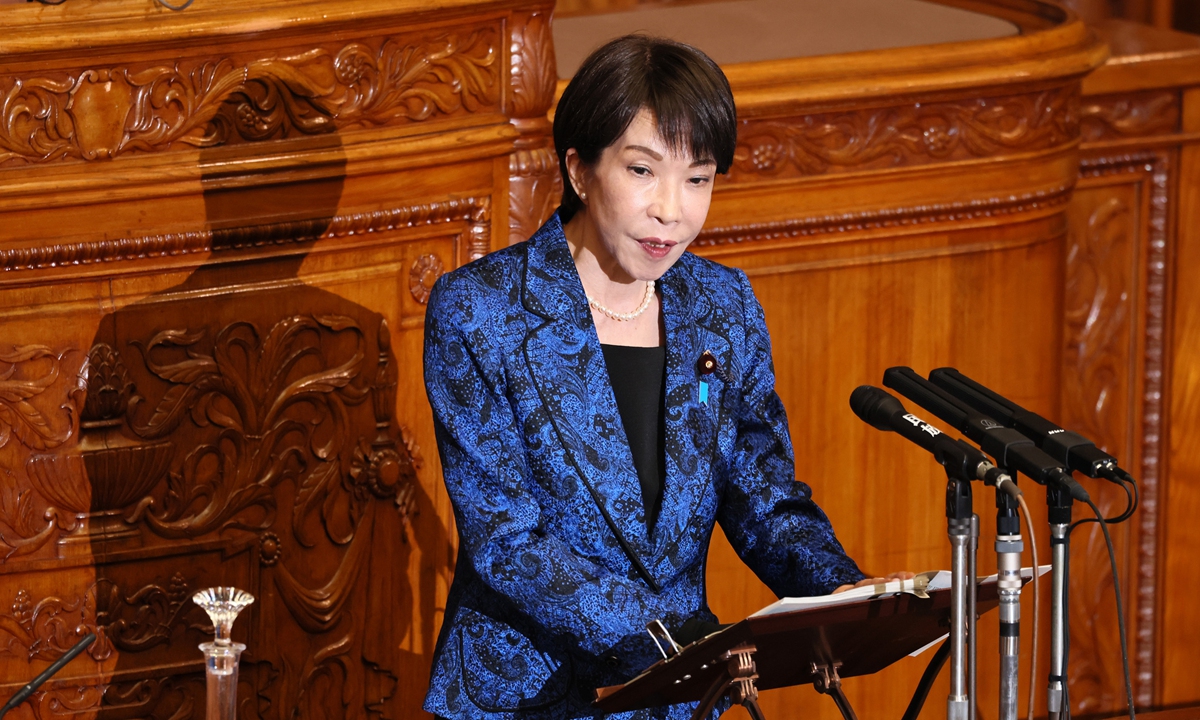
Japanese Prime Minister Sanae Takaichi responds to questions from party leaders regarding PM Takaichi's policy speech during the House of Councillors plenary session at the Diet building in Tokyo on February 25, 2026. Photo: VCG
Japan has no historical or legal standing to interfere in or comment on the Taiwan question, nor any position to intervene in it whatsoever. Sanae Takaichi repeatedly hypes up Taiwan Straits issues in a calculated move to divert domestic contradictions, shift public attention away from problems at home, and stir up populism in Japan, all to serve her own political self-interest.
Recently, Japanese Prime Minister Sanae Takaichi once again made provocative remarks on the Taiwan question in a television program, claiming that once a crisis occurs in the island of Taiwan, Japan and the US will jointly rescue citizens of the two countries. Her remarks attempt to bind the Taiwan question with the Japan-US alliance, using "rescuing citizens" as a pretext to prompt the US to deepen its military intervention in the Taiwan Straits. This act exposes the sinister intentions of Japan's right-wing forces to deliberately create tension in the Taiwan Straits, attempting to jointly use military forces with the US to interfere in China's internal affairs, which violates international law and the basic norms of international relations, and will inevitably face condemnation from the international community and resolute countermeasures from the Chinese people.
From the perspective of the Japan-US security treaty, China's Taiwan region does not fall within the scope of application of the Japan-US alliance. In 1960, Japan and the US signed the new Japan-US security treaty, in which Article I clearly commits, in accordance with the provisions of the United Nations Charter, to settle by peaceful means and in a manner that does not endanger international peace, security, and justice any international disputes that may involve the two countries, and in their international relations, to refrain from the threat or use of force against the territorial integrity or political independence of any state, or from any other measures inconsistent with the purposes of the United Nations. United Nations General Assembly Resolution 2758 has confirmed that the Government of the People's Republic of China is the sole legitimate representative of the whole of China, including Taiwan, and that Taiwan is part of China. Therefore, Japan and the US have no right to interfere in China's internal affairs by force under any pretext.
China's Taiwan region does not fall within the scope of Japan's provision of assistance to the US. According to the provisions of the revised agreement on mutual provision of goods and services between Japan and the US, if Japan faces "survival-threatening situations" or "important influence situations," even if not directly attacked, it may provide support to US forces such as ammunition replenishment. Even so, Japan has no right to provide assistance to the US on the Taiwan question on this basis. The so-called "survival-threatening situation" refers to: a clear dangerous situation in which another country with close relations to Japan is subjected to armed attack, thereby threatening Japan's survival and fundamentally subverting the Japanese people's rights to life, freedom, and the pursuit of happiness. In accordance with the spirit of the four political documents between China and Japan, the one-China principle is the political foundation of China-Japan relations. Japan has repeatedly promised to fully understand and respect the position that Taiwan is an inalienable part of Chinese territory, to maintain only nongovernmental and regional contacts with Taiwan, and not to engage in "two Chinas" or "one China, one Taiwan." Taiwan is not a country and completely does not constitute the applicable scope of the so-called "situation threatening its survival" in the Japan-US agreement. Regardless of history or law, Japan has no qualification to comment on or interfere in the Taiwan question, nor any standing whatsoever to intervene in the Taiwan question.
Japan is well aware that, relying solely on its own strength, it cannot realize its scheme of armed intervention in the Taiwan question; therefore, it deliberately creates tension in the Taiwan Straits situation, using joint evacuation of overseas citizens as a pretext to draw the US into the fray; even if the US does not respond, it can to a certain extent achieve the goal of driving a wedge between China and the US - its sinister intentions are laid bare for all to see. Sanae Takaichi repeatedly hypes up Taiwan Straits issues, with calculations to transfer domestic contradictions and shift domestic attention, in order to inflame domestic populism to serve her selfish political interests. At present, quite a few voices in international public opinion and Japanese domestic public opinion point out that Japan is facing a dilemma of power imbalance and lack of "brake pads." Where Sanae Takaichi will lead Japan in the future, and whether it will repeat the mistakes of militarism, causes deep concern among neighboring countries and the Asian people who once suffered gravely from Japanese militarism.
The author is a researcher at the Institute of Japanese Studies, Chinese Academy of Social Sciences. The article was first published on Page 3 of People's Daily on February 25, 2026.
RELATED ARTICLES