ARTS / CULTURE & LEISURE
Chinese-led team finds first evidence of bone cancer in 99-million-year-old lizard preserved in amber
By Published: Feb 25, 2026 12:21 PM

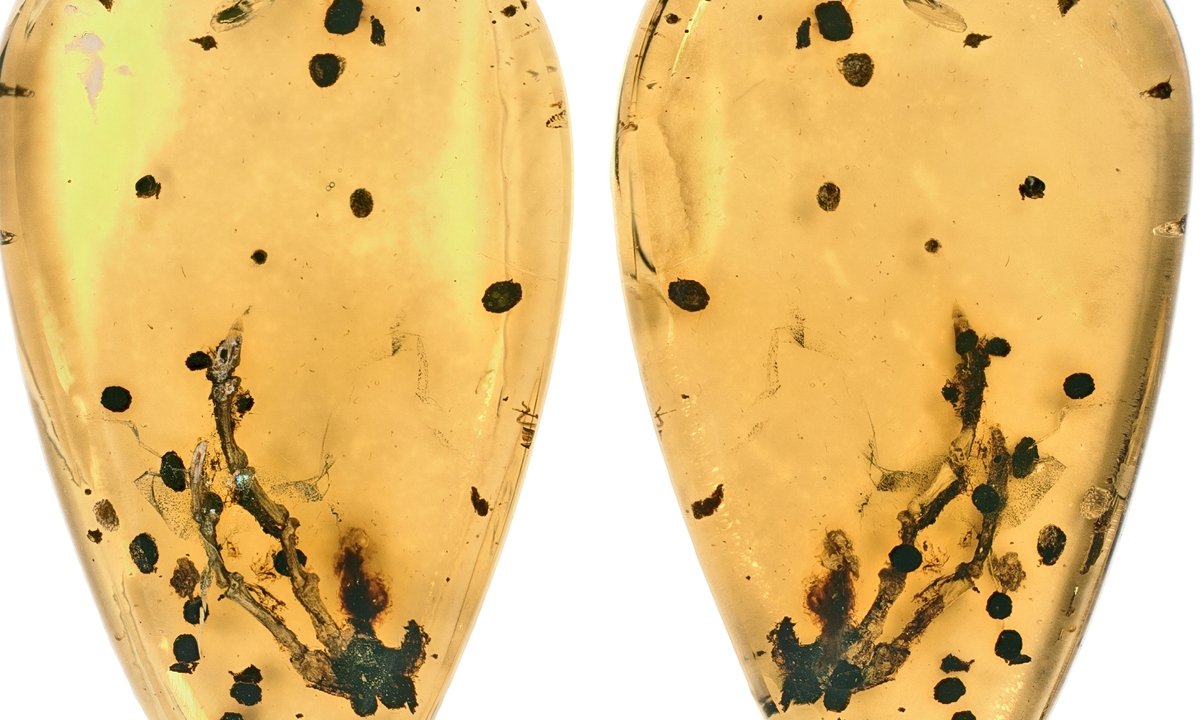
The lizard inclusion in amber from this study Photo: Courtesy of Xing Lida
A team of paleontologists led by Chinese scientists has discovered the first known evidence of a bone tumor in a lizard preserved in Cretaceous-period amber, shedding new light on the prevalence of disease among ancient vertebrates.The international collaboration, led by Xing Lida of the China University of Geosciences (Beijing) and including researchers from the United States and Canada, published its findings on Wednesday in the journal Palaeoentomology, according to a press release that Xing sent to the Global Times on Wednesday.
The specimen, a piece of amber from Kachin State in Myanmar dating back approximately 99 million years, contains the partial remains of a lizard belonging to the Anguimorpha suborder.
Researchers noticed abnormalities in the animal's toe joint and used high-resolution micro-CT scanning to examine the fossilized resin. What they found was a destructive bone lesion consistent with a modern giant cell tumor, a type of bone cancer that commonly affects the joints of mammals and other vertebrates. The scans revealed an enlarged toe bone with multiple small cyst-like cavities and surface erosion - features that closely resemble those documented in modern pathological studies.
The research team conducted an exhaustive differential diagnosis to ensure the lesion was not the result of injury or infection. Unlike bone fractures, which typically show signs of healing such as callus formation, the lizard's fossilized toe bore no such evidence. Nor did it display the bone membrane reaction associated with infection or the aggressive bone destruction seen in other tumor types such as osteosarcoma or chondrosarcoma.
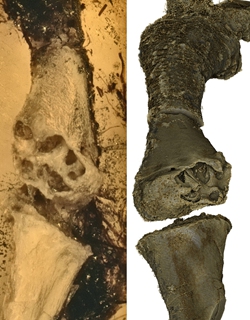
The impact of giant cell tumors on lizard joints Photo: Courtesy of Xing Lida
The findings are significant for the emerging field of paleopathology, which studies disease in ancient organisms. While tumors have previously been identified in dinosaur skeletons, this marks the first time such a condition has been found in a vertebrate preserved in amber, a medium renowned for preserving soft tissues and minute anatomical details in three dimensions.The amber originated in a tropical forest ecosystem during the mid-Cretaceous period, a time when dinosaurs dominated the landscape. The lizard likely became trapped in tree resin either during life or shortly after death, allowing for exceptional preservation of its skeletal structure.
The study offers more than just a diagnostic curiosity. By demonstrating that a form of bone cancer existed 100 million years ago and exhibited features similar to those observed in modern animals, the researchers suggest that the disease has deep evolutionary roots. Giant cell tumors are relatively common in modern animals. The discovery indicates this type of neoplasm may have afflicted vertebrates for tens of millions of years, with its pathological signature remaining remarkably consistent over deep time.
"Every piece of amber is a time capsule of Earth's history, and traces of disease are a unique footnote in the story of evolution," Xing told the Global Times.
"This glimpse into the health of a lizard from 100 million years ago opens a new window for understanding the evolution of life. With more discoveries and technological advances, we hope to uncover further evidence of disease in ancient animals, and perhaps even find evolutionary clues connected to modern illnesses," Xing added.
Media reported that Myanmar's amber deposits have yielded a wealth of exquisitely preserved fossils in recent years, including dinosaur tails, bird wings, frogs, and insects, making the region one of the world's most important sources of Cretaceous-period amber inclusions.
RELATED ARTICLES