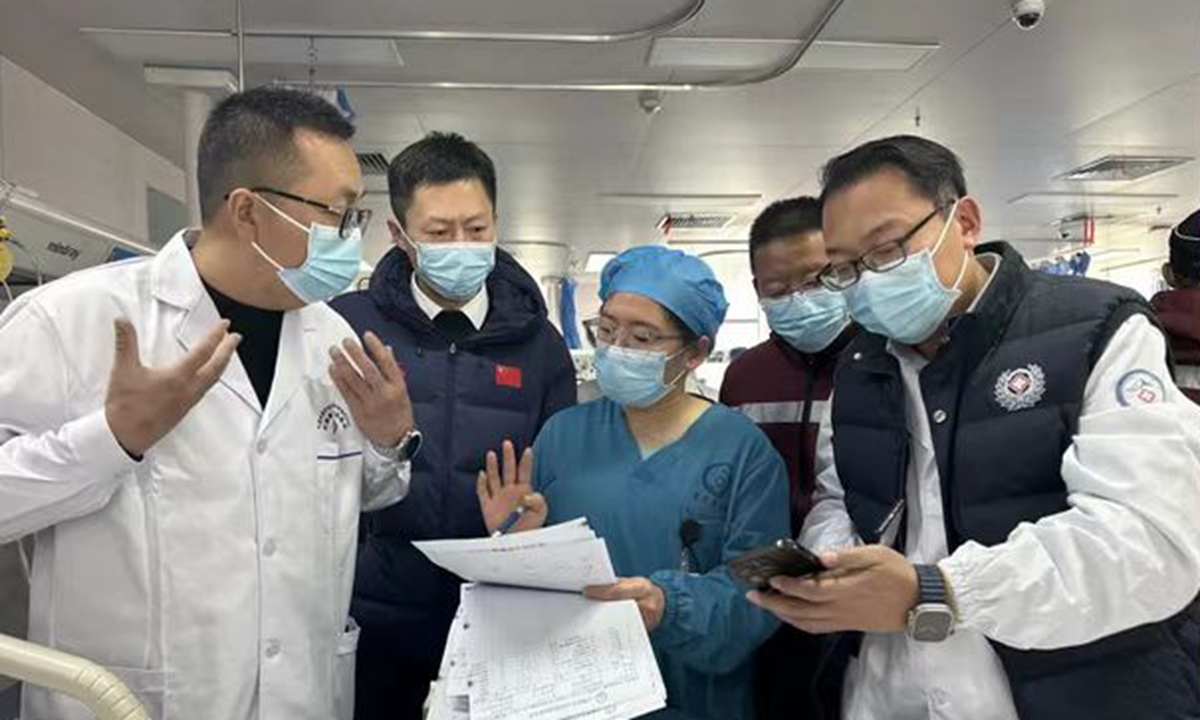
Wu Dong (first left) checks on patients injured in the Xigaze earthquake at their bedsides on January 9, 2025. Photo: Courtesy of Peking Union Medical College Hospital
Editor's Note:
National support for Xizang's development has yielded remarkable achievements. Over the decades, numerous volunteers from across China have come to Xizang, making indispensable contributions to the region's growth. Their efforts focus on various fields such as education, healthcare and infrastructure. Despite harsh conditions, these volunteers persevere in their roles, writing remarkable stories on the plateau. Each diary serves as a vivid testament to the building of the community for Chinese nation. Against this backdrop, the Global Times launches the "My Xizang Diary" series, presenting firsthand experiences from these dedicated volunteers. This is the second piece of the series.
In November 2023, I arrived in Lhasa as head of the ninth batch of "group-style" medical aid workers dispatched to Xizang, beginning my journey as a medical aid doctor on the snow-covered plateau.
'Trust the CPC' - words that echo in my heart
Among many memorable moments during my time in Xizang, the one that left the deepest impression on me involved a five-year-old Tibetan girl named Mingzhen (pseudonym).
On January 7, 2025, a 6.8-magnitude earthquake jolted Dingri County in the city of Xigaze, Xizang. Upon receiving the news, as president of the Xizang Autonomous Region People's Hospital, I immediately led the emergency medical rescue team to the disaster area. Among the injured receiving centralized treatment was Mingzhen, a small child who had just been pulled from the rubble. She immediately caught my attention. After surgery, she lay connected to a ventilator, with multiple tubes attached to her body, and the road ahead for further treatment remained perilous.
At that moment, I thought of my own daughter, whom I had not seen for a long time. I had only one thought: No matter what, we had to save this child.
After a comprehensive assessment, we concluded that transferring her to Chengdu, Southwest China's Sichuan Province, for further treatment offered the best chance of survival. However, communication with the child's mother - who was on the verge of emotional collapse - reached an impasse. Just then, the director of the local women's federation arrived to help mediate. She said only a few words, and the mother signed the consent form for the transfer.
I could not help but wonder what she had said. Her answer was simple: "I told her to trust the Communist Party of China (CPC)."
On January 10, I escorted Mingzhen onto a helicopter bound for Lhasa Gonggar International Airport, where a medical team from the West China Second University Hospital of Sichuan University took over and accompanied her to Chengdu. Later, news came that the child had survived and was conscious.
Looking back on this rescue, I remain deeply moved. After the earthquake, the response was swift and the organization was orderly; medical workers mobilized immediately and worked continuously. This fully demonstrated the country's strong organizational capacity in the face of major natural disasters. And the women's federation director's simple yet resolute words - "trust the CPC" - continue to echo in my heart.
From Lhasa to the borders: expanding medical resources in Xizang
The decisions and deployments of the CPC Central Committee constitute the political foundation for the steady and sustained advancement of medical assistance to Xizang. In August 2015, the sixth central symposium on Xizang-related work introduced the "group-style" medical aid initiative.
Since 2015, more than 2,400 medics in 11 different groups have been dispatched to various hospitals in Xizang, focusing on supporting the Xizang Autonomous Region People's Hospital, seven municipal-level hospitals and 13 county-level hospitals with relatively solid foundations, gradually forming a "1+7+13" medical assistance framework.
After arriving in Xizang, I was appointed as the president of the Xizang Autonomous Region People's Hospital. With more than a decade of sustained "group-style" assistance, the hospital's role as a safety net for critical illnesses has continued to strengthen. I have also come to understand deeply that, as the leading institution in the "1+7+13" system, the Xizang Autonomous Region People's Hospital must not only pursue its own development, but also drive progress at the prefecture and county levels - especially in high-altitude and border areas - so that more people can receive quality medical care close to home.
To this end, we moved beyond Lhasa, reaching places such as Nagqu and Ali, as well as border areas including Motuo, Yadong, Burang and Zanda, delivering high-quality medical resources to where they are most needed. Before 2015, there was only one Grade A tertiary hospital in all of Xizang - the Xizang Autonomous Region People's Hospital. After more than a decade of sustained assistance, all seven municipal-level people's hospitals have achieved Grade A tertiary hospitals, and nearly 10 of the 13 county-level people's hospitals have successfully been upgraded to Grade A secondary hospitals.
Beyond 'blood transfusion': building lasting medical capacity
Medical aid to Xizang is not only about "blood transfusion," but also about building lasting capacity. Medical teams have focused on a mentor-apprentice model, selecting outstanding young doctors for targeted training and sending them to Beijing for advanced studies. At the same time, experts from Beijing have been invited to Xizang to perform surgeries side by side with local doctors - addressing immediate medical needs while fostering the growth of local talent.
In 2025, 56 members of the "group-style" medical aid team at the Xizang Autonomous Region People's Hospital were appointed as faculty members of Xizang University. For the first time, we systematically stepped into university lecture halls, opening a new chapter for the training of clinical medical professionals in Xizang. Meanwhile, we have conducted research on plateau medicine based on the disease characteristics of high-altitude regions, gradually establishing population cohorts to provide scientific evidence for disease prevention and control.
As a Party member and a doctor, working in Xizang has been one of the most valuable experiences of my life. As part of the "group-style" medical aid effort, we have always kept in mind the questions: Why we aid Xizang, what we do while in Xizang and what we leave behind when we depart - devoting ourselves wholeheartedly to advancing the development of Xizang's healthcare system.
In my second year in Xizang, my Tibetan colleagues called me: "Dondrup Tsering," meaning "may all wishes be fulfilled and may one live a long life." This name embodies trust and affection, and it has deepened my sense of responsibility and mission.
Aid to Xizang is not merely a work assignment; it is a journey toward fulfilling our original aspirations and mission. Guided by the "spirit of aiding Xizang," generation after generation of medical professionals have continued their work on the snow-covered plateau - training talent and overcoming challenges, through arduous efforts and unrelenting struggle, all of which contributes to building a community for the Chinese nation and writing a new chapter for a thriving Xizang.
The author is a member of the Standing Committee of the Party Committee and vice president of Peking Union Medical College Hospital, and also a chief physician in the Department of Gastroenterology. He served as head of the ninth to eleventh batches of the "group-style" medical aid workers to Xizang and currently serves as president of the Xizang Autonomous Region People's Hospital. opinion@globaltimes.com.cn
RELATED ARTICLES