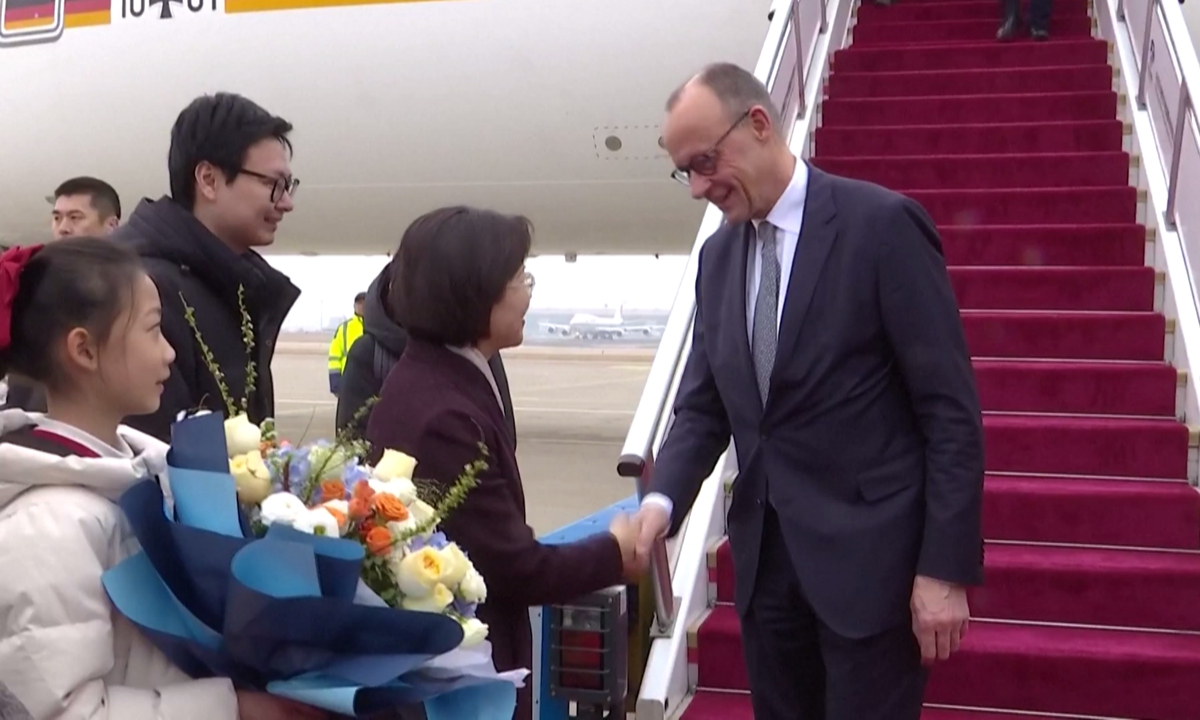
German Chancellor Friedrich Merz arrives in Beijing on Wednesday to start his two-day official visit in China. Photo: VCG
German Chancellor Friedrich Merz is paying his first official visit to China since taking office, from Wednesday to Thursday. The trip propels the wave of engagement with China - already gathering momentum across Europe and the West since the beginning of the year - to a new height.Merz chose to visit China shortly after the Chinese New Year for strategic communication, underscoring a deeper reality: Amid ongoing geopolitical turbulence, Europe - including Germany - is urgently seeking reliable partners in key sectors, dependable markets for economic support, and stable industrial and supply-chain links to inject greater certainty into its development and strategic environment.
From the World Economic Forum Annual Meeting at the beginning of the year to the Munich Security Conference (MSC) before the Spring Festival, Germany and Europe have found themselves increasingly unsettled by the erosion and hollowing-out of the existing international order and its rules. The theme of this year's MSC report, "Under Destruction," is telling. The US, as a principal driver of disruptions to the international order and shocks to Europe's security and economic interests, saw its Secretary of State Marco Rubio deliver remarks at the MSC that were less an effort to reassure European audiences than a continuation - albeit in softer rhetoric - of the US' longstanding pattern of applying pressure and eroding shared values with Europe.
Against this backdrop, Merz is attempting to send a message to the world that Europe is facing reality and prepared to defend its own interests with clarity and resolve. Germany and Europe increasingly recognize that the era of relying almost entirely on the US for diplomatic orientation, strategic direction and rules-setting has passed. They must now prepare for and respond to a US that seeks to sustain its dominance through coercion. Therefore, China-Germany and China-EU relations share significant common ground in seeking greater certainty in security and development, as well as in stabilizing and steering the international order and its rules toward a more stable, inclusive and sustainable direction.
Chinese Foreign Minister Wang Yi once again emphasized that "China and Europe are partners, not rivals" during the MSC, signaling to Germany and Europe that China is willing to further consolidate and deepen cooperation. Merz's visit will serve as an important opportunity for China and Germany to align their strategic direction and enhance strategic communication. It will also add new substance to the China-Germany comprehensive strategic partnership, advance cooperation across various fields and contribute to the sound development of China-Europe relations.
Germany, as the largest economy in the EU and a core driving force of European integration, is a natural partner for comprehensive cooperation with China. Its economic scale, industrial complementarity with China and shared pursuit of a stable international environment underpin this partnership. The greatest lesson from over 50 years of China-Germany engagement is that cooperation has enabled both sides to achieve mutual success and deliver benefits to the world. The current profound and turbulent global changes have also generated intrinsic momentum for the two countries to further deepen cooperation across multiple sectors.
In the economic sphere, China's market potential, commitment to opening-up, technological strengths in emerging sectors and application capabilities will provide German enterprises with renewed growth momentum through mutual investment and industrial cooperation. These can also serve as an important pillar for Germany in mitigating energy costs and geopolitical shocks.
In terms of strategic coordination, China and Germany need not only further shape and expand engagement and deepen cooperation, but also send a clear and decisive message about jointly addressing shocks and challenges while strengthening mutual strategic support.
On global governance, the two countries should make more concrete commitments and advance cooperation in areas including climate change, AI governance and leadership within international organizations. In doing so, they can contribute meaningfully to addressing the widening global governance deficit and to building a more just and equitable global governance system.
At a time when both China and Germany face the challenges, how to work together - seeking common ground while respecting differences - to keep the course of history on the right track has become a fundamental question that the two countries, as well as China and Europe, must answer.
The author is an associate research fellow at Beijing Language and Culture University. opinion@globaltimes.com.cn
RELATED ARTICLES