Illustration: Chen Xia/GT
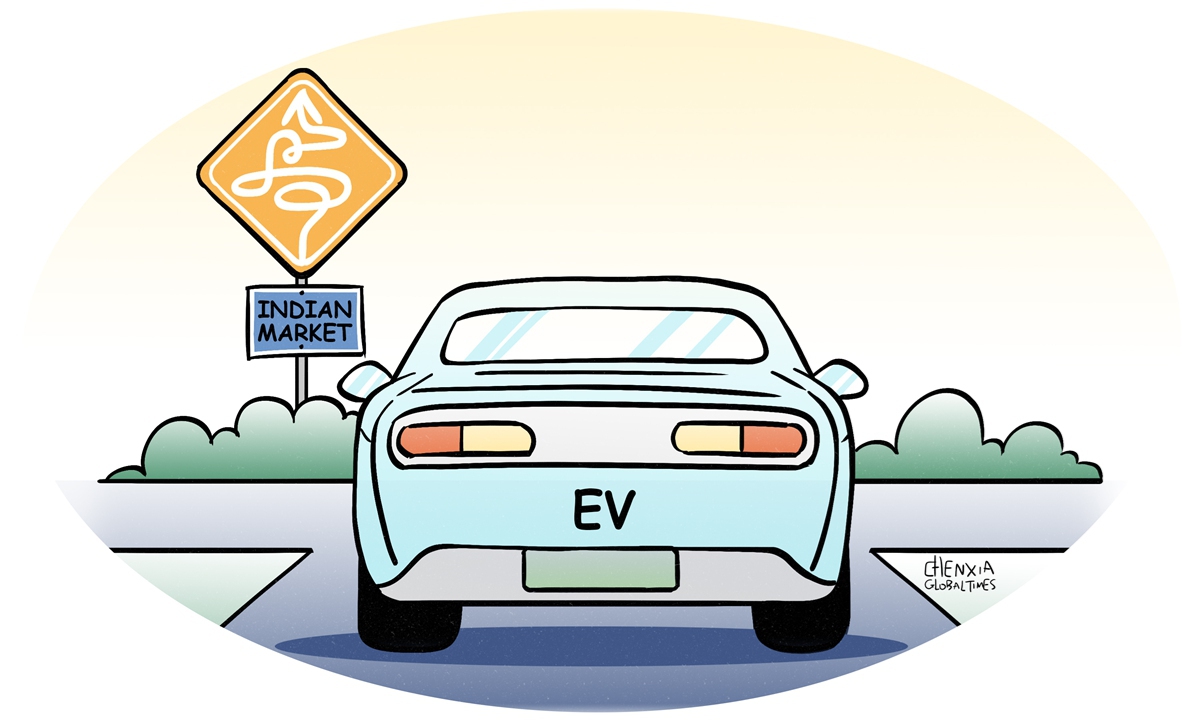
The World Trade Organization (WTO) said in a statement on Tuesday that its Dispute Settlement Body had agreed to establish a panel to examine China's complaint over India's measures in the automotive and renewable energy sectors. These measures include incentives for the production of advanced chemistry cell batteries, automobile and auto components, and electric vehicles in India.It is not news that in recent years, India has vigorously promoted self-reliant initiatives in the manufacturing sector by rolling out a series of supportive policies. Among these, India's production-linked incentive (PLI) programs have drawn international scrutiny, as some have clearly linked subsidy eligibility to stringent localization requirements. This means that to receive government support, manufacturers must use locally produced components instead of imported ones. This type of subsidy is explicitly prohibited by WTO rules for creating unfair competitive advantages for domestic industries at the expense of foreign competitors.
In October 2025, a spokesperson for China's Ministry of Commerce said in a statement that the relevant measures adopted by India are alleged to violate several WTO obligations, including the principle of national treatment, and constitute import substitution subsidies, which are explicitly prohibited under WTO rules. These measures unfairly benefit India's domestic industries and undermine China's legitimate interests, the spokesperson said, noting that China will take resolute measures to safeguard the lawful rights and interests of its domestic industries.
It is understandable that India aims to boost its manufacturing sector and achieve industrial upgrading through leveraging various industrial policies. However, the core question is not the goal itself, but the method. India's chosen method, as seen in the PLI and Faster Adoption and Manufacturing of Electric Vehicles programs, appears to rely on the logic of "working behind closed doors." Yet, the development of a competitive manufacturing industry has rarely, if ever, been the result of such protectionism. Attempting to nurture industries through protection will ultimately lead to more losses than gains.
History has offered numerous examples of industries becoming inefficient under excessive protection. India's own experience with its PLI program appears to be a case in point. While the $23 billion PLI program, along with other reforms, was expected to help lift the share of manufacturing to 25 percent of India's GDP by 2025, it has fallen dramatically short of helping meet that target. Manufacturing's share in India's GDP dropped to 14 percent in the fiscal year ended in March 2025 from more than 15 percent when the program was launched, according to CNBC. The Indian government had decided to let the program lapse, according to a Reuters report in March 2025, citing government officials.
Furthermore, from the perspective of triggering trade disputes and damaging its international image, India's subsidy policies have violated WTO rules and are bound to provoke opposition and dissatisfaction from other countries. China's complaint against India at the WTO is a typical example.
For India, this should serve as a reminder to reconsider its strategy. A more effective path forward lies not in erecting walls, but in embracing open cooperation. By engaging with the global economy within a rules-based framework, India could foster genuine industrial strength through fair competition and collaboration.
The trajectory of China's automotive industry offers a compelling illustration of this path. Decades ago, China began to open its market to attract foreign investment and advanced technologies. Through joint ventures and continuous learning, it gradually built a comprehensive domestic supply chain and nurtured its own research and development capabilities. Today, China is the world's largest auto market and a global leader in the electric vehicle field. This progress was achieved by optimizing resource allocation on a global scale and allowing domestic businesses to upgrade through competition and cooperation. This demonstrates that openness is not the antithesis of independent development, but rather its most powerful catalyst.
India boasts significant advantages that could fuel its manufacturing ascent, most notably its vast and youthful domestic market. Yet, translating this demographic dividend into a true "engineers' dividend" and converting market potential into manufacturing prowess require a confident and open mindset.
For India, fostering an environment conducive to innovation, attracting global capital and expertise, and integrating into complex international value chains may ultimately prove far more effective than subsidies and localization mandates in building a sustainable, resilient and truly competitive modern industrial base.
RELATED ARTICLES