Xi meets Merz, putting forward three suggestions for further development of China-Germany relations
By and Yin Yeping Published: Feb 25, 2026 11:40 PM

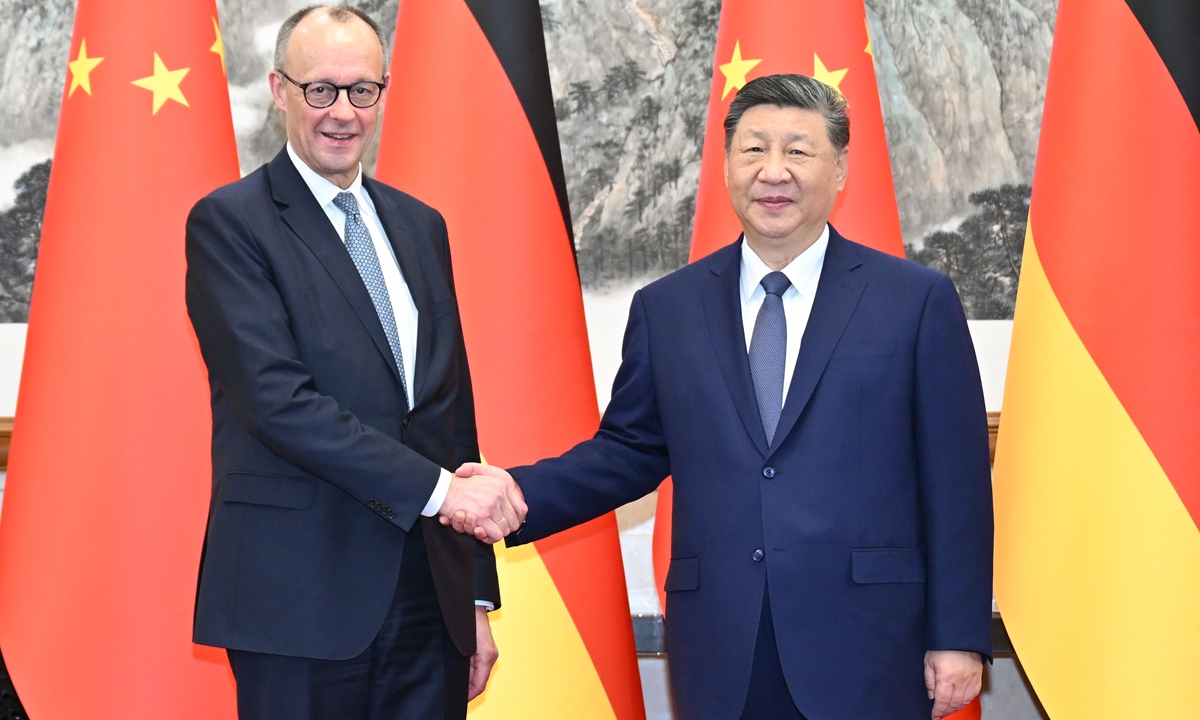
Chinese President Xi Jinping meets with German Chancellor Friedrich Merz, who is on an official visit to China, at the Diaoyutai State Guesthouse in Beijing on February 25, 2026. Photo: Xinhua
Chinese President Xi Jinping met with German Chancellor Friedrich Merz in Beijing on Wednesday, putting forward three suggestions for the further development of China-Germany relations and saying that the two sides need to continue promoting their all-round strategic partnership, the Xinhua News Agency reported.
The more turbulent and intertwined the world becomes, the more China and Germany need to enhance strategic communication, increase strategic mutual trust and promote the continuous new development of the all-round strategic partnership between the two countries, President Xi said when he met with Merz, Xinhua reported.
The current international situation is undergoing the most profound transformation since the end of World War II, he said, per Xinhua.
Xi put forward three suggestions for the further development of China-Germany relations, namely the two countries should be reliable partners that support each other, be innovative partners featuring openness and mutual benefit, and be cultural partners built on mutual understanding and friendship.
Xi said China and Germany should uphold the central role of the UN, reinvigorate its leading role, and take the lead in being upholders of multilateralism, practitioners of the international rule of law, defenders of free trade, and advocates of solidarity and coordination, according to Xinhua.
Xi also outlined China's principled position on the Ukraine crisis, saying that seeking solutions through dialogue and negotiation is key to the issue.
Xi noted the necessity of ensuring the equal participation of all parties to lay a solid foundation for peace, addressing the legitimate concerns of all sides to strengthen the will for peace, and achieving common security to build a lasting framework for peace, Xinhua said.
This is Merz's first official visit to China since taking office. He is also the first foreign leader China has received in the Year of the Horse. The visit was described by some German media as probably Merz's most important visit of the year.
In a joint press statement released during the visit on Wednesday, Merz expressed his gratitude to the Chinese government for the warm reception extended to him as the first foreign leader to visit China after the Chinese New Year.
According to the statement, the Chinese side noted that Germany attaches importance to issues such as "reducing dependence," trade imbalances and export management. The German side has also taken note of China's concerns regarding the over-securitization of economic and trade issues, as well as export restrictions on high-tech products.
Both sides are willing to properly address each other's concerns through candid and open dialogue, so as to ensure a long-term, balanced, reliable, and sustainable economic and trade relationship, according to the joint statement.
'New era' for bilateral ties
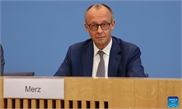
Before embarking on the two-day trip to China, Merz said in an address at Berlin's Brandenburg Airport that China has risen into the ranks of the major powers, and the Germany's China policy must take this into account. No one can bypass China anymore, he stressed, according to a transcript published on the German government's website.
He also admitted during the address that pursuing a policy of decoupling from China would be a mistake and only harm Germany itself.
The German Chancellor also noted that it is no coincidence that French President Macron, British Prime Minister Starmer, and himself are visiting China one after another within just a few weeks, ahead of US President Donald Trump, who is set to travel to China in April, according to the transcript.
In the address, Merz also extended Chinese New Year's greetings and thanked the Chinese side for hosting him on this special occasion. When he concluded his address, he said that "in China, it is said: a horse does not display its strength alone, but only by pulling the wagon together with others. I find this to be a fitting image at the beginning of my journey."
The German Chancellor published several X posts during his first day of the inaugural official visit to China.
After meeting with Chinese Premier Li Qiang on Wednesday, Merz posted in both German and Chinese on X, saying that roughly 7,500 kilometers lie between Berlin and Beijing. A distance that we have been happy to bridge for many years. It is very important to me to maintain and deepen our diplomatic and economic relations. For that to succeed, we need open channels of communication, he said.
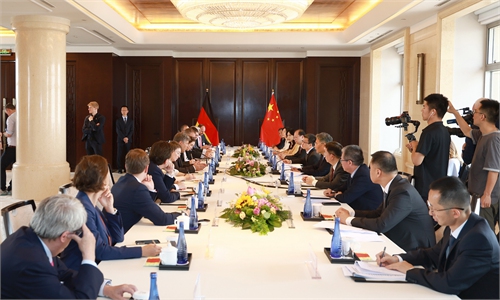
In the evening, he also posted a picture of a business meeting between the two sides, saying that "we want to strengthen the trade relations between Germany and China."
Jiang Feng, a researcher at Shanghai International Studies University and president of the Shanghai Regional Studies Association, who attended several parallel meetings of the visit on Wednesday, described the talks between Chinese and German representatives as highly pragmatic, with a warm and candid atmosphere.
"There was a shared commitment to further consolidating and improving bilateral ties, along with a strong desire to deepen mutual understanding," Jiang said, noting that there was also a clear awareness that China-Germany relations are entering a new phase, different from the past.
The current international landscape and the structure of bilateral ties have both undergone significant changes, and challenges remain substantial. As a result, how to reshape the relationship under these new structural conditions became a central focus of the discussions, the Chinese scholar said.
Optimistic view
While some German media described Merz's visit to China as a delicate balancing act, some headlined their reports with the huge potential of the Chinese market.
Merz also announced on Wednesday that Germany and China will resume intergovernmental consultations, which were launched in 2011 under former German Chancellor Angela Merkel and were last held in 2023, German media Welt reported.
German media Spiegel said before the trip that the German Chancellor has never prepared for a trip so meticulously.
Merz prepared for this meeting like it were a decisive exam, as he invited some of Germany's leading China experts to the Chancellery, listened, asked questions, and formed a clear picture, German media waz.de said.
This visit appears to have two main objectives including strengthening and improving economic and trade cooperation with China, while conducting in-depth consultations on related international issues, Jiang noted. "This is not only about improving relations, but also about deepening understanding of China, including a clearer understanding of China's positions and expectations on international affairs," he said.
In terms of tone and posture, compared with the previous characterization of China as a "systemic rival," Merz's position ahead of his visit to China appears noticeably more cautious, Jiang noted. "I hope that through in-depth exchanges during the visit, the relationship can move a step further forward."
When asked to comment on Merz's remarks before departing for Beijing, in which, unlike the previous government, Merz didn't speak of China as a "systemic rival," Chinese Foreign Ministry spokesperson Mao Ning said on Wednesday that China and Germany are all-round strategic partners. There are successful practices of sound competition and integrated development between the two countries. China-Germany cooperation is mutually beneficial, bringing tangible benefits to our two peoples.
The German Chancellor is leading a 30-firm delegation during the visit including top carmakers such as Volkswagen and BMW. German business circles are also optimistic about the visit.
"We hope the visit will lead to pragmatic exchanges between the two governments - also after the visit. Our member companies wish the Chancellor to address some of their current challenges, including supply chain stability and reliability. But probably he will also take home the understanding of the dynamic and competitive Chinese business environment, and the role that German-Sino cooperation can play therein," Oliver Oehms, Executive Director & Board Member of the German Chamber of Commerce in China-North China, told the Global Times in an exclusive interview on Wednesday.
In 2025, Germany remained China's top European trade partner; China reclaimed spot as Germany's No.1 trading partner after one year, with trade value totaling 1.51 trillion yuan, up 5.2 percent year-on-year, according to Chinese customs.
When the 1.9-meter-tall Merz arrived in Beijing and stepped out of the aircraft, some Chinese netizens noticed that he walked briskly down the stairs. Some interpreted this as body language reflecting a new diplomatic reality, while others in the media saw it as a gesture of sincerity.
"It looks like he can't wait to talk with the Chinese side," a Chinese netizen said on Chinese X-like platform Weibo.
RELATED ARTICLES