Jimmy Lai reportedly wins appeal in separate fraud case, still serving 20-year sentence for national security offenses
By Published: Feb 26, 2026 02:19 PM

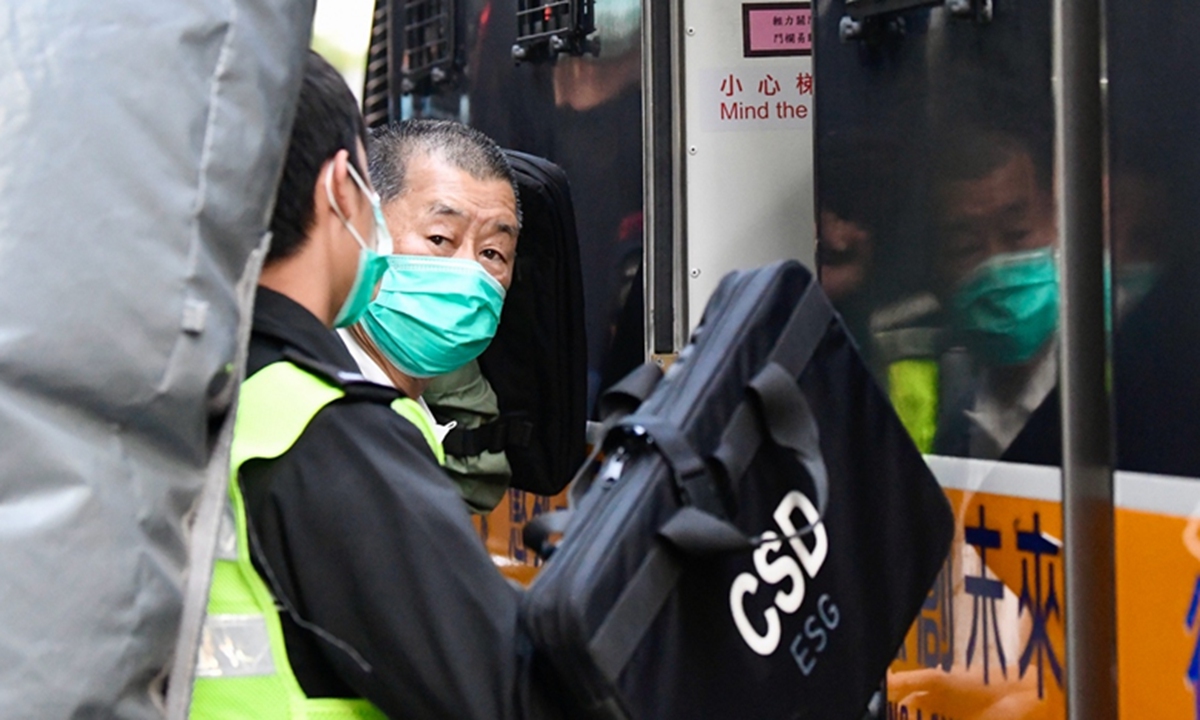
File Photo: Jimmy Lai, founder of Next Digital
Jimmy Lai, founder of Next Digital, has had his fraud conviction in a Hong Kong Science Park-related case overturned on appeal. Lai is serving 20-year sentence in a separate national security case, according to local media reports on Thursday.
Several legal professionals in the Hong Kong Special Administrative Region (HKSAR) told the Global Times that the fraud case is another case different from the earlier national security case in legal characterization, and the two rulings showed that the city upholds the independent judiciary and procedural justice.
Lai, 78, along with former Next Digital executive Wong Wai-keung, were accused of breaching the lease by allowing Dico Consultants to use the Apple Daily building in the Tseung Kwan O Industrial Estate and concealing this from the Hong Kong Science and Technology Parks Corporation for nearly 21 years, according to local media reports.
In delivering the original judgment, trial judge Chan Kwong-chi stated that Dico Consultants Limited was a private company providing management consultancy services, which were unrelated to the newspaper business.
The Court of Appeal held that, under the requirements for the Theft Ordinance, criminal liability for concealment arises only where there is a breach of a duty to disclose.
In this case, although Dico Consultants occupied the premises in breach of the lease terms, and Apple Daily Printing Limited, as the contracting party, had certain disclosure obligations, the Court of Appeal also considered long-established authorities. It found that, under common law principles, a contracting party generally has no duty to disclose its own breach of contract. Moreover, the lease did not expressly stipulate that the contracting party was required to make proactive disclosure.
The HKSAR's Department of Justice countered that, whether the arrangement constituted "exclusive occupation" or "shared use," prior approval in the form of a licence from the Hong Kong Science and Technology Parks Corporation was required. It argued that, as the tenant had enjoyed preferential land premiums under a "special lease," it bore a non-delegable duty of disclosure.
Notably, during the appeal hearing, Justice Anthea Pang Po-kam, who sat on the panel, astutely observed that the tenant had made substantial investments and that the project was intended to promote Hong Kong's economic development. She questioned whether the arrangement was merely beneficial to the tenant alone. Her remarks reflected the Court of Appeal's independent and thorough scrutiny of both the factual matrix and the legal arguments in the case, Willy Fu, a law professor and director of the Chinese Association of Hong Kong & Macao Studies, told the Global Times on Thursday.
Lai received a heavy 20-year sentence for colluding with external forces to endanger national security, and that his unlawful acts had been punished in accordance with the law. The outcome of the fraud appeal falls under a different legal category from the national security case: The former concerns commercial contractual integrity, while the latter involves issues of national sovereignty and security, Louis Chen, a member of the Hong Kong Election Committee, told the Global Times on Wednesday.
"The two cases differ fundamentally in legal characterization, standards of evidence, and sentencing logic. The judiciary's independent handling of the two cases demonstrates Hong Kong's rule-of-law principle of 'one offense, one judgment' and procedural justice," Chen said.
The HKSAR's High Court sentenced Lai on February 9, 2025 to 20 years in prison.
Lai was found guilty in December by the High Court of the HKSAR on two charges of conspiring to collude with external forces and a charge of conspiracy to publish seditious materials. Mitigation hearing for Lai's case began on January 12 and concluded on January 13.
This appeal process is a testament to the essence of the common law tradition. Hong Kong's judicial system, with its multi-tiered appellate mechanism, is designed to ensure that every case receives the fairest possible adjudication, Fu noted.
Even after a trial court has rendered its judgment, a party who believes that there has been an error in the application of the law or in the assessment of the facts may still seek redress before an appellate court, he said. "Such an institutional design serves as a robust safeguard for human rights and the right to a fair trial."
RELATED ARTICLES