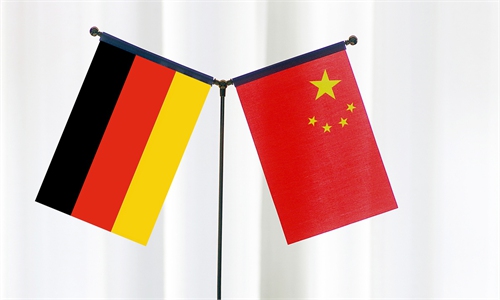
China, Germany see strong complementarity in auto industry; strengthened cooperation can boost global supply chain stability: expert
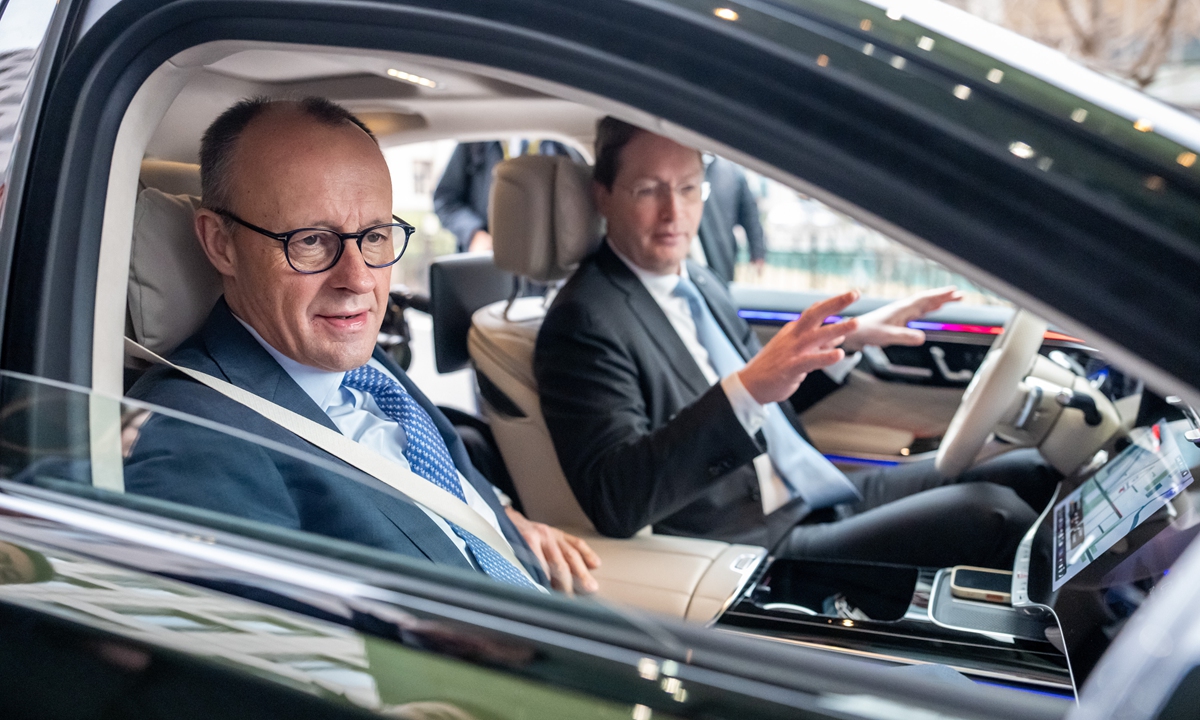
German Chancellor Friedrich Merz takes part in a presentation of self-driving Mercedes vehicles alongside Ola Kallenius, Chairman of the Board of Management of Mercedes-Benz Group AG in Beijing, China on February 26, 2026. Photo: VCG
German Chancellor Friedrich Merz took a special test ride in the new Mercedes-Benz S-Class on Thursday in Beijing during his official visit to China, personally experiencing the L2 Urban and Highway Navigation System, jointly developed by the German auto company and Chinese technology company Momenta.
The move underscores the high complementarity between the two countries, reflecting expectations from the German side to strengthen auto cooperation with China, its major trading partner, a Chinese expert said.
After his test ride on Thursday, Merz offered his high recognition for the technology. He highly commended the collaboration between Mercedes-Benz and Momenta in the era of intelligent vehicles, according to a press release the company sent to the Global Times on Thursday.
This intelligent assisted driving system is seamlessly integrated into Mercedes-Benz's proprietary central brain - the MB.OS (Mercedes-Benz Operating System) architecture. This new electrical and electronic architecture connects the domains of driving assistance, intelligent cockpit, and vehicle control, building an efficient, unified, and continuously evolving integrated intelligent ecosystem, according to the company.
"China is one of the most important markets for Mercedes-Benz not just in scale but also in its power of innovation," said Oliver Thöne, member of the Board of Management of Mercedes-Benz Group AG, responsible for Greater China, noting that over the years, it has established solid footprints in China with its largest production base as well as the most comprehensive research and development (R&D) set-up outside Germany, serving more than 7 million customers.
"Mercedes-Benz is a traditional manufacturer, while Chinese tech companies have unique strengths in the fields of new energy, artificial intelligence, and driving technologies... The complementary advantages of both sides can effectively revitalize traditional manufacturing," Zhou Mi, a senior research fellow at the Chinese Academy of International Trade and Economic Cooperation, told the Global Times on Thursday, noting that this kind of collaboration shows that both parties have a mutual interest in working together, and the German Chancellor's test ride also reflects his recognition of this cooperation.
Oliver Zipse, the chairperson of another German carmaker - BMW Group - accompanied Merz on the German Chancellor's visit to China. During the visit, the BMW Group and Contemporary Amperex Technology Co signed a memorandum of understanding in Beijing, according to information provided by the company to the Global Times on Wednesday.
"Looking ahead, this is more important than ever: those who disregard China's vast market and innovation potential will miss major opportunities for global growth and economic success," Zipse said.
The automotive industry is an important area of China-Germany economic and trade cooperation. The vehicle sector is undergoing profound changes not seen in a century, with technologies such as artificial intelligence and big data deeply integrating with the industry, reshaping the competitive landscape and value chain, Wang Yiwei, director of the Center for European Union Studies at Renmin University of China, told the Global Times on Thursday.
As major forces in the global automotive industry, China and Germany each have strengths in areas such as technology R&D, manufacturing processes, and market resources, making their advantages highly complementary and providing broad opportunities for cooperation, said Wang.
China-Germany automotive industry cooperation and interaction have continued to deepen. In November, the 9th China-Germany Automotive Conference was held in Changchun, Northeast China's Jilin Province with a delegation of more than 60 representatives from the German automotive industry attending. During the event, German business leaders and industry representatives called for deeper cooperation with China's automotive industry to achieve mutually beneficial outcomes, highlighting China's rapid technological progress as an area from which German carmakers can both cooperate and learn.
Following the success of the industry conference, the 10th China-Germany Automotive Conference is scheduled to be held on October 30, 2026, in Wolfsburg, Germany, focusing on innovative cooperation within the China-Germany automotive industry chain, which is expected to play an active role in further building consensus for open collaboration, the Global Times learned from the Investment Promotion Agency of China's Ministry of Commerce (MOFCOM).
In January, China and the EU agreed on the necessity of providing general guidance on price undertakings for Chinese companies exporting battery electric vehicle passenger cars to the EU, according to the MOFCOM, another recent positive sign for businesses on both sides to further unleash the cooperation potential in the auto sector.
To ensure supply chain stability while continuously upgrading the industry, China and Germany need to further leverage their respective strengths and pursue complementary cooperation, experts said. "Beyond manufacturing and production, there is now greater potential for collaboration in areas such as technology, standards, and policy," said Zhou.
In the bigger picture, China and Germany have seen increasingly close trade ties. According to Chinese customs statistics, the total value of goods imported and exported between China and Germany in 2025 reached 1.51 trillion yuan ($217.8 billion), a year-on-year increase of 5.2 percent.
Germany remained China's largest trading partner in Europe, while China regained its position as Germany's largest trading partner after a one-year interval.
The Chinese market is crucial for German companies in the export sector, especially in mechanical engineering, automobiles and auto parts, electrical engineering, and chemicals. China and Germany maintain close cooperation in all major economic and industrial fields, according to a document published on the official website of the German Embassy in Beijing.
Against the backdrop of numerous uncertainties in global industrial and supply chains, strengthened cooperation between China and Germany not only advances bilateral relations but also offers a valuable example of sustainable, rules-based collaboration, bringing greater stability to today's world, Wang said.
RELATED ARTICLES