Per capita 500 kg of grain availability represents a major part of China’s confidence, responsibility
Illustration: Liu Rui/GT
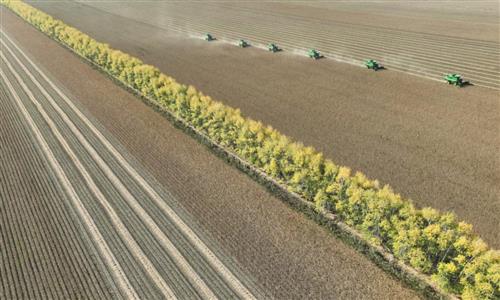
In 2025, China's total grain output reached 714.88 million tons, building on the historic achievement of surpassing the 700-million-ton threshold for the first time just a year earlier. This brings the country's per capita grain availability to over 500 kilograms. Against a backdrop of complex global geopolitics and mounting economic pressures, this figure represents far more than a statistical milestone. It embodies the quiet confidence of a major developing nation capable of weathering storms - and its commitment to anchoring a volatile world with much-needed stability.
The people are the foundation of a country; food is the primary need of the people. For a country of more than 1.4 billion people, food security has always been a top priority. Two consecutive years of steady grain output growth provide a solid anchor for China's overall development - consolidating the foundation for long-term economic and social stability. As Li Guoxiang, a researcher at the Rural Development Institute of the Chinese Academy of Social Sciences, told the Global Times, a secure food supply ensures the stability of people's livelihoods, laying the groundwork for the pursuit of high-quality development.
This confidence is rooted in the coordinated advancement of policy and technology. In recent years, China has continuously enhanced its food security governance, building a more resilient guarantee system. More importantly, the increase in grain output is not a matter of chance, but the outcome of an agricultural technological transformation. The country has prioritized the development of strategic agricultural science and technology and accelerated breakthroughs in key technologies, with the contribution rate of agricultural technological progress exceeding 64 percent in 2025. It is these concrete and sustained efforts that enable the Chinese people to say with calm assurance, in the face of any storm: "China's rice bowl is filled primarily with grains we produce ourselves."
China has achieved basic self-sufficiency in grains and absolute security in staple food. This solid foundation underpins the stable lives of countless families and the nation's confidence in pursuing long-term development. In a volatile international environment, China firmly holding its "rice bowl" not only ensures domestic stability but also injects precious certainty into global food security, demonstrating the responsibility of a major country.
Globally, geopolitical conflicts, frequent extreme weather events and persistent supply chain disruptions have brought unprecedented uncertainty to the food market. At a time when some countries attempt to weaponize food - using monopolistic trade practices and price manipulation to exert pressure - China's consecutive bumper harvests carry special strategic weight.
"China's increasing grain output serves both as a 'ballast stone' for its own economy and as a 'stabilizer' for the international market, genuinely contributing to the maintenance of global food security," said Li.
China feeds around 20 percent of the world population with 9 percent of the world's arable land, firmly holding its position as the world's largest grain producer. The calm confidence that comes from "having grain in hand" stands as the most resolute response to any form of external pressure or bullying.
"One out of every 2.5 kilograms of grain produced globally comes from China" - this is not a boast, but a concrete demonstration of global responsibility.
Through the FAO-China South-South Cooperation Programme, China provides technical assistance on hybrid rice technologies to dozens of countries and regions across Asia, Africa and the Americas. This model of cooperation goes beyond traditional one-way aid, helping developing countries gradually achieve food self-sufficiency and secure their own food supply - without relying entirely on supply chains dominated by multinational grain traders.
714.88 million tons is more than a statistic - it is a statement of confidence. 500 kilograms of grain per capita is more than a milestone - it is a measure of responsibility. The Recommendations of the Central Committee of the Communist Party of China for Formulating the 15th Five-Year Plan for National Economic and Social Development highlights further capacity for ensuring the supply of grain and other major agricultural products, emphasizes both output and production capacity, both agricultural production and ecological conservation, and both output expansion and income growth. On the new journey toward national rejuvenation, we have every reason to believe that this deep-seated confidence, rooted in the fields, will continue to steady the course of China and bring greater peace and certainty to a turbulent world.
RELATED ARTICLES