What Merz’s China tech vanguard visit reveals
From robot lab to calls for a partnership, trip signals deeper economic engagement
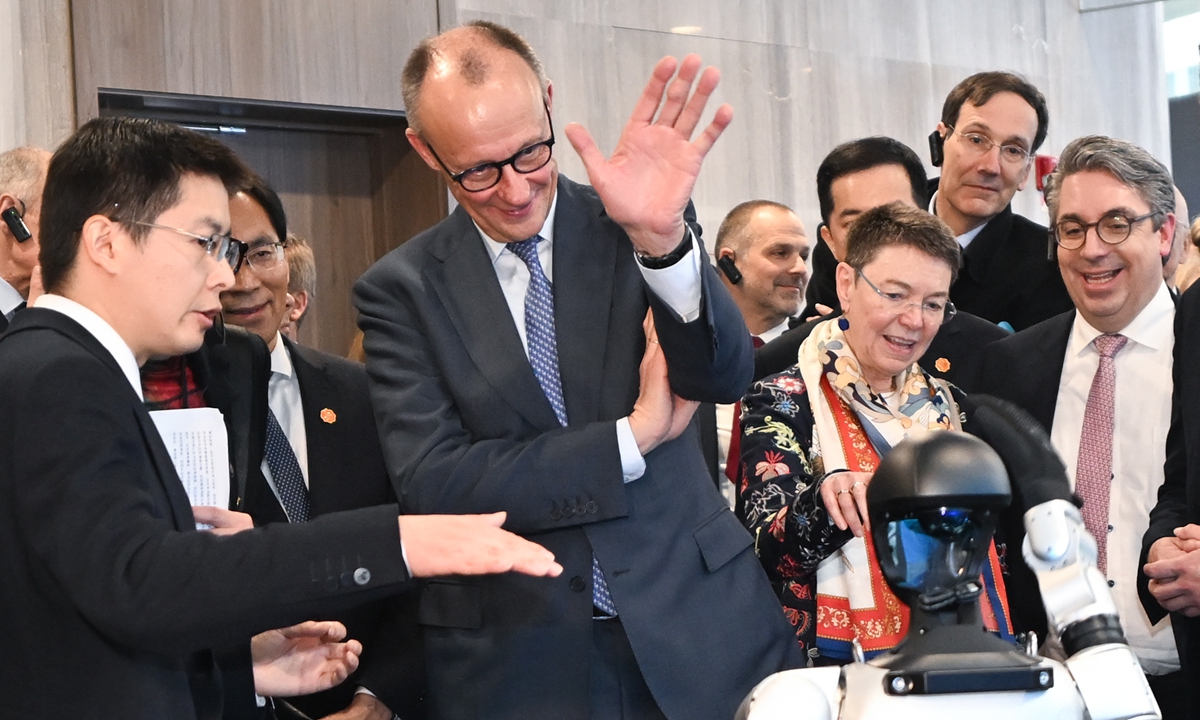
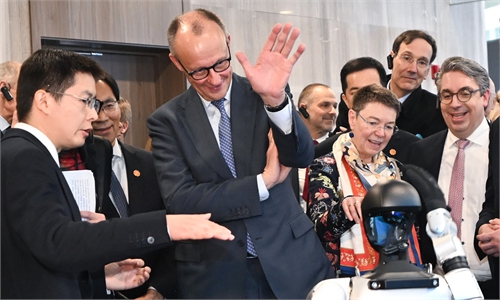
German Chancellor Friedrich Merz waves to a humanoid robot during his visit to the Chinese robot company Unitree Robotics in East China's Hangzhou on February 26, 2026. Photo: cnsphoto
"You can see all the dynamics and the uprising mood in China," said German Chancellor Friedrich Merz, summing up his impressions of China in three words during his intensive two-day visit: dynamics, exciting, and cooperation.
He shared the above summary in a short video clip posted on his Instagram account on Friday, which was recorded while visiting Unitree Robotics — China's leading humanoid robot company — and viewing cutting-edge technology displays in Hangzhou, East China on Thursday.
In a separate video on Instagram Thursday, he noted that this year is the Chinese Year of the Horse, which stands for energy and strength — "I like that... and I hope it will be a year of growth and economic cooperation between Germany and China," he posted.
From top-level engagements to a visit to a high-tech company and even a Palace Museum tour, it was not only the Chancellor who appeared impressed by what he saw during the visit. His trip also drew wide attention at home and abroad, especially against the backdrop of European countries' recent gesture of "looking Eastward" for enhancing cooperation, as well as a transatlantic rift.
Wide attention
Many German media outlets have described the visit as "long overdue." Since assuming office in May of last year, Merz has repeatedly expressed his intention to visit China.
Commenting on the visit to China, German media outlet DW News reported that during his visit, Merz is "keen to deepen economic links between Germany and the world's second-largest economy, which recently overtook the US as Germany's most important trading partner."
According to Germany's Spiegel, the chancellor had never prepared so meticulously for an overseas visit. Similarly, German media waz.de said Merz prepared for this meeting like it were a decisive exam.
Highlighting the significance and purpose of Merz's visit, Reuters reported that "The technical sophistication of Chinese firms, their deep integration in manufacturing supply chains and the sheer size of the country's consumer market make China an indispensable partner for Germany."
Some conservative right-wing critics in Germany have attacked the bilateral cooperation outcomes of Merz's visit as kowtowing to China, satirizing him to "Merkel 2.0." Some media outlets have also focused on the challenges in Germany's relations with China, particularly regarding claims of so-called "overcapacity" and concerns over trade deficits. Yet, more have recognized the importance of the visit.
The business delegation accompanying Merz is the largest to join a German chancellor on an overseas trip since the era of Angela Merkel, according to media reports.
Responding to Merz's social media post, one Instagram user commented, "You went, You saw, You returned... keep up with the good works, we need more change."
Echoing concerns about Germany's economic trajectory, another netizen dubbed Andreas_srienz also added, "Thank you, Chancellor, for doing something our country urgently needs. The economy and the economic growth!!!"
Noting the backdrop of widening rift with Washington and Berlin "still emerging from two years of recession," the NBC commented that Merz's visit underlined the vital importance of China's huge consumer market and the technical sophistication of its all-conquering manufacturers for Germany's weakened economy.
This was far more than a simple "show-and-tell" visit, as both the German government and business community were closely watching China's latest advances in digital economy and intelligent manufacturing, while actively seeking new opportunities for collaboration, Zhao Junjie, a senior research fellow at the Institute of European Studies at the Chinese Academy of Social Sciences, told the Global Times on Friday.
'Teaching to learning'
Beyond bilateral cooperation, many Germans have also shown a spirit of reflection after seeing the progress China made in manufacturing and cutting -edge technology through the lens of Merz's video.
Germany is known a nation where technological innovation and manufacturing excellence run deep in its DNA, and once brought their technologies to China and formed joint ventures. While China, in the past decades, was known as the "world's factory," and defined primarily by scale, efficiency, and cost competitiveness.
Michaela Kuefner, Chief Political Editor at DW News who joins Merz's China visit, posted on X while watching German Chancellor Merz observe Unitree's humanoid robots performing kung fu in Hangzhou on Thursday: China shows off its AI robotics edge. German Chancellor Merz gets a taste of how the roles between China and Germany reverse.
On Thursday, a Global Times reporter observed that robot parts and components were arranged openly for close inspection and explanation, a display that underscored the confidence of Chinese technology companies in their own technology capabilities.
At one point, Merz moved his hand from his pocket, picked up a lower leg component, and studied it carefully, turning it over in his hands. He then tapped it lightly with his fingers and asked a question to people beside him, a move that experts described as reflecting a clear interest in how the machine works in practice.
For some German companies, this represents a shift for Germany from "being the teacher to becoming the student." Jens Dallendörfer, Regional CEO of Germany's Wilo AMEA (Asia, Middle East, Africa), told a reporter from China Daily that China has developed so quickly and so impressive, using the German proverb "Der Lehrer wird zum Schüler" or "The teacher becomes the student" to describe the changes.
Jordi Boto Rodriguez, CEO of Elbe Flugzeugwerke (EFW), who accompanied the visit seeing the robot performance with Merz, told the Global Times that the Chinese advanced technology can be applied to support aging society.
Reinhard Christian Zinkann, another German businessperson echoes Rodriguez's thoughts about learning and adopting from China. As an executive Director and Co-Proprietor of Miele Group, he told the Global Times that "my business is in appliance. So having housekeepers who are robots will be interesting for the future and to have robots in the production process, in the logistics will also be interesting."
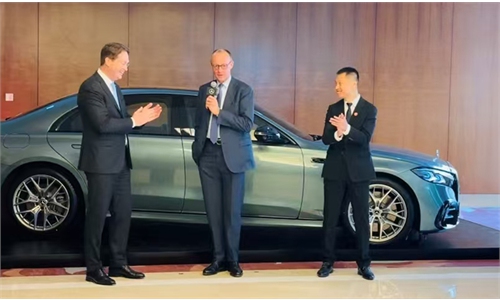
Luke Hu, Co-Founder of Electroder, an automotive industry insider familiar with the landscape of China-Germany auto industries, told the Global Times on Friday that China possesses distinctive resources and capabilities in electrification, intelligent industrial scenarios, and large-scale supply chain.
For German companies, particularly those in fast changing auto sector, collaboration with Chinese partners can facilitate faster access to mature technologies, timely market feedback, and accelerated product iteration, the insider said.
Bilateral trade between China and Germany reached 251.8 billion euros ($296.6 billion) in 2025, up 2.1 percent year-on-year, with China surpassing the US to once again become Germany's most important trading partner, Germany's Federal Statistical Office said in a recent press release.
The breakdown is even more revealing: Germany imported 13.9 billion euros worth of machinery from China, up 11.6 percent; imports of electrical equipment rose 14.8 percent to 32.8 billion euros.
Zhou Mi, a senior research fellow at the Chinese Academy of International Trade and Economic Cooperation, said that the global manufacturing landscape is rapidly being reshaped, and the focus of China-German economic and trade discussions is shifting from changes in trade volume to a shared understanding of the next generation of manufacturing cooperation.
Following the reports about Merz's visit to China, a Germany netizen dubbed ferat_de wrote on Instagram that, "I thought the Chinese were years ahead of us - thanks to their visit, we now know it's actually decades." The remark, posted under related coverage of the trip, reflected a sense of surprise at the pace of development described during the visit.
RELATED ARTICLES