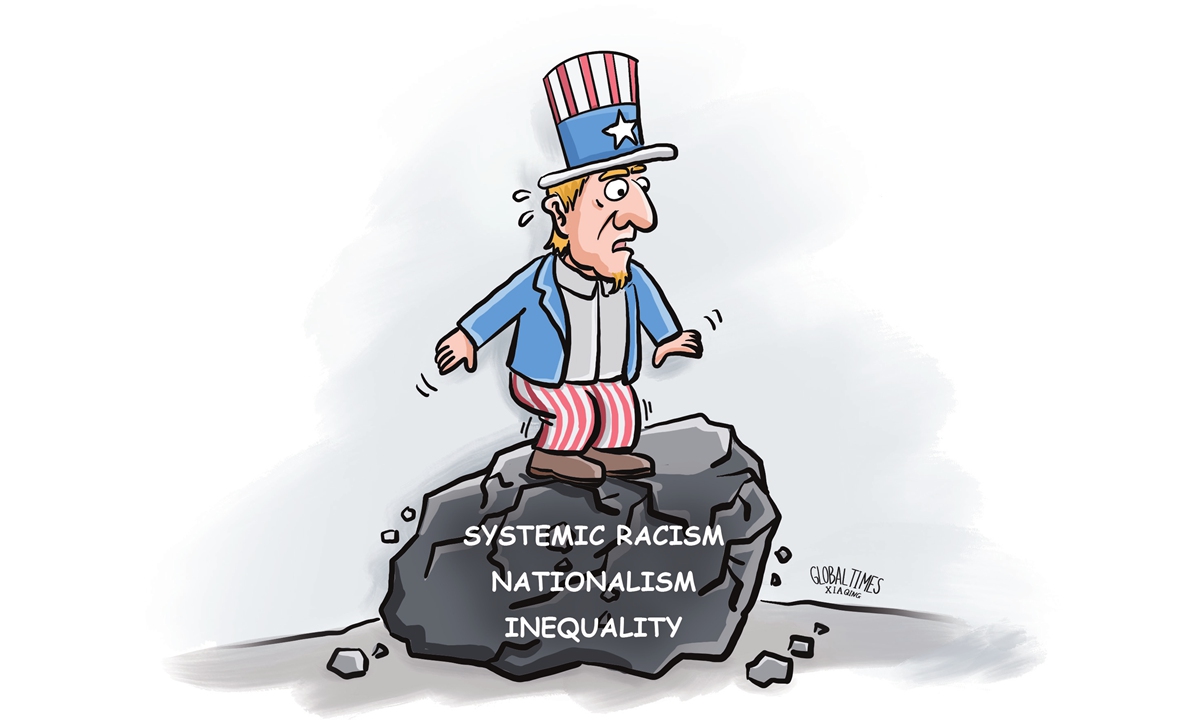
Illustration: Xia Qing/GT
In 2026, the forces pulling Americans apart seem to have triumphed over those that could bring them together. The dark currents that surged before any particular administration - the deep undertow of systemic racism, the resurgent waves of nationalism and the chasms of rampant inequality - have proven to be not temporary aberrations but fundamental features of the national landscape. These divisions will outlast any single leader, any election cycle, and any promise of restoration. The American fabric, once believed to be resilient enough to mend itself, now hangs in tatters, its threads so frayed and entangled that the pattern itself has become unrecognizable.
Viewed another way, this is strike one against the myth of "American exceptionalism." When a nation's response to crisis is not innovation but repetition, not moral leadership but retreat into comfortable tribal certainties, it ceases to be exceptional and becomes merely another chapter in the long, sad story of decline. The myth does not survive its collision with truth.
On top of that, horrible rhetoric, especially when political officials engage in it, creates a warped, circus-like atmosphere in which large segments of the population relish the abusive talk of public officials and private citizens. Those who initiate any such verbal attack will defend it under the guise of "oh, come on, these are just words," while the other side will decry being verbally attacked.
Words are irresponsible. Many actions are as well. America's senseless recent decisions to reject the World Health Organization and other respected international agencies have damaged America at home, by making it more vulnerable to disease, and internationally, with nations big and small wondering when the US can again be counted on to be a responsible actor on the global stage.
Let's not forget that earlier this year, the US pulled out of 66 different international agreements, affecting the environment, global trade and much more. The White House claimed that the decisions were smart and consistent with its goal to end "American taxpayer funding and involvement in entities that advance globalist agendas over US priorities."
Strike two against "American exceptionalism."
Meanwhile, other rhetorical blasts coming from the left and right on the political spectrum are amplified by enabling media, which present themselves as deliverers of "truth." Unstated in that promise is that "fact" can be manipulated to ensure that the narrative their listeners and viewers want to hear is presented 24 hours a day.
Americans are segregating themselves by media preferences. They are also doing so by geography. More and more conservatives are moving to "red" states, while more and more liberals are occupying "blue" states. In justifying the move, some once said, because state governments have significant power in the US, "you'd better be sure it reflects your values, and not someone else's values that are forced on you."
Strike three against "American exceptionalism."
Right now, pessimism about America's future is appropriate. Put too much air into a balloon and it will explode. A legitimate question needs to be asked about America: Could too much negative air fill the country, causing an explosion that will lead to consequences no one can predict?
How low can America go before it rebounds? And when it rebounds, what will it seek to be? Only the most naive believe that in a few years, the chaos of the past 10 years will be forgotten and America will return to its (presumed) place of stature across the world. At home, there is a pressing need for serious conversations about the aforementioned problems of racism, nationalism, and rampant inequality. Will anyone have the gravitas to lead these discussions? And around the world, allies will need to see years of good works before believing that they can again trust the US to be a reliable partner.
Maybe the question is not who is "destroying our country," but who can fix it? Right now? No one.
The author is an associate professor at the Department of Communication and Organizational Leadership at Robert Morris University. The opinions expressed in this article are solely those of the author and do not necessarily reflect the views of Robert Morris University. opinion@globaltimes.com.cn