Philippine vessel's risky maneuver near Huangyan Dao 'highlights rising provocations'
Experts say move reflects rising provocations from Manila
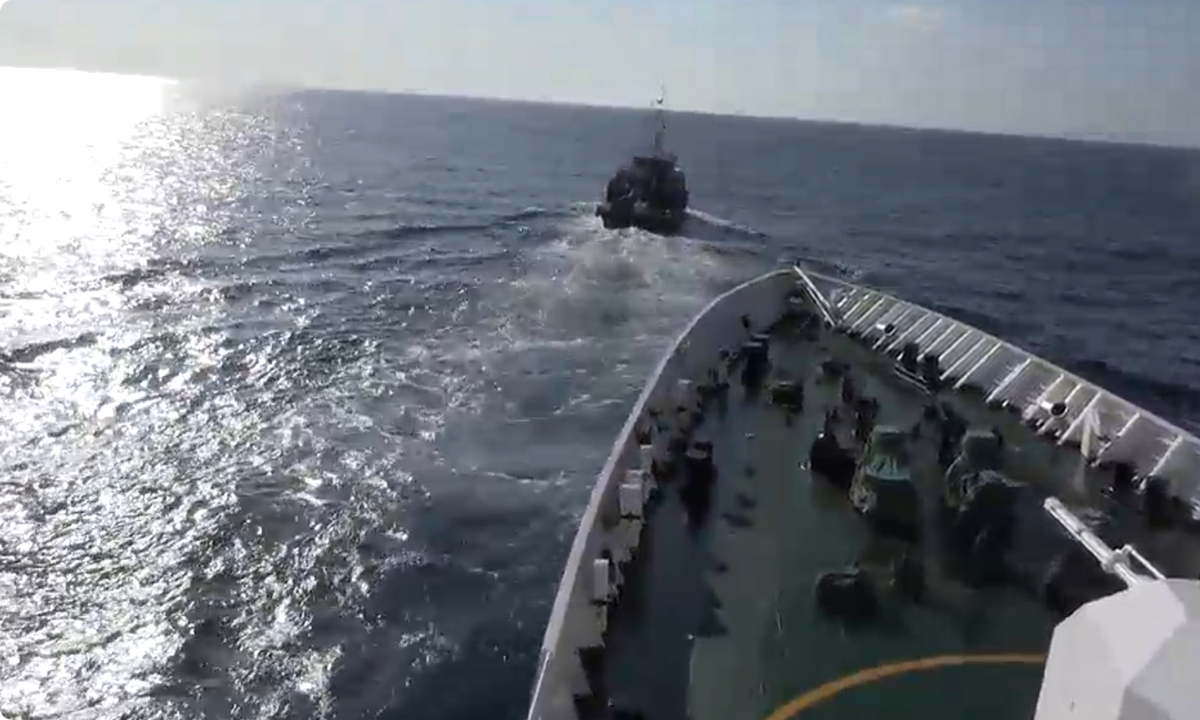
Photo: A screenshot of the exclusive footage obtained by the Global Times on March 1, 2026 shows that a Philippine ship alters course to the right, cutting across the front of the Chinese vessel at close range
In the blue waters of the South China Sea, a China Coast Guard (CCG) vessel was seen cruising at high speed when, from its port bow, a Philippine ship altered course to the right, cutting across the front of the Chinese vessel at close range, disregarding the risk of a potentially fatal collision. The scene comes from exclusive footage obtained by the Global Times on Sunday of the incident that occurred on Friday.
The Philippine vessel, hull number 3004, operated by the country's Bureau of Fisheries and Aquatic Resources (BFAR), was navigating near China's Huangyan Dao when it dangerously crossed the bow of a CCG ship. The maneuver was widely viewed as provocative and posed serious risks to maritime navigation safety. The video once again shows the Philippine side interfering with the CCG's regular law-enforcement patrols in waters near Huangyan Dao, Chinese experts said.
The footage stands in contrast to earlier remarks by Philippine Coast Guard (PCG) spokesperson Jay Tarriela, who claimed that PCG and BFAR vessels deployed in the area were there to "promote peace, stability and rule of law." Experts noted that the on-site situation documented in the video does not align with that characterization.
Dangerous provocation
Chen Xiangmiao, a research fellow at the National Institute for South China Sea Studies, told the Global Times after reviewing the footage that the Philippine vessel's act of crossing in front of a CCG ship violated relevant international maritime rules and navigation regulations. He described it as an irregular and dangerous maneuver highly likely to trigger accidents such as collisions.
"On one hand, such behavior appears to be predicated on the assumption that the Chinese side would not ram their vessel, which constitutes a provocation. On the other hand, if a collision were to occur, the Philippine side could seize the opportunity to hype up so-called 'China threat' narratives in the region," Chen said.
The Friday incident coincided with Tarriela's social media posts. He claimed that multiple PCG and BFAR vessels had headed to Huangyan Dao and Xianbin Jiao to distribute fuel, ice and food packs to fishing boats, asserting that the operation was meant to assert the nation's rights "without provocation." However, experts said the footage suggests otherwise.
The Philippine maneuver and its operations around Huangyan Dao came as the Chinese side was carrying out law-enforcement patrols in the area. In a statement released on its official WeChat account on Saturday, the CCG said that it conducted law-enforcement patrols in the territorial sea of China's Huangyan Dao and its surrounding areas.
Since February, the CCG has enhanced law-enforcement patrols in the territorial sea of Huangyan Dao and its surrounding areas, and regulated ships engaged in illegal rights-violation activities in accordance with laws and regulations. Such patrols are meant to further strengthen orderly management of relevant waters and resolutely safeguard China's territorial sovereignty and maritime rights and interests, according to the statement.
According to Yang Xiao, a maritime affairs expert at the China Institutes of Contemporary International Relations, the Philippine side deliberately dispatched BFAR and PCG vessels to circle Huangyan Dao, while coordinating with the countries' fishing vessels to draw international attention and stage a provocation.
"Faced with such provocations, China has sufficient capability to exercise control in waters near Huangyan Dao. At the same time, despite holding an absolute advantage, the Chinese side has maintained professionalism and restraint, operating strictly in accordance with procedures and preserving evidence," Yang said.
'Joint patrols'
The US, Japan, and the Philippines held a so-called joint military exercise from February 20 to 26 in the South China Sea, the Philippines' armed forces claimed in a statement on Friday.
On Saturday, naval and air units of the PLA Southern Theater Command conducted readiness patrols in the territorial sea and airspace of China's Huangyan Dao and its surrounding areas. The Chinese patrols were said to "respond to the so-called joint patrols by relevant countries," according to a statement from the PLA Southern Theater Command.
The Philippines has repeatedly conducted so-called multilateral training exercises with the US, Japan and other countries in the South China Sea, partly in response to domestic dissatisfaction over China's effective control of Huangyan Dao and its adjacent waters, Chen noted.
Following China's establishment of the Huangyan Dao national nature reserve in 2025 and a series of measures to strengthen controls in the region, China has further reinforced its governance and control over Huangyan Dao and the broader South China Sea, while adopting more comprehensive and forceful countermeasures against Philippine infringement activities, Chen said.
A statement released on Saturday by the official WeChat account of the PLA Southern Theater Command reiterated that Huangyan Dao is an inalienable part of China's territory. Since February, naval and air units of the Southern Theater Command have enhanced readiness patrols in the territorial sea and airspace of Huangyan Dao and surrounding areas.
Such patrols serve as effective countermeasures against various rights violations and provocative acts, including the so-called joint patrols by relevant countries, and are aimed at resolutely safeguarding China's territorial sovereignty and upholding peace and stability in the South China Sea.
RELATED ARTICLES