AI injects strong tech momentum into holidays: MIIT
Applications gain ground, sector eyes deeper industrial integration: experts
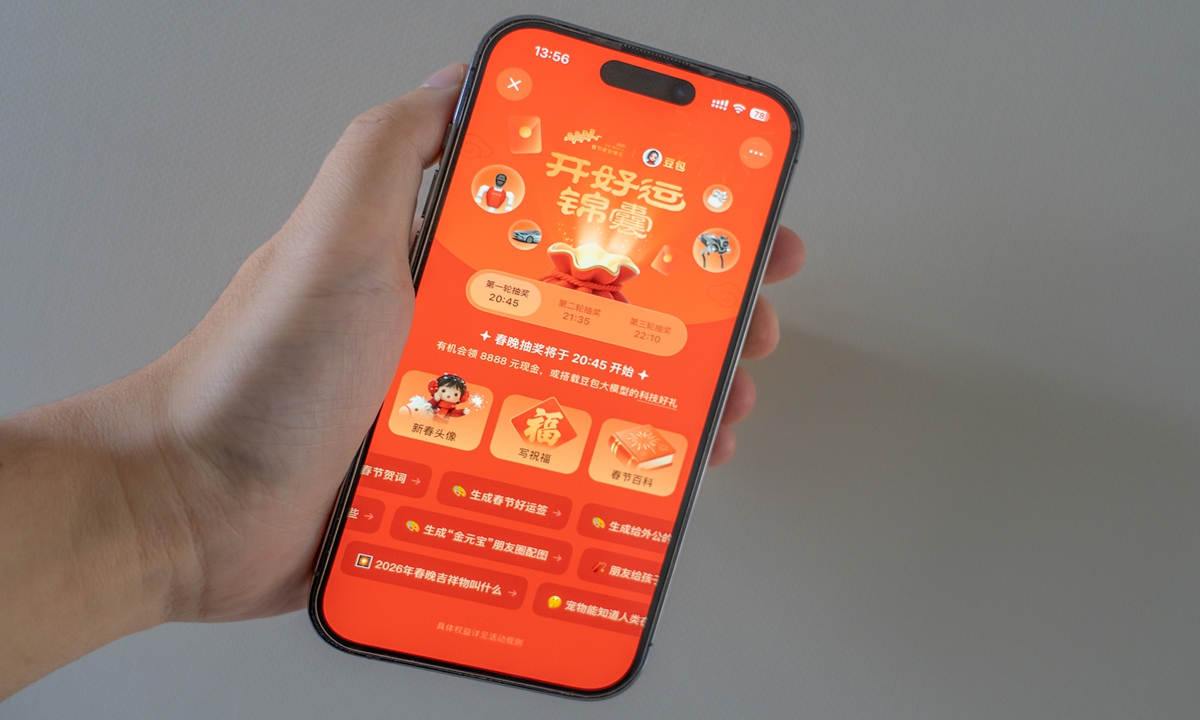
The red envelope campaign interface of Doubao, ByteDance's AI-powered app, displays AI creation options, including AI-generated New Year greetings, on February 16, 2026. Photo: VCG
As fireworks lit up the night sky and families exchanged greetings during the Spring Festival, millions of Chinese users were also tapping their phones to generate artificial intelligence (AI)-powered New Year wishes, create festive avatars and interact with virtual companions.
China's major telecom operators stepped up implementation of the "AI+" initiative, expanding AI applications across multiple sectors during the 2026 Spring Festival holidays to inject strong technological momentum into the festive period, the Ministry of Industry and Information Technology (MIIT) said on Monday.
The MIIT said on its official WeChat account that telecom operators actively leveraged AI to enhance digital life during the Spring Festival holidays, launching services such as AI-powered content creation and intelligent interaction. Applications including AI-generated New Year greetings gained wide popularity, with user participation continuing to grow, it said.
Applications such as AI-generated New Year greetings, which allow users to create customized holiday messages, digital avatars and short videos through simple prompts, gained wide popularity this year, with participation continuing to grow, experts said.
"I used AI this Spring Festival to generate greetings and short videos for my family, friends and colleagues," said Ye Yufei, a 25-year-old worker in Beijing. "There are dozens of people I need to send wishes to, and typing each one by hand is just too exhausting.
"Large-language AI models have become especially popular this year, and almost everyone is using them. I just type in a few lines, and it can produce greetings in different styles, and even turn them into short videos. I make a few edits to personalize them, and it's really convenient and saves me a lot of time," she said.
Wang Peng, an associate research fellow at the Beijing Academy of Social Sciences, told the Global Times that rising participation in AI-powered Spring Festival greetings suggests AI is gradually entering daily life. Telecom operators have accelerated adoption by providing strong cloud and network infrastructure and expanding practical use cases.
AI is entering a phase of accelerated growth, and China holds distinct advantages in both large-language model development and real-world deployment, Bian Yongzu, a senior researcher at the China Institutes of Contemporary International Relations, told the Global Times.
Companies including Alibaba, Baidu, Tencent and DeepSeek are rapidly upgrading their models, placing China among global front-runners, while the country's vast manufacturing base and rich application scenarios provide strong support for large-scale AI adoption, Bian said.
AI has moved beyond merely attracting users to deeply empowering industries, and it is reshaping business operations by improving efficiency, optimizing product structures and supporting market strategy and scientific research, Bian said. China's highly developed mobile internet ecosystem and strong user adaptability have enabled AI applications to scale up quickly.
According to the South China Morning Post, young people in China are reshaping Spring Festival traditions by creating a "Cyber Chinese New Year," lighting virtual incense, sending digital gifts and increasingly turning to AI companions for comfort, a sign that AI is moving into mainstream holiday rituals.
Meanwhile, Reuters reported that over the holidays, Chinese AI start-ups rolled out advanced open-source models, with systems such as Alibaba's Qwen and Moonshot AI's Kimi gaining overseas attention and in some cases rivaling leading Western models in reasoning and coding benchmarks.
On the last day of the Spring Festival holidays, major technology firms released fresh user data highlighting surging AI engagement. Ant Group said that Alipay's "AI Pay" users have surpassed 100 million. Baidu reported that its newly launched "Yue Yunpeng AI co-driver" on Baidu Maps saw explosive growth ahead of the holidays, with daily active users jumping 29-fold since its release.
Alibaba's Qwen app said on February 23 that it handled nearly 200 million "one-sentence" orders during the holidays. Doubao, which had a partnership with the CCTV Spring Festival Gala, recorded 1.9 billion AI interactions on Chinese New Year's Eve alone, generating more than 50 million festive avatars and more than 100 million greetings. Tencent said that its Yuanbao app has surpassed 50 million daily active users, with monthly active users reaching 114 million.
The surge in AI-driven services came amid record-high mobile data consumption. Official figures showed that during the nine-day 2026 Spring Festival holidays (February 15-23), total mobile internet traffic reached 8.783 million terabyte (TB), up 18.7 percent year-on-year, with growth accelerating by 8.8 percentage points.
Traffic peaked at 993,000 TB on February 21, while 5G usage surged 39 percent from a year earlier, accounting for 71.4 percent of total mobile data, underscoring the growing digital intensity of holiday consumption.
Wang said that 2026 could become an important year for accelerating AI deployment, though not necessarily a definitive turning point. Policy support and expanding application are creating favorable conditions, yet challenges remain in technology maturity, data security and sustainable business models. As AI continues to empower industries and enhance governance efficiency, it is expected to drive digital transformation, create new growth engines and elevate the overall quality of the digital economy.
RELATED ARTICLES