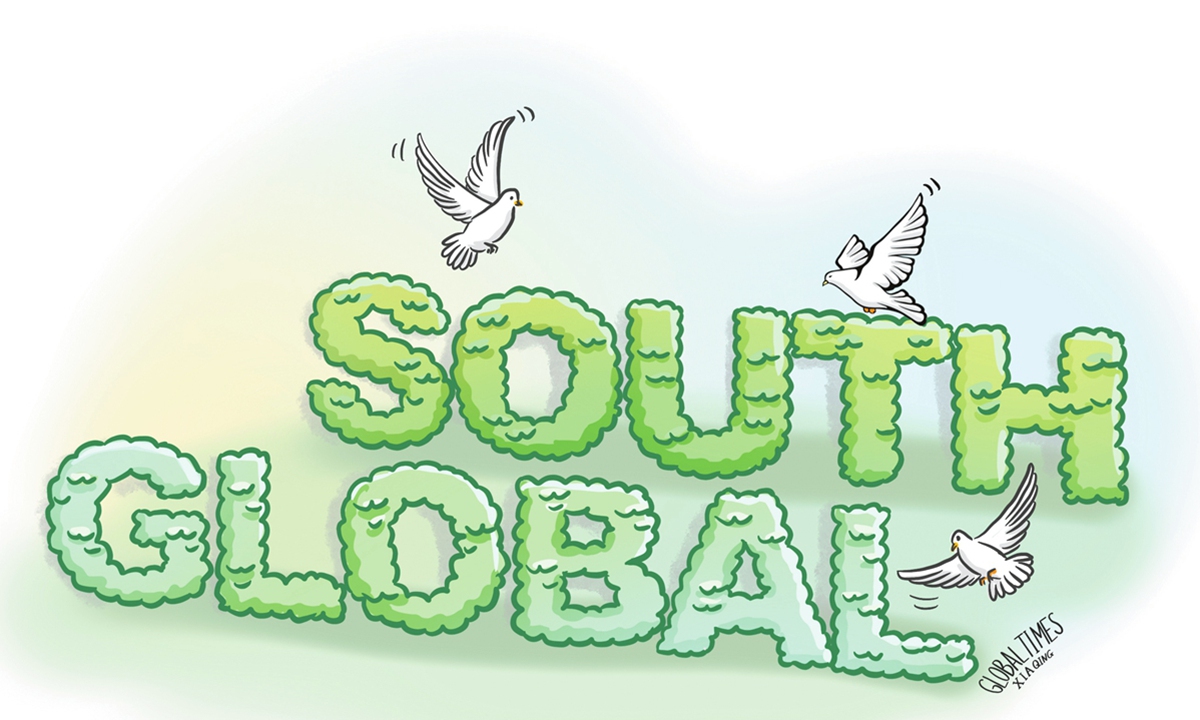
Illustration: Xia Qing/GT
The international order is experiencing its most profound transformation since 1945. While Western institutions decay under protectionist pressures and unilateral interventions, a new collective consciousness is crystallizing across Asia, Africa and Latin America. The Global South, representing 85 percent of humanity, is no longer content with a peripheral status. It is building parallel systems, challenging financial hegemony and demanding genuine multilateralism.
This shift transcends mere geopolitical rivalry. The BRICS bloc's explosive expansion - from five founders to 11 full members plus 13 partner countries - signals institutional maturation rather than symbolic protest. Meanwhile, another 32 nations are actively seeking entry, transforming BRICS from an acronym into a genuine gravitational force. Having financed over $32 billion across 96 projects, the New Development Bank, according to sources, plans to issue its first Indian rupee-denominated bond this month, accelerating financial sovereignty.
The catalyst for this awakening extends beyond economics. Recent US-Israel strikes that killed Iran's Supreme Leader Ali Khamenei lay bare the selective enforcement of the post-World War II "Washington Consensus": preaching a rules-based order to the Global South while wielding raw power for core interests, fueling great-power competition and a fierce backlash against hegemony.
Earlier, the January 2026 US military intervention in Venezuela - capturing President Nicolas Maduro under "narcoterrorism" accusations without international consensus - epitomized a "no-rules" era. African leaders immediately condemned the action as echoing colonial interventions, while across Latin America, even conservative governments began accelerating diversification toward Beijing and Delhi. When sovereignty itself becomes transactional, neutrality transforms into necessity.
Yet the Global South Consensus refuses to become merely anti-Western. The July 2025 BRICS Rio summit, themed "Strengthening Global South Cooperation for More Inclusive and Sustainable Governance," explicitly rejected confrontational framing. Brazil's presidency emphasized bridge building over bloc formation, recognizing that sustainable development requires engaging - not abandoning - Northern markets and technology. This pragmatic solidarity distinguishes today's movement from 1970s Non-Aligned romanticism.
The consensus prioritizes four interconnected pillars: industrialization without carbon colonialism, digital infrastructure sovereignty, food and energy security, and reform of Bretton Woods institutions.
China's Global Development Initiative demonstrated that Southern-led public goods could fill gaps left by retreating Western aid. South-South trade now accounts for nearly 60 percent of developing countries' high-tech exports, while developing countries host 65 percent of global foreign direct investment inflows.
The US has accelerated this trajectory through strategic miscalculation. The 2025 National Security Strategy's transactional "America First" approach - treating Africa as "mineral extraction zones" and demanding tariff concessions without development partnership - has validated worst fears of unreliability. When Washington simultaneously demands alignment against China while cutting climate finance and development assistance, it forces impossible choices that drive hedging behavior.
Africa and the broader Global South secure interests through pragmatic non-alignment: fast-tracking platforms like the African Continental Free Trade Area, unifying African Union global positions, and building strategic reserves to buffer shocks and gain leverage. Technology democratization amplifies these structural shifts. The Global South no longer accepts technological dependency as development's price. From India's digital public infrastructure models to Brazil's agricultural biotechnology cooperation with African nations, knowledge transfer occurs horizontally rather than vertically. The 2025 Shanghai Cooperation Organisation summit in Tianjin established artificial intelligence governance principles - standards developed without Western participation but likely to influence global norms.
Climate justice remains the consensus' moral anchor. As Northern countries retreat from emission commitments while demanding Southern decarbonization, the hypocrisy fuels solidarity. The 2024 G20 Brazilian presidency's successful push for wealth taxation and other climate actions demonstrated that unified Southern bargaining power can extract concessions previously deemed impossible.
What emerges is neither anti-Western bloc nor nostalgic Third Worldism, but something unprecedented: a post-hegemonic pragmatism. The Global South seeks not to crown new hegemons but to constrain unilateral domination through collective institutional power. By prioritizing sovereignty, security and equity, this consensus architects a world where power diffuses via law, not force. Khamenei's killing, following interventions in Venezuela, presents both peril and opportunity: It could catalyze UN Security Council reform, strengthen regional dispute mechanisms and establish precedents against arbitrary intervention. More importantly, it demonstrates that Southern solidarity - when activated - creates genuine costs for unilateralism.
The post-1945 order served its creators well but ossified into inequality. The Global South consensus does not seek to destroy what works, but to transform what failed. In this rebalancing, the world's emerging majority moves from object to subject of international history - finally claiming the agency that decolonization promised but neoliberalism denied.
The author is vice chair of the World Rural Tourism Council (WRTC), Africa chapter president of WRTC and former state minister of planning and development of Ethiopia. opinion@globaltimes.com.cn
RELATED ARTICLES