Draft ecological environment code signifies institutional upgrade in China’s green transition
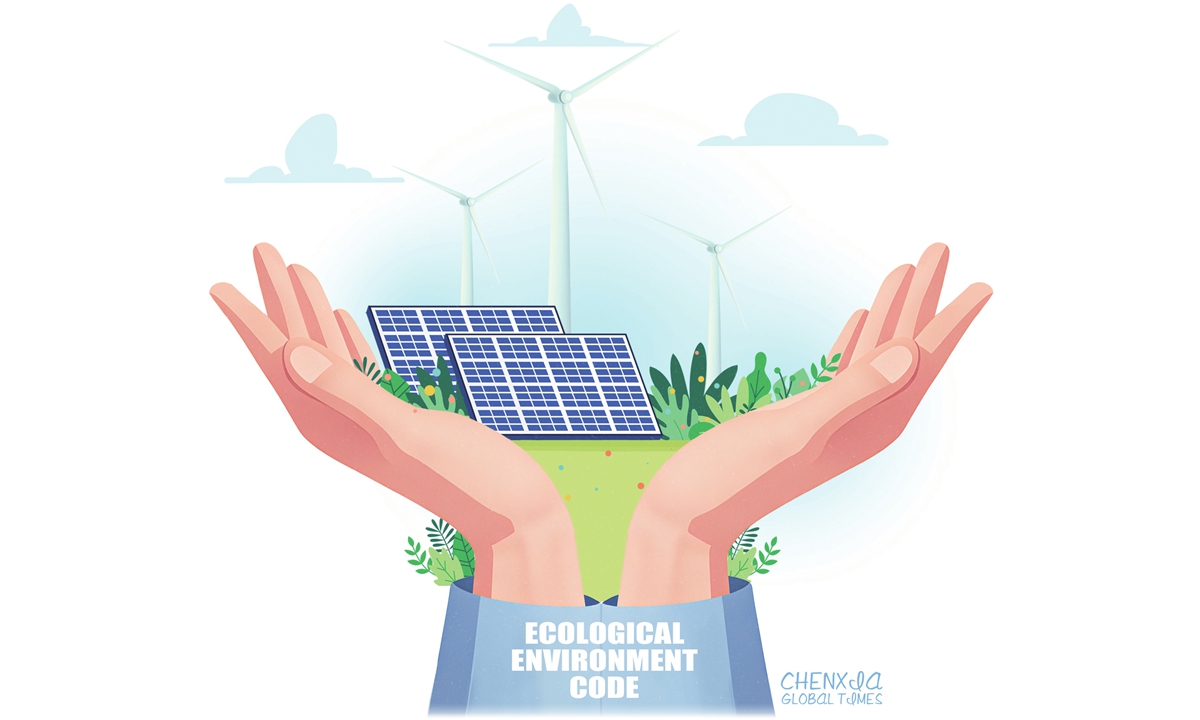
Illustration: Chen Xia/GT
The upcoming fourth session of the 14th National People's Congress is set to deliberate on the draft ecological environment code. As a highlight of the "two sessions," this code is expected to provide a solid legal guarantee for the nation's green transition at a critical stage in building a Beautiful China.
"Major strides in advancing the Beautiful China Initiative" are outlined as a key objective for economic and social development during the 15th Five-Year Plan (2026-30) period. The timely compilation of this code is significant for strengthening overall coordination. Notably, the draft ecological environment code includes a separate chapter on "green and low-carbon development," which represents a pioneering move globally, indicating that China is promoting its green transition in a more systematic and standardized manner.
Green and low-carbon development is a fundamental solution to ecological and environmental issues, while a high-quality ecological environment supports high-quality development. "The introduction of the code is intended to create a more robust and enduring framework for promoting green development in China. This will enable the green transition to become the underlying logic of development rather than a temporary choice," stated Jia Weilie, a professor at the Institute for Sustainability of Huzhou University and a researcher at the Budapest Centre for Long-term Sustainability, in an interview with the Global Times.
Since the start of the 14th Five-Year Plan (2021-25), China has vigorously promoted a comprehensive green transformation across economic and social sectors. Significant progress has been achieved in the green transition of industry, energy, transportation, urban and rural development, and consumption, laying a robust foundation for accelerating green and low-carbon development in the 15th Five-Year Plan period.
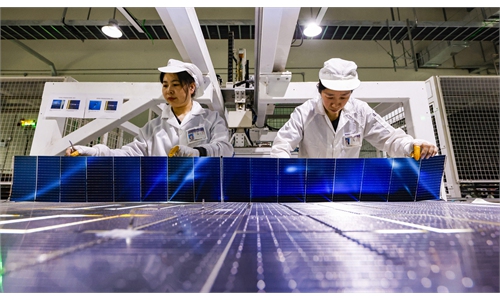
During the 14th Five-Year Plan, China constructed the world's largest and fastest-growing renewable energy system, increasing the share of installed renewable energy capacity from 40 percent to approximately 60 percent. The country also established the largest electric vehicle charging network globally, with production and sales of new energy vehicles ranking first worldwide for 10 consecutive years. Additionally, China has achieved the fastest improvements in air quality and the most significant increase in forest coverage. Its new-type energy storage capacity now leads the world, and over 40 percent of global new energy patents are held by China. These achievements underscore the higher quality and stronger innovation driving China's green development.
The 15th Five-Year Plan period will be crucial for advancing the Beautiful China Initiative and achieving substantial improvements in the ecological environment. As high-quality development enters a new phase, the green transition will encompass more complex structural areas, including energy system restructuring, industrial chain decarbonization, and territorial spatial planning optimization. This evolution requires more stable policy signals and robust legal support.
"The ecological environment code integrates mechanisms that were previously scattered across multiple laws into a cohesive legal system. This will help avoid institutional duplication and conflict, enhancing the coordination and stability of the legal framework while fostering a stronger institutional synergy to advance ecological civilization and build a Beautiful China," explained Bao Cunkuan, a professor in the Department of Environmental Sciences and Engineering at Fudan University, to the Global Times.
At a deeper level, the ecological environment code reshapes not only governance pathways but also a forward-looking value system. It transitions green production, lifestyles, and consumption from advocacy to regulation, establishing them as shared societal norms. In essence, the code's role extends beyond pollution control; it drives a comprehensive transformation of the country's development model, embedding green development as a core value of China in the new era.
From a global perspective, the worldwide green transition is reshaping the landscape of energy, industry, trade, and technology. The introduction of the ecological environment code reflects China's proactive adaptation to international trends and its commitment to enhancing institutional resilience. Additionally, it demonstrates to the international community China's rule-making contribution and governance capacity in global ecological governance.
With a more institutionalized and systematic framework, China's green transition is set to become more stable, clear, and sustainably driven. As the draft ecological environment code is submitted for deliberation at the "two sessions," China's green development is poised to advance to a higher level under the support of the rule of law. The vision of a Beautiful China is transitioning from initiative to institution, from aspiration to reality.
RELATED ARTICLES