Chinese Foreign Ministry responds intensively to Iran-related queries as US-Israeli military operation enters the third day
Regional war fears grow as US-Iran confrontation hardens
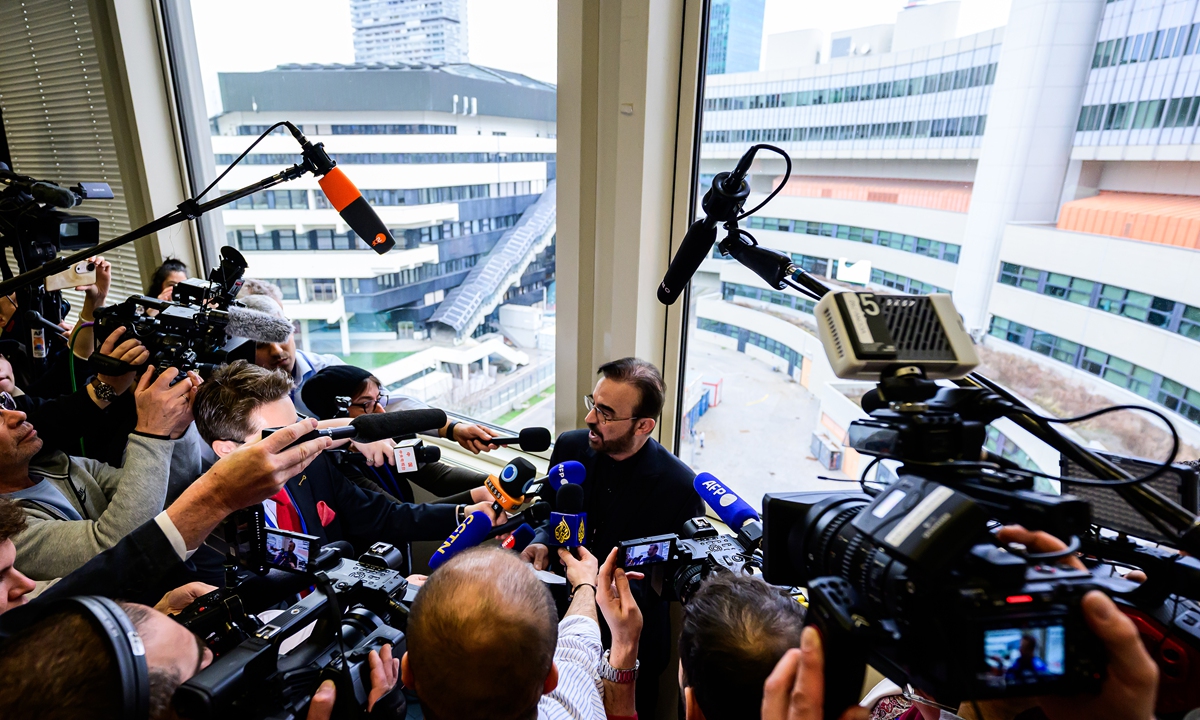
Iran's ambassador to the International Atomic Energy Agency (IAEA) Reza Najafi speaks to media during a meeting of the IAEA Board of Governors on March 02, 2026 in Vienna, Austria. Photo: VCG
As the US Israeli military operation against Iran entered its third day on Monday, fighting and mutual retaliatory attacks intensified, with rising casualties on all sides and growing risks of a wider regional war. Amid the tense situation, China has intensified diplomatic efforts.
Chinese Foreign Minister Wang Yi on Monday held intensive phone talks with counterparts of several countries. According to the Xinhua News Agency, Chinese Foreign Minister Wang Yi on Monday held phone calls with Iranian Foreign Minister Seyed Abbas Araghchi, French Foreign Minister Jean-Noel Barrot and Omani Foreign Minister Sayyid Badr bin Hamad Al Busaidi.
Wang affirmed China's support to Iran in safeguarding its sovereignty, security, territorial integrity and national dignity, during his phone call with Araghchi, urged joint efforts with France to de-escalate Middle East tensions when talking to Barrot. And he also said that the spillover of war does not serve the fundamental and long-term interests of the Gulf countries during the phone conversation with the Omani foreign minister.
Chinese Foreign Ministry spokesperson Mao Ning also elaborated China's position when responding on Monday a barrage of relevant questions, urging parties to stop the military operations and prevent further spread of the conflict. According to the Chinese Foreign Ministry web page of the Monday press conference, Mao took at least 11 questions concerning the situation in Iran.
Addressing a question of how China plays a role in preventing the US from carrying out unilateral actions, such as assassinating leaders of sovereign countries, Mao said that China is deeply concerned over the current situation. China firmly opposes the use of force in international relations or infringement on other countries' sovereignty and security. The priority now is to immediately stop military operations and prevent the spread and spillover of the conflict.
Mao also noted Monday that China was not notified about the US' military operations beforehand, when responding to a query on whether China had any contacts with the US side during or just before this military operation.
The spokesperson also confirmed at the Monday's press briefing that one Chinese citizen in Tehran had unfortunately been killed amid the ongoing military conflicts
According to the spokesperson, as of March 2 Beijing time, over 3,000 Chinese citizens have been evacuated from Iran. Chinese diplomatic missions in Iran's neighboring countries have sent working groups to receive and assist the evacuated Chinese citizens at border ports.
Exchange of words and missiles
Parties to the conflict exchanged threats and vows of revenge on the third day of the conflict, which was followed by intensified strikes on each other.
US President Donald Trump recorded a new video address on Sunday, vowing to avenge three American deaths after the strikes on Iran.
But he warned: "Sadly, there will likely be more before it ends. That's the way it is likely to be more. But we'll do everything possible where that won't be the case," according to the Guardian.
Trump also said the military operation will continue "until all of our objectives are achieved" and that more casualties are possible. In an interview, he said it could "take four weeks or less." The US president claimed he's agreed to speak with Iran and that the military operation is proceeding "ahead of schedule."
And according to Iran International, Israel's foreign minister claimed on Sunday that Israel and the US have set no timeline for their joint military campaign against Iran, describing the strikes that began on Saturday as an effort to weaken the country's leadership. Speaking to Euronews, Gideon Sa'ar said the operation would continue without a fixed end date.
Also showing a tough stance, Iranian security chief Ali Larijani said Tehran won't resume nuclear talks with Washington, denying a report that he had privately sought a diplomatic off-ramp amid the ongoing conflict with the US and Israel. "We will not negotiate with the United States," Larijani said in a post on X on Monday.
Larijani also wrote on X that "He [Trump] turned his self-made 'America First' slogan into 'Israel First' and sacrificed American soldiers for Israel's power-hungry ambitions."
Iran's Islamic Revolution Guards Corps (IRGC) said on Monday its missile strikes targeted Israeli Prime Minister Benjamin Netanyahu's office and the place of stay of Commander of the Israeli Air Force Tomer Bar, Xinhua News Agency reported citing a statement published on the IRGC official news outlet Sepah News. The IRGC said the "targeted and surprise" attacks were carried out using homegrown Kheibar ballistic missiles.
Iran's ambassador to the International Atomic Energy Agency (IAEA) Reza Najafi speaks to media during a meeting of the IAEA Board of Governors on March 02, 2026 in Vienna, Austria. Najafi said at an IAEA board of governors' extraordinary session that the key nuclear site Natanz had been attacked, without specifying further, AFP reported.
Loud explosions were also heard across the Gulf cities of Dubai, Doha and Manama as well as in Jerusalem on Monday, the Guardian reported.
Kuwaiti air defenses mistakenly shot down three US F-15 fighter jets, the US military said Monday, noting that all six aircrew members ejected safely and are in stable condition, per Xinhua.
The IRGC claimed it had targeted the USS Abraham Lincoln aircraft carrier with four ballistic missiles, saying its strikes against US forces had "entered a new phase" and that "land and sea will become more and more the graveyard of terrorist aggressors," Turkey's Anadolu Agency reported. However, such claim was denied US Central Command (CENTCOM) on Sunday, asserting the missiles "didn't even come close" to the Lincoln, which it said continued launching aircraft in support of attacks against Iran, per the report.
The IRGC has also reportedly destroyed the oil tanker Stena Imperative, which was flying the US flag, while it was in the port of Bahrain, Tehran Times reported. The vessel was hit by Iranian drone or missile fire on Monday, according to the Reuters and other outlets that cited the maritime security firm Vanguard Tech. There was no immediate comment from US authorities.
US military says four troops now confirmed dead on third day of war. "Four US service members have been killed in action" since the US and Israel launched their war on Iran, the US Central Command said Monday, raising the death toll reported on Sunday by one. The strikes have also killed at least 11 people in Israel, and the Iranian Red Crescent says 555 people have been killed in Iran, CBS News updated.
In a move that aligns themselves with the US led camp, France, Germany and the UK said Sunday they were ready to defend their interests and those of its allies in the Gulf if necessary by taking "defensive action" against Iran, according to France 24.
Aftermath of the conflict
In a brief telephone interview with The New York Times, Trump offered several seemingly contradictory visions of how power might be transferred to a new government — or even whether the existing Iranian power structure would run that government or be overthrown, according to The New York Times report on local Sunday.
From Tehran's perspective, the US has repeatedly used the promise of talks as a lure, only to renege, eroding Iran's trust in the very idea of diplomacy, Ding Long, a professor at the Middle East Studies Institute of Shanghai International Studies University, told the Global Times.
Judging from past experience, as long as Iran retains even a minimal capacity to resist, it is likely to continue doing so - after all, it remains a country with significant strategic depth, said Ding.
Yet many are questioning the US ability to control a sustained war and whether its strategic goals can be achieved.
In Iran, the killing of Khamenei and many in his inner circle risks triggering a wider regional conflict that could destabilize the country and mire the US in another war in the Middle East, wrote the Wall Street Journal, noting that its also one constrained by hard logistics. The US military is burning through scarce air-defense interceptors faster than it can replace them, raising concerns about how long it can sustain this tempo while continuing to protect US forces and partners from retaliation.
In an article published on the Economist, it said that "when the only organizing principle is American might, the Trumpian strategy could also cause a spiral of anarchy and violence. Conflicts may multiply. The government in Washington may not have the appetite - or the capacity - to control them."
The magazine said that if the Iranians suffer from misery, "do not expect Mr Trump to step in. His main work is almost done."
"The US has already broken with established international norms," Lü Xiang, a research fellow at the Chinese Academy of Social Sciences, told the Global Times. "It launched the war abruptly in the midst of negotiations and killed the leader of another country."
Lü said Washington's apparent objective of forcing regime change is unlikely to be achieved quickly, noting that Iran had long ago put in place mechanisms for a rapid leadership transition. He added that any effort to cripple Iran's military capabilities would require a prolonged campaign, not a short operation.
RELATED ARTICLES