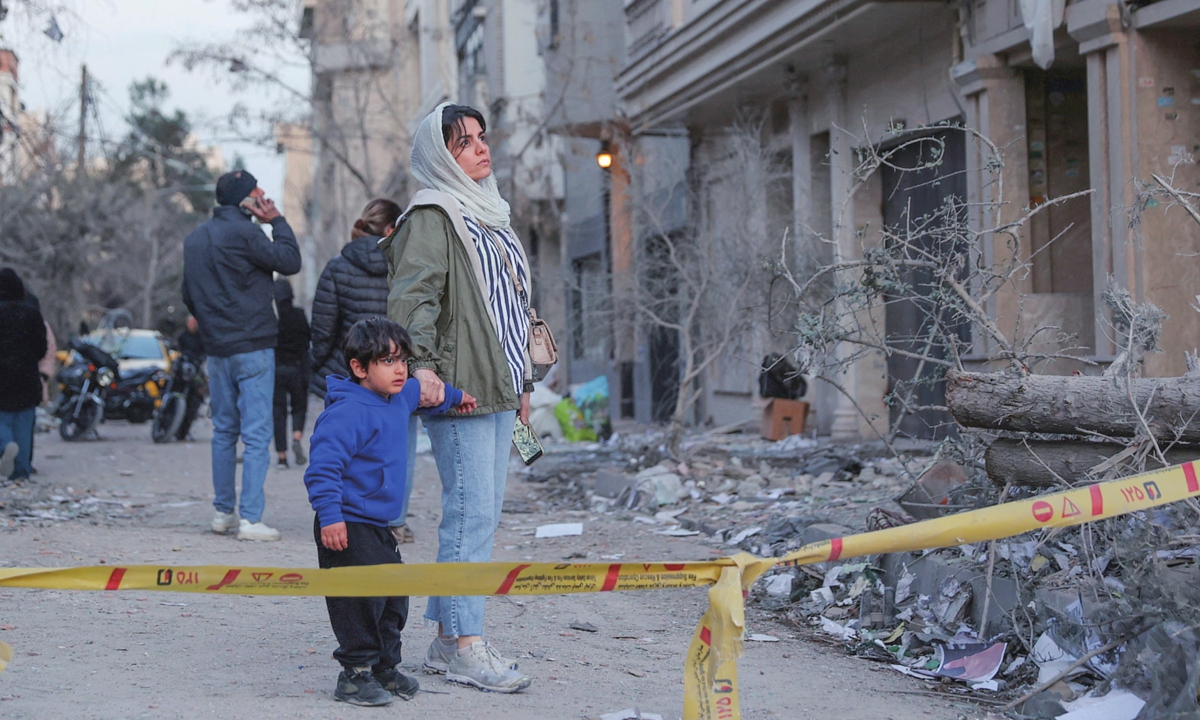
Dozens of government institutions in central Tehran were struck, and the police headquarters was heavily damaged during US and Israeli airstrikes on March 2, 2026. Photo: IC
Editor's Note:
The US-Israel strikes on Iran, which began on Saturday, have sent shockwaves around the globe. The operations and ongoing hostilities have fueled fears of a wider war and caused further damage to the international order. In her I-Talk show, Global Times (GT) reporter Wang Wenwen talked to Jeffrey Sachs (Sachs), a renowned US scholar and director of the Center for Sustainable Development at Columbia University, and Sara Flounders (Flounders), a political writer and activist for over 50 years in the US, to unpack the deeper geopolitical implications of the US-Israel strikes.
GT: How do the US actions contradict what it claims as "rules-based" order?
Sachs: We have no normal constitutional order in the US. Under the US constitution, it is congress that has the power to declare war. But we have all of these decisions coming from the president and presumably the CIA behind him. This is not in any way a legally based government, and it is a very dangerous one. It is led by an extremely militaristic ideology. The US has displayed only contempt for the UN Charter. This is, again, very dangerous. The US has abandoned the UN system.
Flounders: This was an absolutely criminal attack, planned in advance, at a time when every form of negotiation was underway. It is against the rules of international law, US law, and even diplomatic protocols. This is total lawlessness. The rules-based order meant the US made the rules and everyone followed or was ordered to follow. But now, there're no rules whatsoever. It's total lawlessness and unpredictability, creating provocations where there was no need.
GT: The attacks on Iran reflect a broader attempt by the US to maintain strategic control and hegemony over the Middle East, particularly its oil resources. Do you think this goal can be achieved?
Sachs: This is the goal. The US is trying to control the oil of the Americas, and that's why it invaded Venezuela. And it is trying to control the oil of the Middle East.
I don't think that the US has the means to defeat Iran. I would expect that Iran will be backed by countries in different parts of the world as it fights this war. But one of the major issues will come in the next few weeks. Iran has powerful missiles. The US has missile defenses, but they are limited in number. So there's a big debate about whether the missiles or the missile defenses will last longer. This is one of the military questions that's at stake.
The US is trying to take over the Middle East and put Israel in charge of the Middle East. In the short term, it could be feasible, but I think it's very unlikely [in the long term]. It seems that what is more likely is violence, war, chaos, and instability. This is mostly what happens when the US and Israel go to war, whether it's in Libya, Sudan, Somalia, Lebanon, Syria, Iraq, Iran, or Yemen. They don't win, but they do create a tremendous amount of suffering and chaos.
Flounders: I really think this is a desperate effort of the US to reverse by military means what they can no longer accomplish with their economic productivity. The US is in a position of complete decline, and it will understand this, and it is trying with all-out war to reverse. This cannot be accomplished. Sanctions, war or tariffs will not return its position in the world today, but it does show the US desperation and it will not succeed. What it has accomplished is to inflame the people of the whole region who are striking back with what they have.
GT: The strikes on Iran have led to widespread speculation about the possibility of World War III. What do you think could be the trigger for the conflict to escalate into a broader war?
Sachs: We already have a kind of World War, because there's war in the Americas, there's war in the Middle East, there's a European and US war with Russia in Ukraine, there's a war in Asia between Pakistan and Afghanistan. This is low level, but it's very serious and risky. The US is a rogue state that does not engage in diplomacy. It tries to kill the counterparts even during the negotiations. In this sense, it's an extremely dangerous situation.
Flounders: It is already quite a broad war involving about 12 to 15 countries in the immediate region. It could definitely go wider because Israel and the US feel they can't afford to lose. So it's a very dangerous moment.
GT: Some Western governments signaled support, directly or indirectly, for the joint US-Israel strikes on Iran, demonstrating that "the fist of my ally is the fist of justice." In your view, is the world order rules-based or alliance-based?
Sachs: I have to admit the European states are simply vassals of the US. Whatever the US does, Europe almost says the same thing at the UN Security Council. So this is not exactly a rules-based system. This is a bit of a travesty.
The world order is alliance-based because the US has abandoned any attempt at establishing rules. Now, what has happened is actually rather straightforward. If the US has military bases in a country, that country behaves like a vassal state of the US. So this is a real issue, very serious one. The CIA operates there, the military operates there. They are afraid of being overthrown or destabilized by the US.
Flounders: The world today is US-terror based. It wants to create an air of complete unpredictability so that every country must bow down and fear the US. Throughout the whole region, it is trying to re-conquer and re-colonize the globe. Will that succeed? I don't think there's any chance of that in this day and age, but that's what it is attempting to do - to re-colonize the world completely under its domination.
GT: What political, economic or diplomatic means can peace-loving countries use to effectively counter the unilateral military actions of the US and create conditions for the peaceful resolution of conflicts?
Sachs: I hope that the Shanghai Cooperation Organization and BRICS will hold emergency meetings together to emphasize the unity of these large entities. That's very important - to avoid being pulled apart by the US forces. I would like to see cooperation between China and India, for example, to say to the US and the world that they are defending peace and multilateralism and are not allowing themselves to be undermined by US actions.
The US cannot go it alone. Its strategy is divide and conquer. It aims at individual places, and it tries to bully them. This is how empires behave and the US is an empire that operates on the old principle of divide and conquer. If the rest of the world says, "no, we are united in principle and we're not going to be divided," then it's possible that the bully is pushed back.
Flounders: In West Asia, there is a real understanding that it will take resistance at every level within the entire population and at enormous cost, but they can no longer accept the old ways. And certainly, you can see this in Palestine today. We will see uprisings and rebellions in this region against the entire order. The US has lit the fuse. This is a war on all the formerly colonized countries that will not accept this racist arrogance, this economic and political dominance, and this enforced underdevelopment. They have every right to lead healthy, fulfilling lives for the whole population. This is what the struggle is about on a global scale.
RELATED ARTICLES