ARTS / CULTURE & LEISURE
Neolithic color palettes discovered in Shanxi Xiyin village site
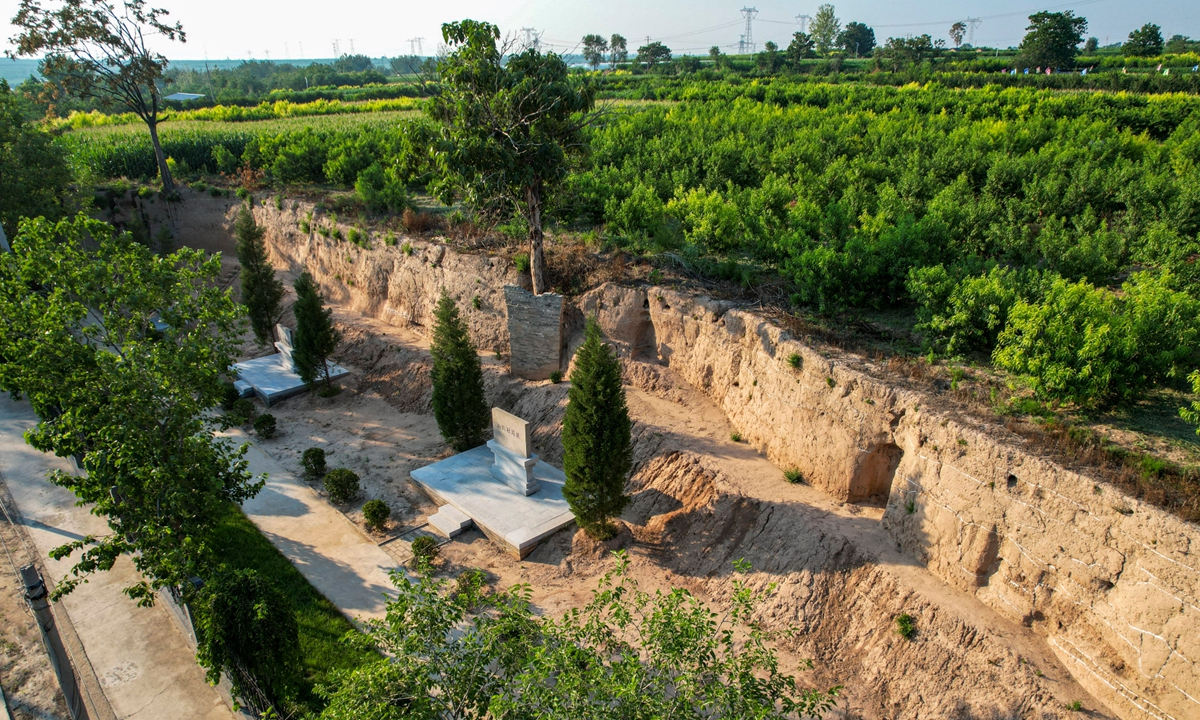
The Xiyin village site in Yuncheng, North China's Shanxi Province Photo: VCG
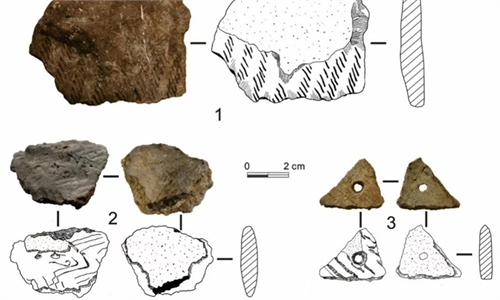
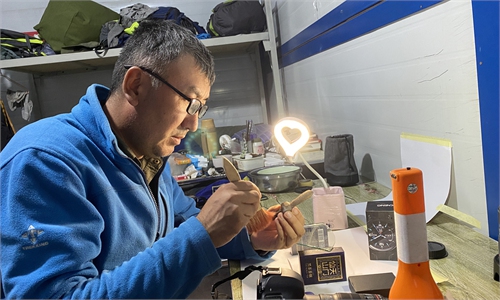
Including a Neolithic pigment palette, several new discoveries at the Xiyin village site have recently been revealed. Located in Yuncheng, North China's Shanxi Province, the site is the first archaeological excavation project independently led by Chinese archaeologists.At the Xiyin village site, archaeologists unearthed a set of ancient art tools, including a stone slab, a stone grinding rod, and several palettes with pigment residue. "The set was used to prepare pigments for painting pottery," said Wu Yangyang, the project's lead. "With them, we can trace a rather complete production chain of Neolithic painted pottery."
Both the stone slab and the grinding rod were found covered in dark red pigment. Through analysis, researchers identified the pigment as hematite powder. The "color palettes" archaeologists discovered turned out to be fragments from the belly of a pointed-bottom ceramic bottle.
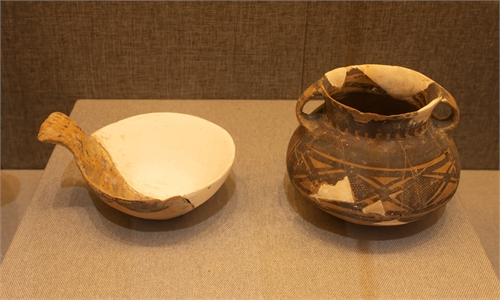
"Those ancient pottery creators first mixed hematite powder with other substances on the palettes, then applied or painted it onto pottery basins. After firing, patterns and drawings on these basins turned a shiny black," Wu explained.
"The black-colored pattern is a signature feature of pottery from both the Yangshao and Miaodigou cultures," Cui Siming, a Neolithic specialist, told the Global Times. "The presence of these patterns also attests to the rich cultural layers of the site."
Covering an area of 360,000 square meters, the Xiyin village site contains remains from the Yangshao culture and the early cultures of the Miaodigou, Longshan, and early Shang Dynasty (c.1600BC-1046BC) periods, with the majority belonging to the middle phase of the Yangshao culture.
Beyond the intricate patterns and diverse forms of the pottery relics unearthed at the site, other significant discoveries include perforated stone knives, pottery rings, and stones carved like silkworm chrysalises. According to Wu, these artifacts reveal that, as early as the Yangshao period, ancient people "had already mastered exquisite craftsmanship, which had become an integral part of their daily lives."
In July 2025, archaeologists started the third excavation of the site. Covering 500 square meters, the excavation has primarily focused on the remains of the middle Yangshao period. In addition to cultural relics, the team has also uncovered remnants of a double-ring trench structure. This discovery will play a key role in understanding the settlement layout and functions of the various zones at the Xiyin site.
Prior to the 2025 excavation, the site was first unearthed in 1926 by two Chinese archaeologists, Li Ji and Yuan Fuli. Among the discoveries were not only a large number of painted pottery pieces but also half of a cut silkworm cocoon made of silk.
"It was our most interesting find. It was half of a sliced, silk-like cocoon shell. Examined under a microscope, the cocoon shell was already half-decayed, yet it still glistened. The cut by the ancestors was extremely neat," wrote Li.
Subsequent research confirmed that this cocoon belonged to a wild ancestor of the domesticated silkworm. This finding strongly supports the identification of this area as a key birthplace of silkworm farming and mulberry tree cultivation by the ancient ancestors of the Chinese people.
RELATED ARTICLES